The national coat of arms of Spain is far more than a simple governmental logo; it is a meticulously constructed historical mosaic. Every quadrant, color, and symbol represents a specific kingdom, dynasty, or historical turning point that contributed to the formation of the modern Spanish state. To look at this emblem is to read a compressed visual history of Iberian political unification and the country's transformation into a global empire.
The Territorial Assembly: The Five Kingdoms
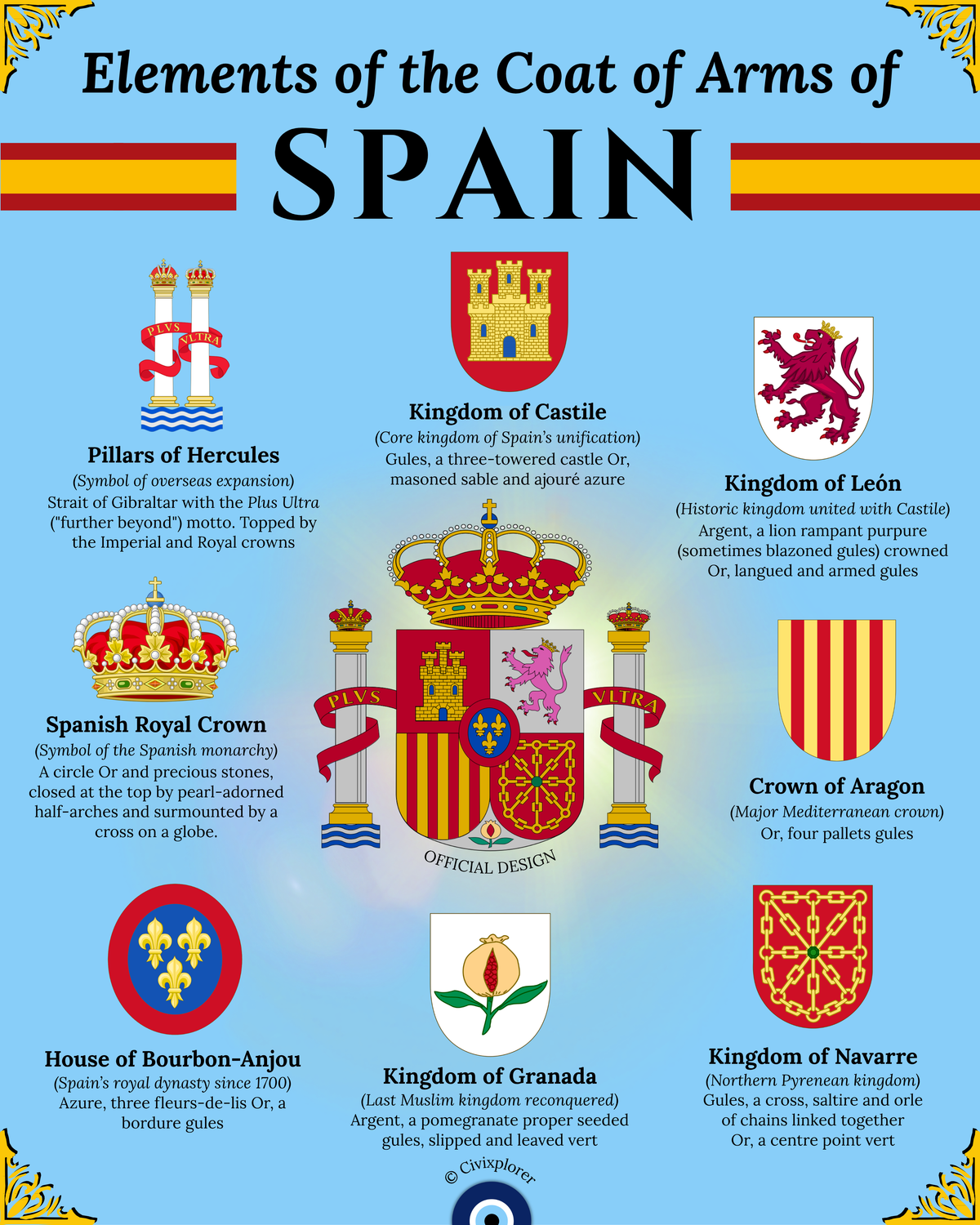
The main shield is divided into quarters, representing the medieval kingdoms that merged over centuries to form Spain. This unification was driven primarily by the Reconquista, the long campaign by Christian kingdoms to recapture territory from Moorish rule.
- The Kingdom of Castile: Represented by a three-towered golden castle on a red field. As the linguistic and political engine of unification, the castle symbolizes the many fortresses built during the frontier wars.
- The Kingdom of León: Featuring a purple rampant lion on a silver background. León was an influential early Christian kingdom that permanently united with Castile in 1230. The use of purpure (purple) is a rare and distinct heraldic choice in European history.
- The Crown of Aragon: Defined by four red vertical stripes on a gold background, known as the Senyera. The marriage of Isabella I of Castile and Ferdinand II of Aragon in 1469 provided the foundational act of modern Spain, bringing with it a vast Mediterranean maritime empire.
- The Kingdom of Navarre: Displaying golden chains on a red background. This design is famously linked to the Battle of Las Navas de Tolosa in 1212, where King Sancho VII supposedly broke the slave-chains guarding the Almohad Caliph's tent.
- The Kingdom of Granada: Found at the bottom point of the shield, represented by a pomegranate. This marks the fall of the last Muslim stronghold in 1492. The pomegranate is a classic example of canting arms, a heraldic pun on the Spanish word for the fruit, granada.
The Dynastic Center: The House of Bourbon
At the very heart of the shield sits a small blue escutcheon with three golden fleurs-de-lis. This represents the House of Bourbon-Anjou, the current reigning royal family. This dynasty arrived in Spain in 1700, following the death of the last Habsburg monarch, which triggered the War of the Spanish Succession. While the territorial quarters represent the land, this central symbol represents the dynastic legitimacy of the constitutional monarchy.
Symbols of a Global Empire: The Pillars of Hercules
Flanking the shield are two columns representing the Strait of Gibraltar, the ancient boundary of the known world. Traditionally, these pillars bore the warning Non Plus Ultra (Nothing Further Beyond). However, following the voyages of Christopher Columbus, King Charles I (Holy Roman Emperor Charles V) inverted this concept.
The banner wrapping the pillars now reads "PLVS VLTRA" (Further Beyond), a bold declaration that Spain had shattered ancient geographic limits to build a trans-oceanic empire. Notably, the two pillars are topped with different crowns—the Imperial Crown and the Royal Crown—signifying the dual role of the monarch as both the head of the Holy Roman Empire and the King of Spain.
A Living Record of Sovereignty
The composition is topped by the Spanish Royal Crown, representing national sovereignty and the continuity of the state. Unlike many European emblems that simplified over time, Spain’s coat of arms retains its multi-layered medieval structure. It serves as a reminder that Spain was built through the aggregation of distinct identities, preserving its political memory in a single, powerful image.

Comments (0)
Join the Conversation
Login to share your thoughts with the community.
Login to Comment