
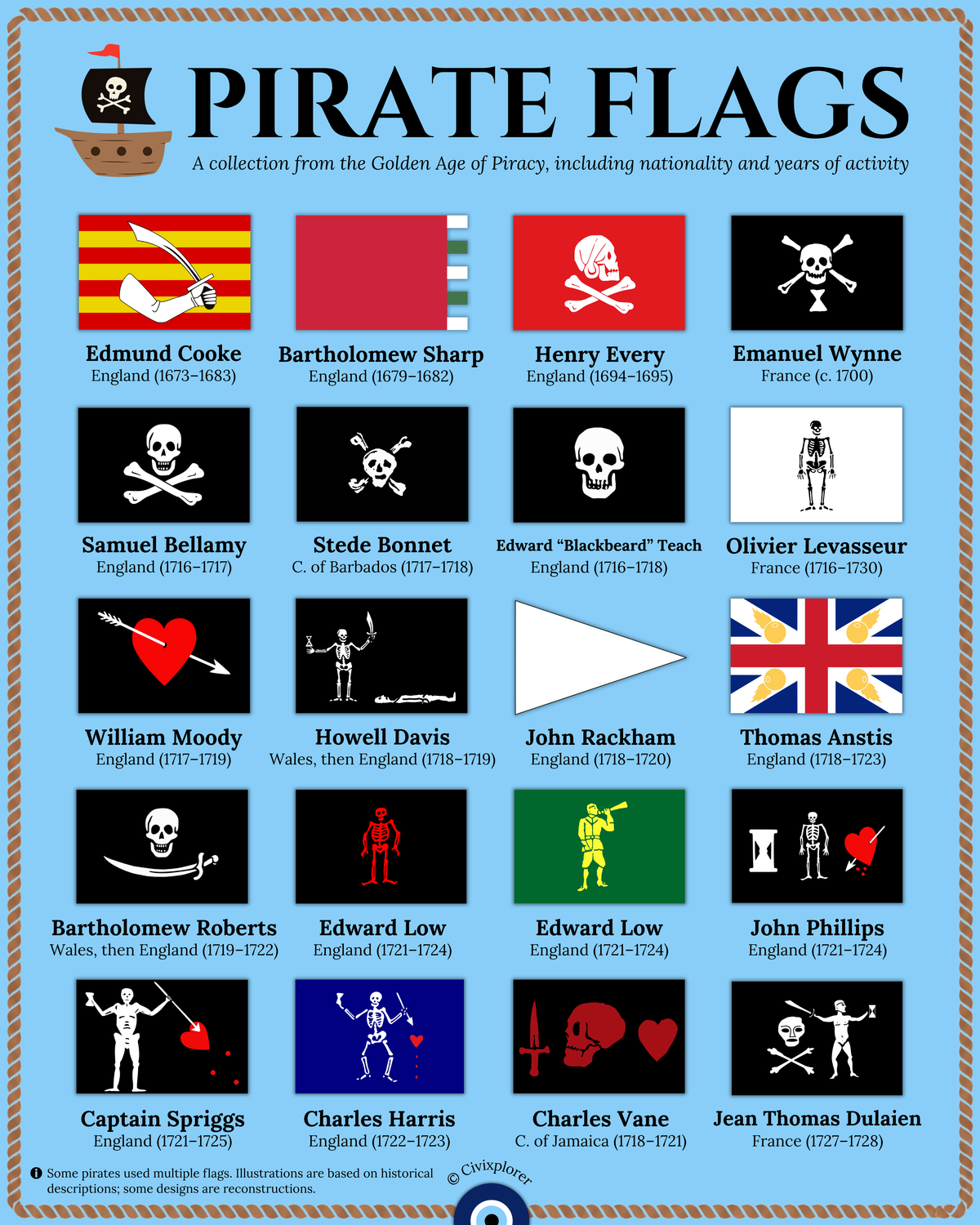
The history of pirate flags reveals a sophisticated system of psychological warfare designed to force merchant vessels into immediate surrender without a single shot being fired. Rather than flying a single standardized emblem, sea raiders of the Golden Age of Piracy employed a flexible visual vocabulary of mortality—ranging from skulls and active skeletons to hourglasses, cutlasses, and bleeding hearts. This visual signaling evolved significantly over time. Late seventeenth-century buccaneers like Edmund Cooke and Bartholomew Sharp carried colorful company standards and striped flags resembling military ensigns rather than terror banners. By the turn of the eighteenth century, captain Emanuel Wynne raised one of the earliest documented black ensigns featuring a death's head, crossed bones, and an hourglass, signaling a major shift toward death-themed intimidation.
Far from being purely decorative, these banners operated as a precise tactical communication network at sea. Pirates displayed black flags as an initial warning to intimidate targets, while raising a red flag—often known as the Pavillon Sans Quartier—to signal that no mercy or quarter would be given if the merchant ship resisted. Pirates like Edward Low and Francis Spriggs even shared terrifying motifs across connected crews, such as red figures of Death or pierced bleeding hearts, demonstrating that designs were often group emblems rather than unique personal logos. Furthermore, captains frequently raised false national ensigns to approach unsuspecting vessels before hoisting their true colors, using flags as adaptable tools of maritime deception.
Despite the enduring popularity of classic pirate imagery, a surprising number of iconic flags are modern fabrications created centuries after the Golden Age. For instance, the famous skull and crossed cutlasses long attributed to Calico Jack Rackham never appeared in historical trial records, which instead document his ship flying a plain white pennant. Similarly, the elaborate horned skeleton spearing a bleeding heart associated with Blackbeard originated in twentieth-century literature rather than eighteenth-century eyewitness accounts, which simply record him using standard black flags with a death's head. Even the black banner with a red dagger and skull linked to Charles Vane was actually created as a modern television prop for the show Black Sails. Real historical evidence, such as the well-documented death's head and cutlass of Bartholomew Roberts, demonstrates that authentic pirate flags were far more varied, strategic, and fascinating than Hollywood folklore suggests.

Comments (0)
Join the Conversation
Login to share your thoughts with the community.
Login to Comment