
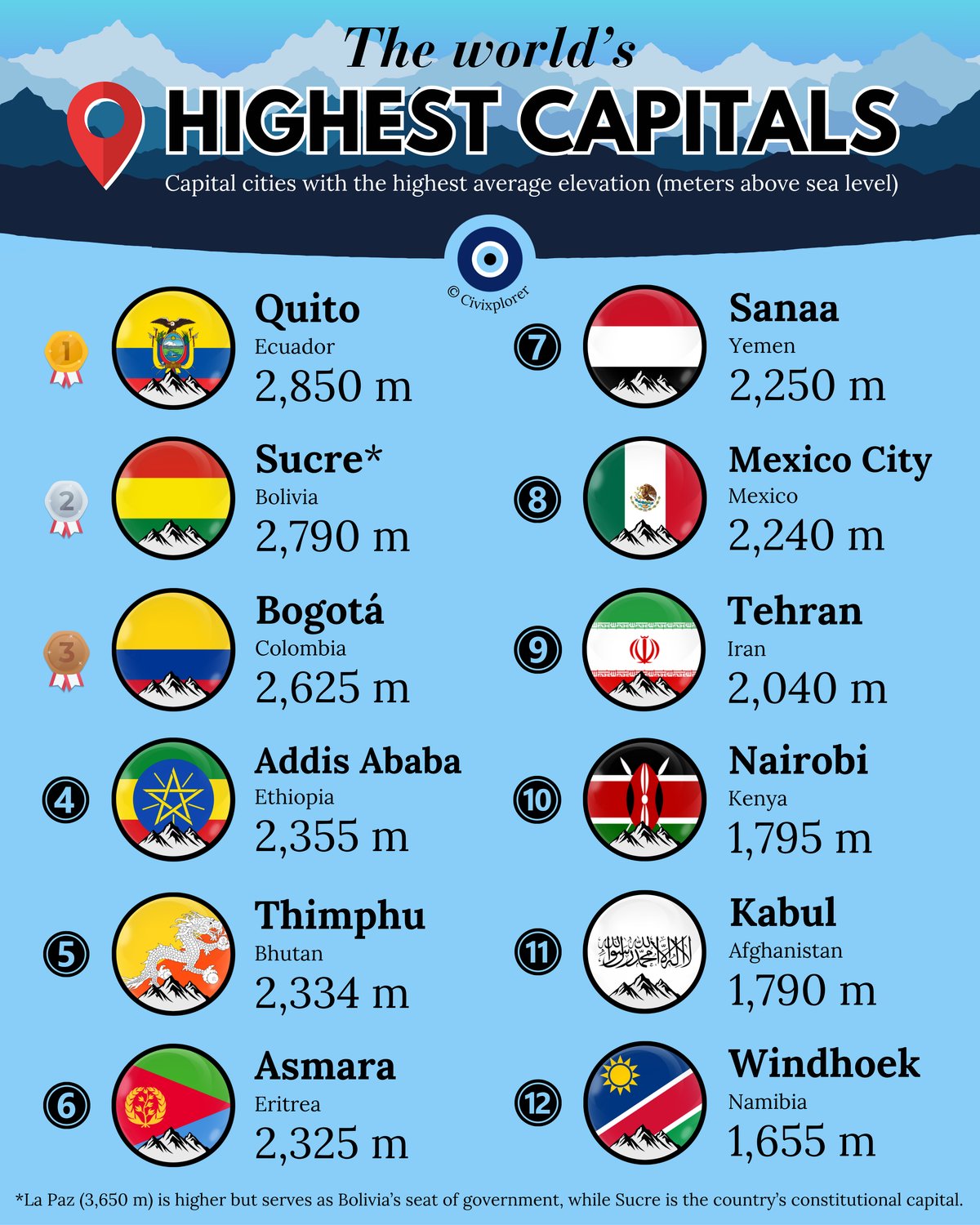
The distribution of the world’s highest capital cities reveals a striking geographical reality: the most elevated seats of power are overwhelmingly concentrated in just a few major mountain systems, including the Andes, the Ethiopian Highlands, and the Himalayas. While most global cities are founded in lowlands to favor trade and agriculture, these high-altitude capitals exist because unique historical, political, and climatic circumstances outweighed the challenges of thin air.
The Andean Domination and the Gold Medalist
The top of the ranking is dominated by the northern Andes. Quito, Ecuador, stands as the world’s highest official national capital at 2,850 meters (9,350 ft). Its location is remarkable; despite sitting almost directly on the Equator, its extreme elevation produces a "permanent spring" climate, protecting residents from the intense tropical heat found at lower altitudes. Close behind are Sucre and Bogotá, completing a trio of Andean cities that have served as regional hubs since pre-Columbian times. Bogotá is particularly noteworthy as a high-altitude megacity, housing nearly 12 million people at an elevation where most struggle to catch their breath.
The Bolivian Anomaly: Sucre vs. La Paz
A critical distinction in this ranking is the status of Bolivia. While Sucre (2,790 m) is the constitutional capital and seat of the judiciary, La Paz serves as the administrative seat of government. If the ranking considered seats of government rather than official capitals, La Paz would be the undisputed champion at 3,650 meters (11,975 ft). This dual-capital system is the result of the Federal War of 1898–1899, a conflict that shifted political power toward the tin-mining elites of the north while leaving the symbolic title of capital to the historic "White City" of Sucre.
Why Build So High? Disease, Defense, and Climate
The concentration of these capitals is no accident. In tropical latitudes, high-altitude basins provided a sanctuary from vector-borne diseases like malaria and yellow fever, which historically plagued humid lowlands. Pre-Columbian civilizations, such as the Inca and Aztecs, established empires in these temperate highlands because the climate supported intensive agriculture and offered natural defensive barriers. Spanish colonizers later co-opted this infrastructure, building their administrative centers directly over conquered indigenous hubs like Mexico City (2,240 m) and Quito.
A similar logic applies to Africa’s highest capitals. Addis Ababa (2,355 m) was chosen by Emperor Menelik II for its moderate climate and mineral springs, while Nairobi (1,795 m) was favored by British colonial planners who deemed the "White Highlands" more hospitable for European settlement than the sweltering coast.
The Modern Challenges of Living at the Peak
Living at these elevations presents unique physiological and logistical hurdles. Residents in cities like Thimphu or Kabul exist in an environment where atmospheric pressure is significantly lower, leading to evolutionary adaptations such as increased lung capacity. However, for modern infrastructure, altitude can be a liability. Mexico City, built on the former bed of Lake Texcoco, faces a severe subsidence crisis, where the combination of groundwater extraction and soft soil causes parts of the city to sink by up to 50 centimeters per year. Furthermore, in bowl-shaped valleys like Tehran, temperature inversions can trap urban pollution, turning geographical sanctuaries into environmental traps.
Ultimately, these twelve cities are living archives of human resilience, proving that the desire for a temperate, defensible, and fertile environment can lead civilizations to thrive at the very roof of the world.
| Rank | Country | Capital City | Elevation (Meters) | Elevation (Feet) |
|---|---|---|---|---|
| 1 | Ecuador | Quito | 2,850 | 9,350 |
| 2 | Bolivia | Sucre | 2,790 | 9,154 |
| 3 | Colombia | Bogotá | 2,625 | 8,612 |
| 4 | Ethiopia | Addis Ababa | 2,355 | 7,726 |
| 5 | Bhutan | Thimphu | 2,334 | 7,657 |
| 6 | Eritrea | Asmara | 2,325 | 7,628 |
| 7 | Yemen | Sanaa | 2,250 | 7,382 |
| 8 | Mexico | Mexico City | 2,240 | 7,350 |
| 9 | Iran | Tehran | 2,040 | 6,693 |
| 10 | Kenya | Nairobi | 1,795 | 5,889 |
| 11 | Afghanistan | Kabul | 1,790 | 5,873 |
| 12 | Namibia | Windhoek | 1,655 | 5,430 |
| 13 | Lesotho | Maseru | 1,673 | 5,489 |
| 14 | Rwanda | Kigali | 1,567 | 5,141 |
| 15 | Guatemala | Guatemala City | 1,529 | 5,016 |
| 16 | Burundi | Gitega | 1,504 | 4,934 |
| 17 | Zimbabwe | Harare | 1,483 | 4,865 |
| 18 | Nepal | Kathmandu | 1,400 | 4,593 |
| 19 | Mongolia | Ulaanbaatar | 1,350 | 4,429 |
| 20 | Madagascar | Antananarivo | 1,288 | 4,226 |
| 21 | South Africa | Pretoria | 1,271 | 4,170 |
| 22 | Zambia | Lusaka | 1,270 | 4,167 |
| 23 | Eswatini | Mbabane | 1,243 | 4,078 |
| 24 | Uganda | Kampala | 1,190 | 3,904 |
| 25 | Costa Rica | San José | 1,146 | 3,760 |
| 26 | Honduras | Tegucigalpa | 1,120 | 3,675 |
| 27 | Brazil | Brasília | 1,079 | 3,540 |
| 28 | Malawi | Lilongwe | 1,024 | 3,360 |
| 29 | Andorra | Andorra la Vella | 1,023 | 3,356 |
| 30 | Tanzania | Dodoma | 1,010 | 3,299 |
| 31 | Armenia | Yerevan | 989 | 3,246 |
| 32 | Botswana | Gaborone | 983 | 3,225 |
| 33 | Turkey | Ankara | 938 | 3,077 |
| 34 | Venezuela | Caracas | 935 | 2,982 |
| 35 | Jordan | Amman | 900 | 2,953 |

Comments (0)
Join the Conversation
Login to share your thoughts with the community.
Login to Comment