
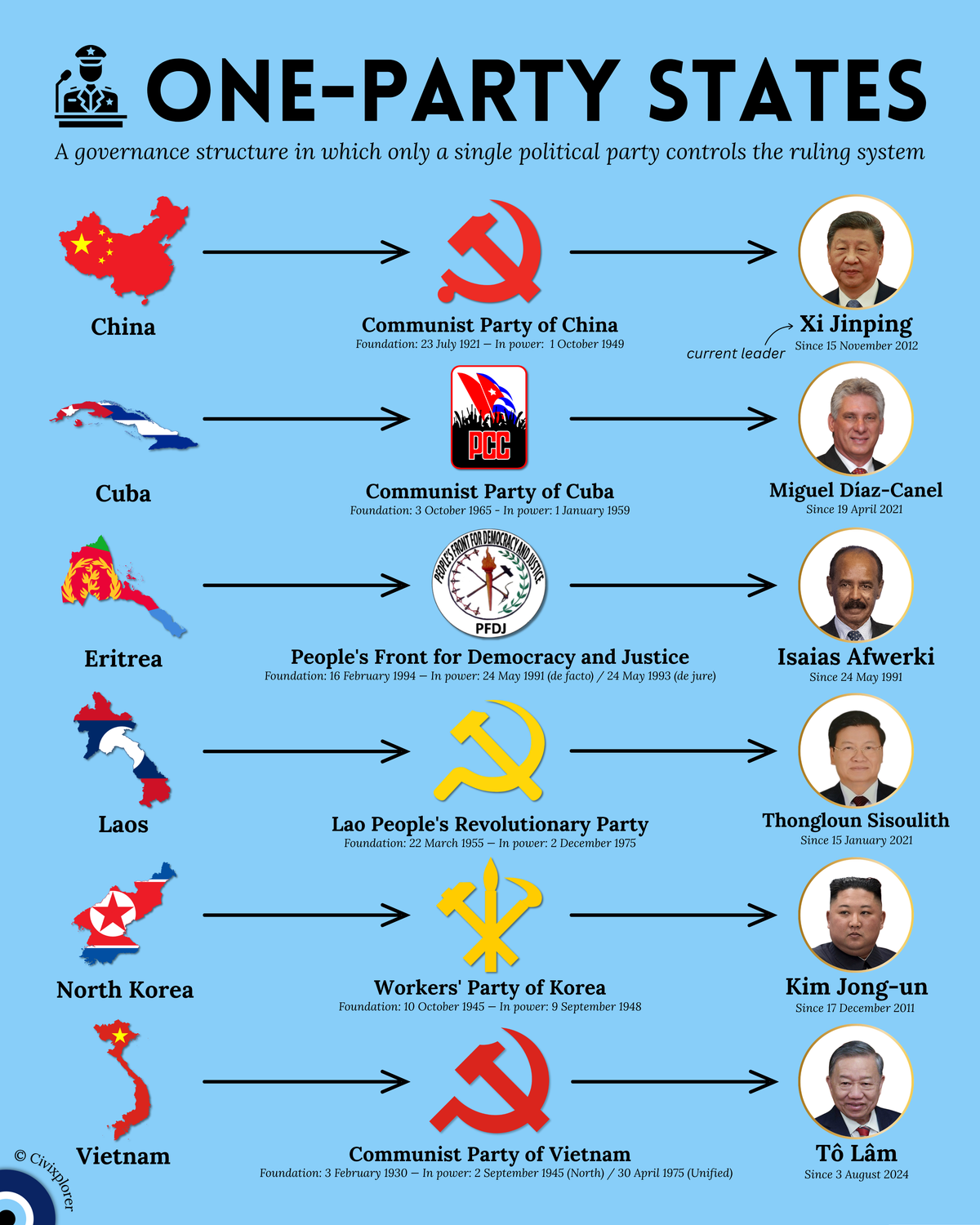
Across the modern political landscape, six nations operate under systems widely recognized as official one-party states, where a single political organization holds decisive control over national power without facing realistic competitive elections. These countries—China, Cuba, Eritrea, Laos, North Korea, and Vietnam—are institutionalized so that no organized political opposition can replace the ruling party. However, a closer look reveals that a single-party ruling system does not always mean that only one party exists legally. In China, for instance, eight non-Communist satellite parties participate in political consultation while accepting the explicit leadership of the Communist Party of China. Similarly, North Korea maintains two minor satellite organizations within a unified front, even though its constitution dictates that all state activities are conducted under the Workers' Party of Korea.
The ideological foundations of these six states showcase both shared revolutionary roots and striking outliers. Five of the six nations emerged from twentieth-century Marxist-Leninist revolutions or national-liberation struggles, visually preserving their proletarian heritage through the hammer and sickle emblem. North Korea uniquely adapts this emblem by incorporating a traditional Korean writing brush, explicitly bringing intellectuals into its foundational Juche framework alongside workers and peasants. Meanwhile, Eritrea stands as the sole non-Communist outlier on the list. Ruled by the People's Front for Democracy and Justice, Eritrea operates as a nationalist, post-independence state where President Isaias Afwerki has governed by decree since 1991 without holding national elections or implementing the ratified 1997 constitution.
Beyond their emblems, these regimes demonstrate contrasting governance, economic strategies, and succession models. Nations like China, Vietnam, and Laos have successfully integrated market-oriented economic reforms while maintaining total political monopolies, using disciplined party congresses and politburo consensus to manage leadership transitions. This is evident in Vietnam, where Tô Lâm assumed dual party and state leadership to consolidate authority. Conversely, Cuba transitioned leadership from the Castro family to President Miguel Díaz-Canel while reinforcing the Communist Party's unique constitutional status. North Korea stands alone in combining Communist party structures with a hereditary dynastic succession under Kim Jong Un. Together, these six surviving systems highlight how dominant ruling parties merge party and state power to maintain long-term authority across diverse historical contexts.

Comments (0)
Join the Conversation
Login to share your thoughts with the community.
Login to Comment