
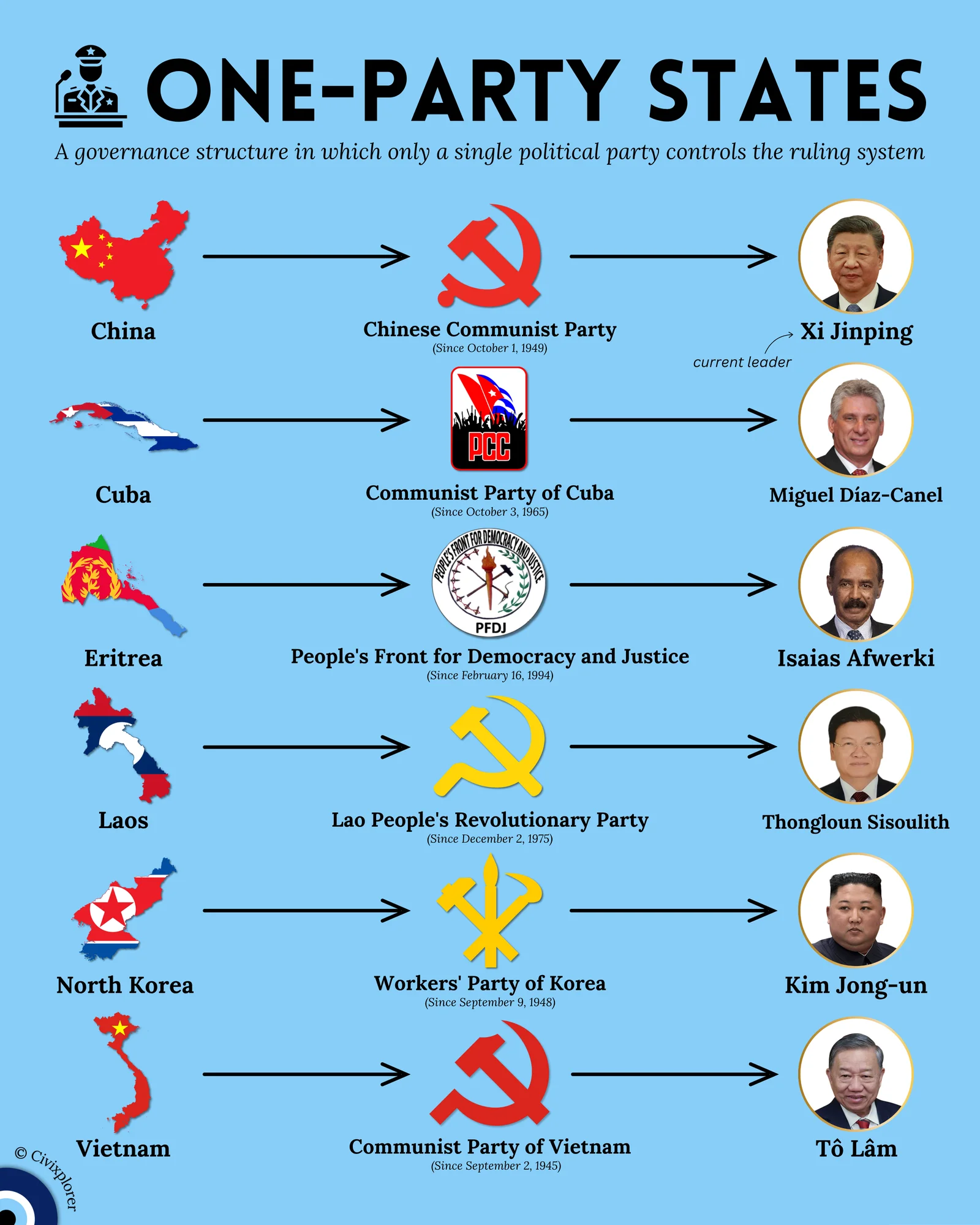
One-party states are a unique form of governance where a single political party controls all aspects of the ruling system, often suppressing opposition and limiting competitive elections.
These countries, mainly formed post-World War II, are largely guided by Marxist-Leninist principles, though Eritrea stands out for its nationalist statism. In these regimes, power is concentrated in one entity, with no political opposition allowed and limited space for dissent. The role of these parties often extends beyond just ideology, forming a critical part of the national identity and political survival.
The roots of these one-party systems trace back to mid-20th-century revolutionary movements, shaped by Cold War geopolitics and decolonization struggles. China and Vietnam implemented reforms in the late 20th century, allowing for economic liberalization while keeping tight control over political freedom. In contrast, North Korea’s dynastic rule under the Workers' Party of Korea and Eritrea’s post-independence state control have evolved into some of the world’s most isolated and authoritarian regimes, with limited engagement with the international community.
Comments (0)
Join the Conversation
Login to share your thoughts with the community.
Login to Comment