
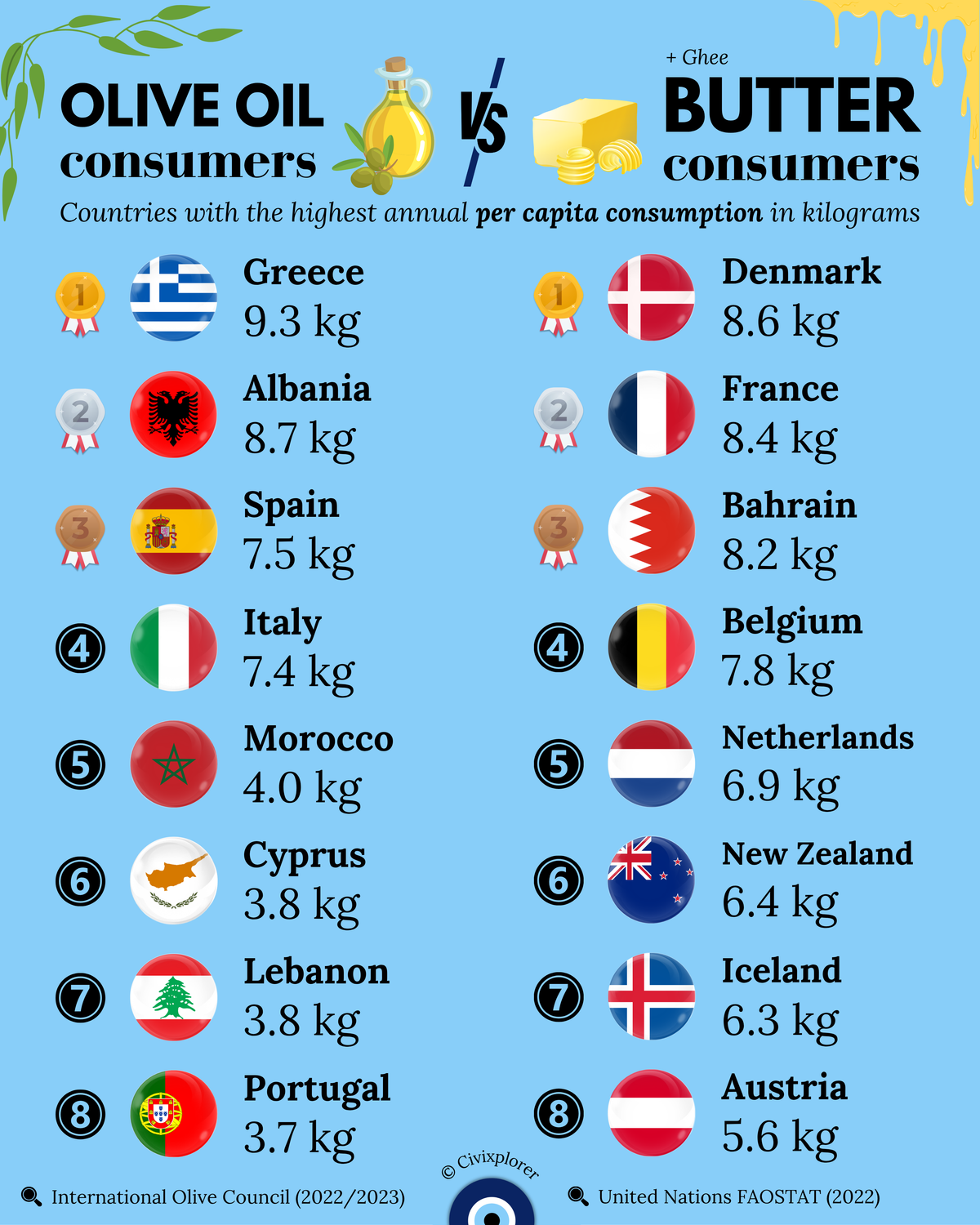
The global distribution of culinary fats reflects a profound agrarian and historical divide dictated by regional climate, agricultural history, and cultural evolution. Across the globe, national dietary preferences split cleanly between plant-based lipids and dairy fats. Data from the International Olive Council for the 2022/2023 crop year and the United Nations FAOSTAT food balance statistics for 2022 show how geographical ecosystems shape the foundation of traditional cooking. The sun-drenched Mediterranean basin relies almost universally on olive oil, whereas the cooler, temperate pasturelands of Northern and Central Europe have long depended on cattle husbandry and butter production.
At the top of the olive oil rankings, Greece leads global availability at 9.3 kg per person annually. This extraordinary consumption is backed by an ancient olive-growing tradition dating back over 7,000 years in the eastern Mediterranean. In Greece, olive oil is far more than a commercial product; a substantial share of household supply circulates directly through informal family groves and local rural networks rather than formal retail purchases. Albania follows closely in second place at 8.7 kg per person, driven by a shared coastal Mediterranean climate and expanding domestic olive groves. Major agricultural producers Spain (7.5 kg) and Italy (7.4 kg) further illustrate how olive oil forms the structural core of Southern European diets, while North African and Levantine nations such as Morocco (4.0 kg), Cyprus (3.8 kg), and Lebanon (3.8 kg) confirm that olive oil reliance spans the broader Mediterranean ecological zone.
On the dairy side, Denmark leads the world in per capita butter availability at 8.6 kg per person. This position is rooted in a highly organized nineteenth-century cooperative dairy movement that modernized milk processing and integrated butter deeply into daily meals like traditional open-faced sandwiches. France ranks second at 8.4 kg per person, highlighting a fascinating dual culinary identity where butter reigns supreme in northern and western regional cooking, even as olive oil dominates its southern Mediterranean coast. Positioned as a major global outlier, Bahrain holds third place at 8.2 kg per person. This statistical anomaly occurs because the UN FAOSTAT category includes ghee—a clarified butter composed of nearly 99.5% milk fat—which is a fundamental staple in traditional Gulf Arab cooking and among Bahrain’s large South Asian expatriate community. In the Southern Hemisphere, New Zealand reaches 6.4 kg per person, illustrating how extensive pasture-based dairy farming sustains high domestic availability alongside major export industries.
When analyzing these regional rankings, it is essential to understand the underlying statistical framework. These figures represent national food availability per capita derived from production, imports, and stock balances, rather than precise individual dietary intake. Furthermore, comparing gross product weights directly does not mean equal fat consumption, as pure olive oil and clarified ghee carry a significantly higher fat density than standard table butter. Ultimately, these national rankings demonstrate that how the world eats is not merely a matter of modern dietary choice, but the accumulated result of climate adaptability, trade history, and centuries of cultural continuity.

Comments (0)
Join the Conversation
Login to share your thoughts with the community.
Login to Comment