
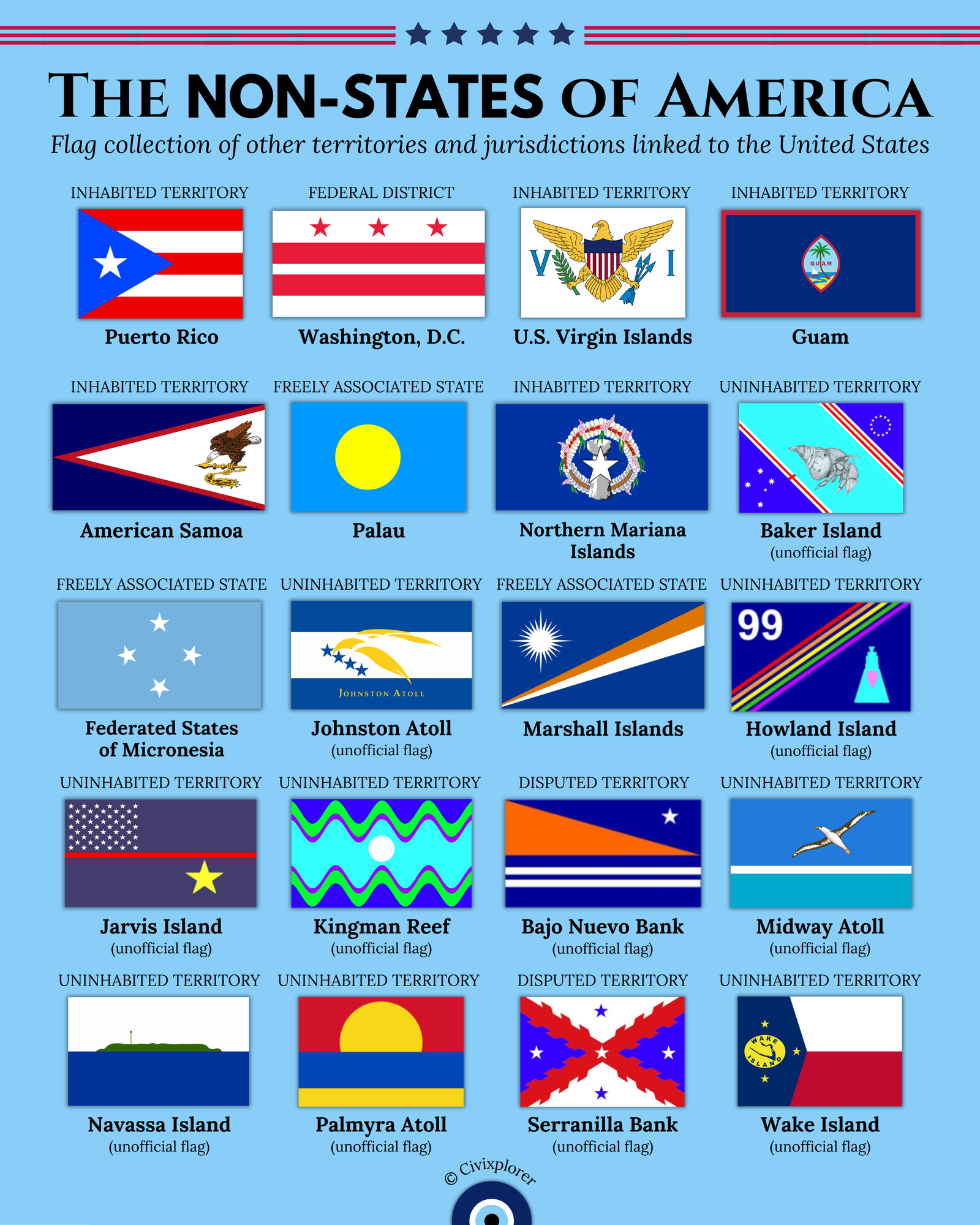
The United States is widely known for its fifty stars, but the American flag's reach extends far beyond those iconic states. Scattered across the Pacific and Caribbean is a complex web of jurisdictions, territories, and historical claims known as the "non-states." These areas represent a fascinating intersection of 19th-century expansionism, Cold War strategy, and modern geopolitical anomalies.
The history of many uninhabited specks of land, such as Baker, Howland, and Jarvis Islands, traces back to the Guano Islands Act of 1856. During this era, bird droppings (guano) were a prized global commodity for fertilizer and gunpowder. This law allowed any American citizen to claim an uninhabited island for the U.S. to mine these resources. While the guano is long gone, the U.S. maintains these sites today as strategic military outposts and vital wildlife refuges.
One of the most intriguing aspects of these remote locations is their visual identity. Places like Midway Atoll and Kingman Reef lack permanent populations and, therefore, official local flags. The colorful designs often associated with them are actually "fan-made" creations by vexillologists. For instance, the unofficial flag of Howland Island features the number "99" as a tribute to Amelia Earhart, who was attempting to reach the island before her disappearance in 1937.
The "non-states" also include inhabited territories like Puerto Rico and Guam, where millions of U.S. citizens live without full voting representation in Congress. This status stems from early 20th-century Supreme Court "Insular Cases" that labeled these regions "unincorporated." Meanwhile, sovereign nations like Palau, the Marshall Islands, and the Federated States of Micronesia maintain a unique "Freely Associated" status, granting the U.S. exclusive military access in exchange for economic aid and defense.
Finally, the infographic includes "phantom" disputed territories like Bajo Nuevo and Serranilla Banks. Though technically claimed by the U.S. under the old Guano Act, they are administered by Colombia and contested by several other nations. These submerged reefs remain relevant today because they grant significant maritime and fishing rights, proving that even the smallest patch of sand can carry immense geopolitical weight.
Comments (0)
Join the Conversation
Login to share your thoughts with the community.
Login to Comment