
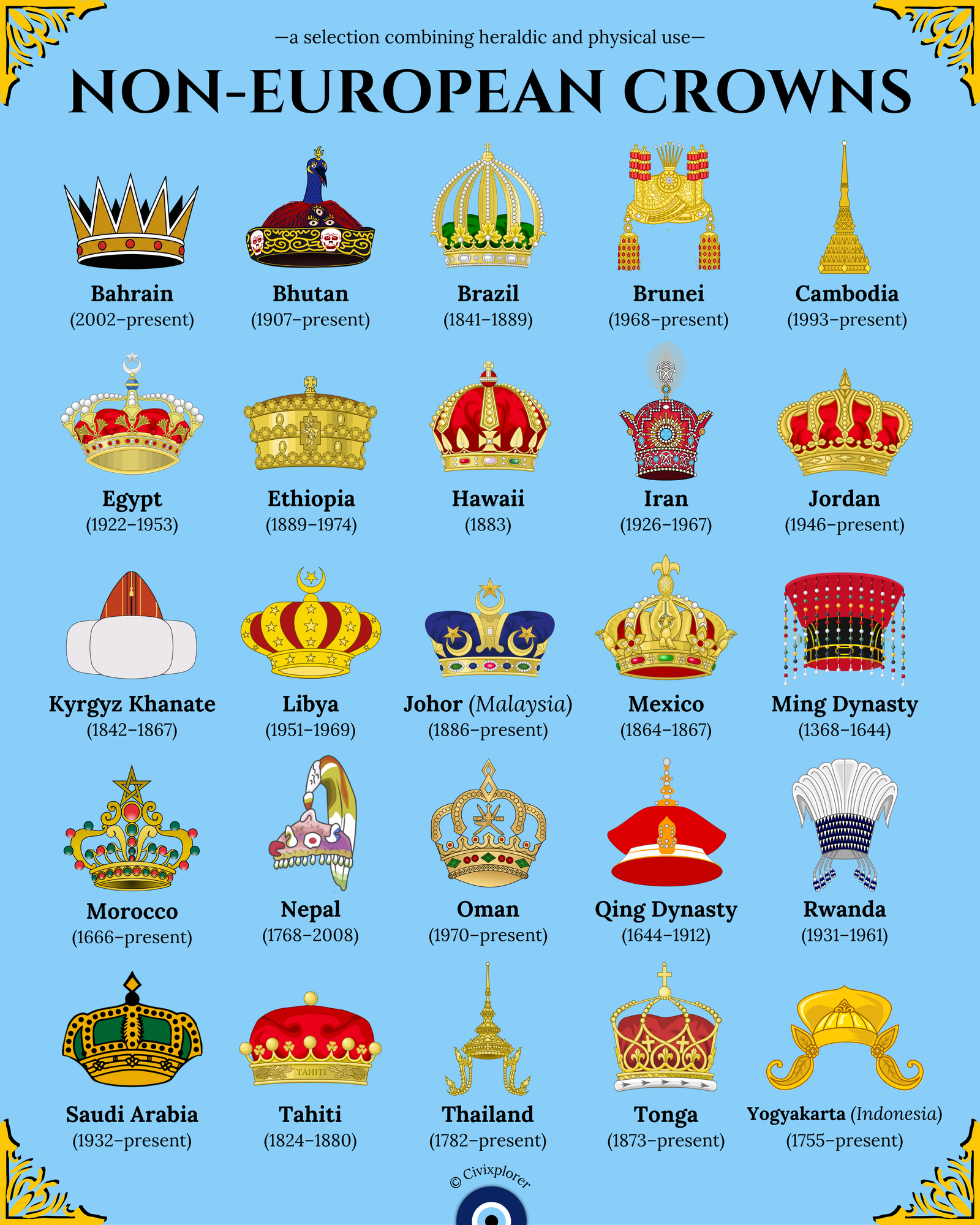
The concept of a crown as a marker of supreme authority often evokes images of jeweled gold circlets from the European tradition. However, a deeper look at global regalia reveals a visual language that is profoundly local, shaped by religion, climate, and political history. From the sacred peaks of the Himalayas to the heraldic emblems of the Middle East, non-European crowns represent a sophisticated blend of spiritual guardianship, cultural continuity, and strategic adaptation.
The European Blueprint for Global Legitimacy
During the 19th century, several non-European monarchies adopted Western-style regalia to project an image of modern, sovereign statehood to the world. For example, King Kalākaua of Hawaii commissioned physical crowns from London in 1883 to signal that his kingdom was a civilized peer to Western empires. Similarly, Sultan Abu Bakar of Johor became the first Malay ruler to commission a crown from British jewelers, though he localized the design by replacing Christian symbols with the Islamic crescent and star. In the Americas, the imperial crowns of Brazil and Mexico represented direct offshoots of European royalty, serving as conscious tools for political legitimization.
Indigenous Cosmology: Spires and Sacred Mountains
In Southeast Asia, crowns take the form of towering, tiered spires known as the Makuṭa. Found in Thailand and Cambodia, these gold-and-enamel conical diadems represent Mount Meru, the center of the spiritual universe in Hindu and Buddhist traditions. Wearing the Great Crown of Victory physically identifies the Thai monarch as a divine ruler positioned at the center of the cosmos. In contrast, the Nepalese Shripech features a unique silhouette created by the cascading plumes of the bird of paradise, encrusted with diamonds and emeralds to create one of the most distinct royal headpieces in history.
The Raven Crown of Bhutan
Standing entirely apart is the Raven Crown of Bhutan, which is a cloth hat rather than a metal coronet. Topped with a raven’s head representing the protective deity Mahakala, it blends military leadership with religious authority. Originally a 19th-century battle helmet, it was adopted in 1907 as the emblem of the hereditary monarchy, with its decorative skulls symbolizing the impermanence of life.
The Heraldic Illusion in Islamic Monarchies
Perhaps the most intriguing category involves crowns that only exist on paper. In many Islamic cultures, such as Saudi Arabia, Bahrain, Oman, and Morocco, monarchs traditionally do not wear physical crowns, prioritizing religious austerity over coronation theater. Instead, these "crowns" were designed as heraldic symbols to fit international graphic standards for state emblems and military insignia. The Saudi Arabian crown, for instance, is a graphic design featuring crossed swords and a palm tree—a symbol of the state that the King has never physically worn.
Ultimately, this diverse collection reminds us that a crown is never just a hat; it is a concentrated expression of a society’s cosmology and its claim to power.
Comments (0)
Join the Conversation
Login to share your thoughts with the community.
Login to Comment