
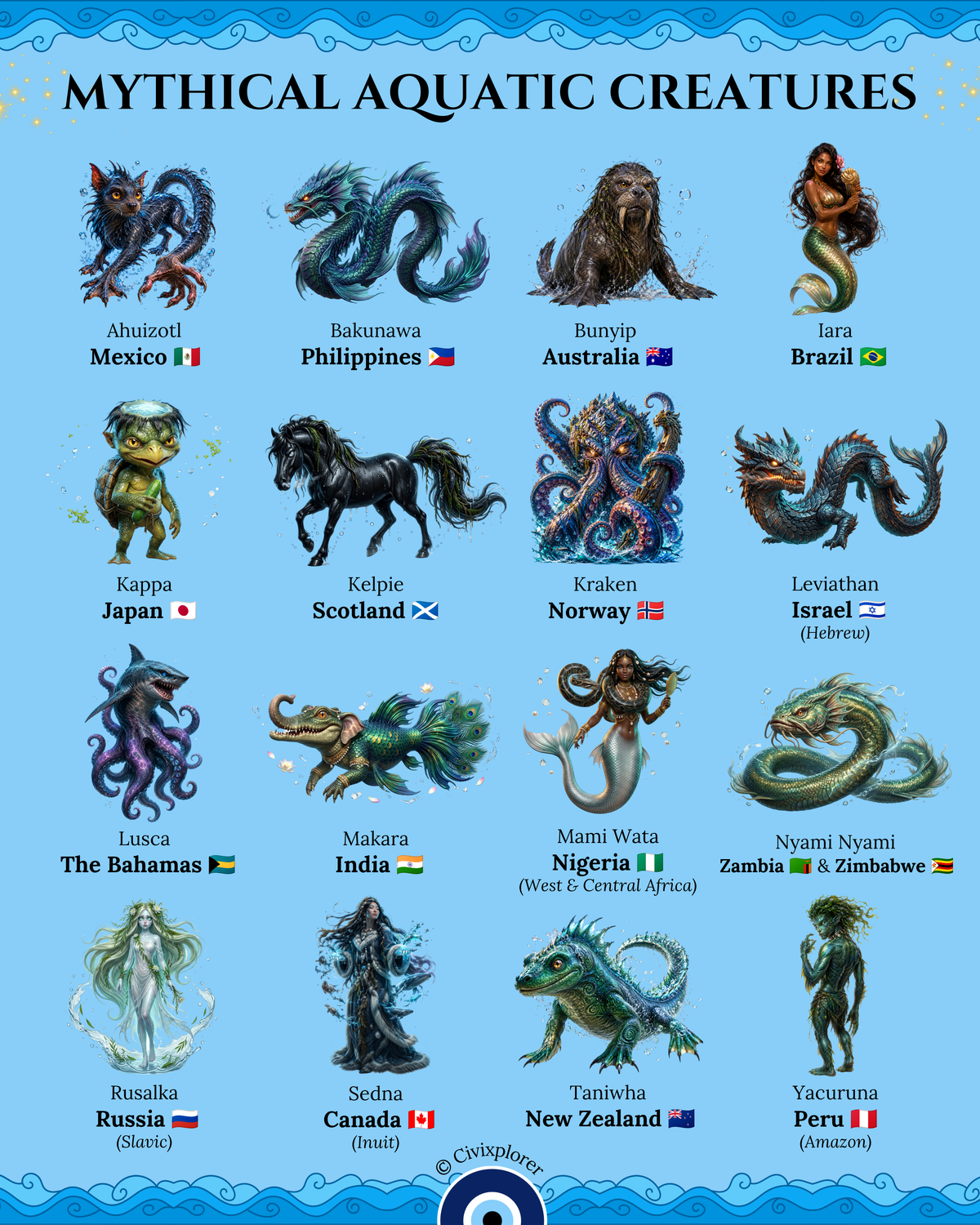
Across every continent and culture, water has always been treated as a sacred yet dangerous threshold. It is life-sustaining and unpredictable, a duality that has birthed a vast atlas of mythical aquatic beings that personify our deepest fears and wonders. From the deep "blue holes" of the Caribbean to the volatile riverbeds of the Australian outback, these legends are more than just stories; they are mirrors to human psychology and ancient environmental hazards.
Many of these entities are direct personifications of localized topography. For instance, the Lusca of the Bahamas, described as a shark-octopus hybrid, is a prescientific rationalization of the deadly tidal flows and whirlpools found in underwater sinkholes. Similarly, the Bunyip of Aboriginal Australian mythology served as a cautionary tale to keep children away from dangerous swamps and billabongs, perhaps even echoing cultural memories of extinct megafauna. In the North Atlantic, the Kraken likely stems from early encounters with the giant squid, combined with the very real danger of violent maelstroms off the Norwegian coast.
In many traditions, these figures are not merely "monsters" but foundational deities governing human survival. In the Canadian Arctic, Sedna is the Goddess of the Sea, whose fingers transformed into the marine mammals the Inuit rely on for food. In Zambia and Zimbabwe, the Nyami Nyami (the Zambezi River God) remains a symbol of cultural resistance and environmental power, famously blamed for the devastating floods during the construction of the Kariba Dam in the 1950s. Even the Leviathan, often viewed as a simple sea serpent, represents a theological symbol of primordial chaos in ancient Near Eastern traditions.
We also see fascinating examples of cultural syncretism, where trade and colonization reshaped folklore. Mami Wata, though often associated with Nigeria, is a pan-African spirit whose modern mermaid-like iconography was heavily influenced by 19th-century European and Hindu art, making her a global symbol of wealth and the dual nature of water. Likewise, Brazil’s Iara reflects a blending of indigenous Amazonian river spirits with European mermaid legends.
Finally, some aquatic myths reach beyond the water to explain the cosmos. The Bakunawa of the Philippines is a giant sea dragon believed to rise from the depths to swallow the moon, providing an ancient explanation for lunar eclipses. Whether they are guarding communities or personifying the unknown, these creatures endure because our relationship with the water remains one of dependence, wonder, and risk.

Comments (0)
Join the Conversation
Login to share your thoughts with the community.
Login to Comment