
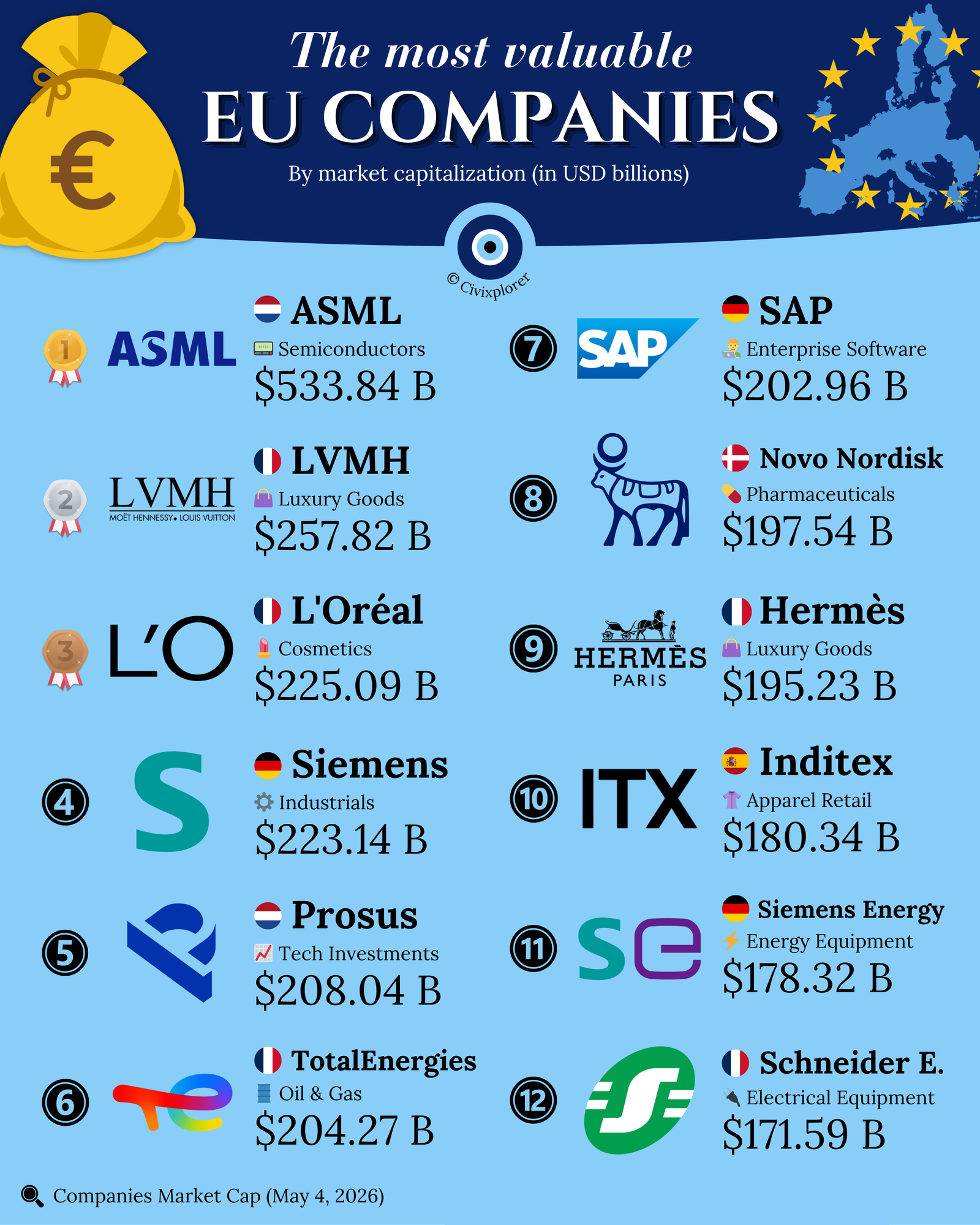
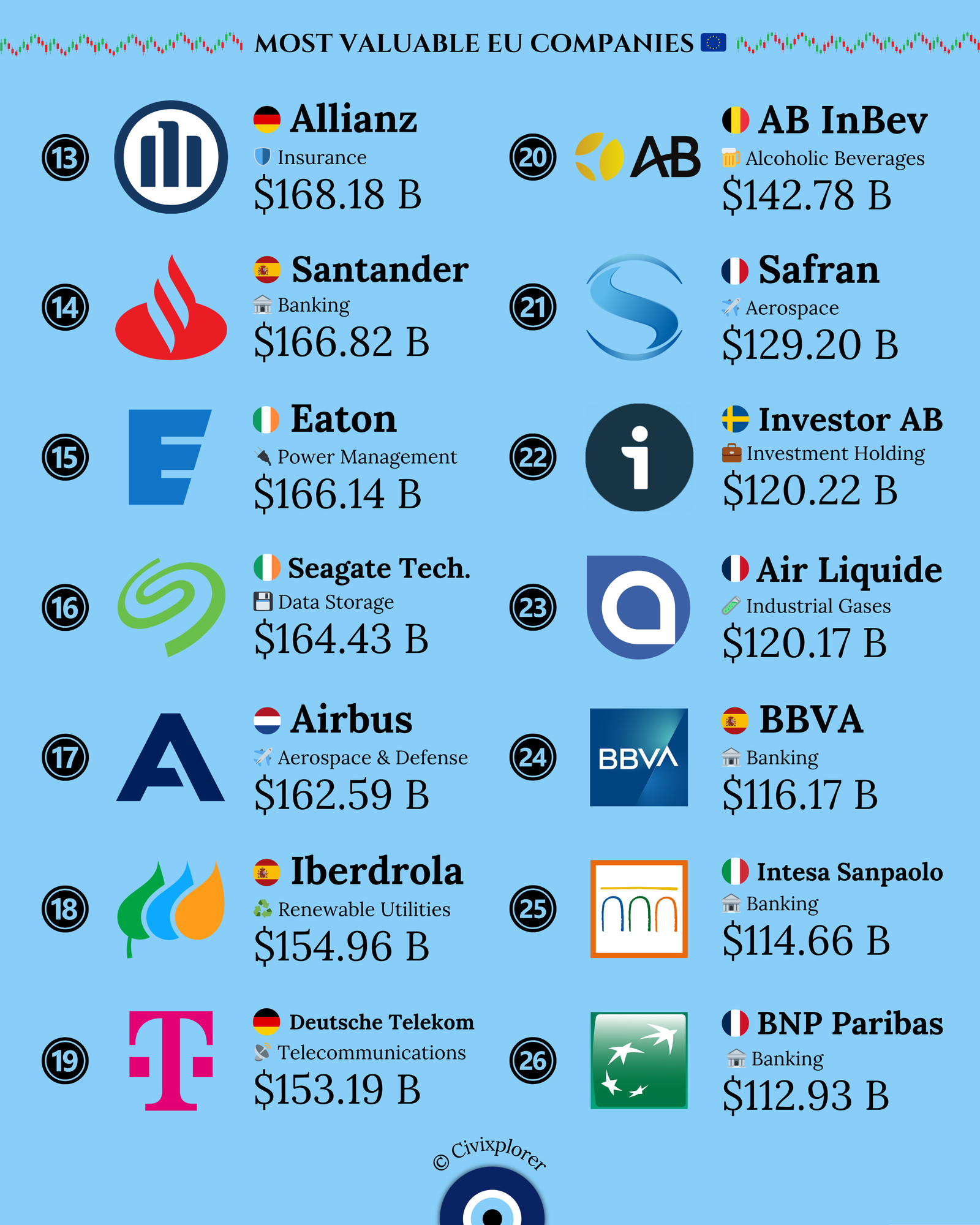
The landscape of corporate power in the European Union as of May 4, 2026, offers a fascinating glimpse into the continent's structural economic strengths. Unlike the United States, where consumer tech platforms dominate the charts, Europe’s most valuable companies represent a unique blend of industrial deep tech, heritage luxury, and enterprise software.
At the absolute pinnacle of this ranking sits ASML. With a market capitalization of $533.84 billion, the Dutch semiconductor equipment manufacturer is the undisputed crown jewel of the European economy. ASML holds a global monopoly on Extreme Ultraviolet (EUV) lithography machines, which are the only tools capable of mass-producing the advanced chips required for the AI revolution. This positions the Netherlands as a critical geopolitical linchpin in the global tech supply chain.
Following the tech-industrial dominance of the North, France emerges as a powerhouse of "soft power." The top 10 is heavily populated by French luxury conglomerates like LVMH, L’Oréal, and Hermès. In the European context, luxury is to the EU what Big Tech is to Silicon Valley. These brands command immense global pricing power and high margins, though they remain sensitive to economic stability in Asian markets.
The German economic engine continues to provide the B2B backbone for the Union. Giants such as SAP and Siemens showcase Germany's prowess in enterprise software and industrial automation. Notably, Siemens Energy has seen a significant rise in its valuation, driven by the EU’s aggressive Green Deal and the surging demand for grid infrastructure to support data centers and renewable energy transitions.
A particularly interesting data point in 2026 is the "reality check" for Novo Nordisk. After the initial euphoria of the weight-loss drug craze in previous years, the Danish pharmaceutical giant’s valuation has normalized due to increased competition and pricing pressures in the US. Meanwhile, Spain stands out as a regional growth outlier, with firms like Inditex, Santander, and Iberdrola outperforming the EU average thanks to a resilient service sector and effective use of recovery funds.
Ultimately, this ranking is more than just a list of stock prices; it is a map of engineered endurance. From the specialized tech of the Netherlands to the branding excellence of France and the engineering heritage of Germany, these 26 companies represent the sectors where Europe maintains a strategic "moat" in an increasingly competitive global economy.
| Position | Company | Country | Market Cap (USD) |
|---|---|---|---|
| 1 | ASML | Netherlands | $533.84 B |
| 2 | LVMH | France | $257.82 B |
| 3 | L’Oréal | France | $225.09 B |
| 4 | Siemens | Germany | $223.14 B |
| 5 | Prosus | Netherlands | $208.04 B |
| 6 | TotalEnergies | France | $204.27 B |
| 7 | SAP | Germany | $202.96 B |
| 8 | Novo Nordisk | Denmark | $197.54 B |
| 9 | Hermès | France | $195.23 B |
| 10 | Inditex | Spain | $180.34 B |
| 11 | Siemens Energy | Germany | $178.32 B |
| 12 | Schneider Electric | France | $171.59 B |
| 13 | Allianz | Germany | $168.18 B |
| 14 | Santander | Spain | $166.82 B |
| 15 | Eaton | Ireland | $166.14 B |
| 16 | Seagate Technology | Ireland | $164.43 B |
| 17 | Airbus | Netherlands | $162.59 B |
| 18 | Iberdrola | Spain | $154.96 B |
| 19 | Deutsche Telekom | Germany | $153.19 B |
| 20 | AB InBev | Belgium | $142.78 B |
| 21 | Safran | France | $129.20 B |
| 22 | Investor AB | Sweden | $120.22 B |
| 23 | Air Liquide | France | $120.17 B |
| 24 | BBVA | Spain | $116.17 B |
| 25 | Intesa Sanpaolo | Italy | $114.66 B |
| 26 | BNP Paribas | France | $112.93 B |

Comments (0)
Join the Conversation
Login to share your thoughts with the community.
Login to Comment