
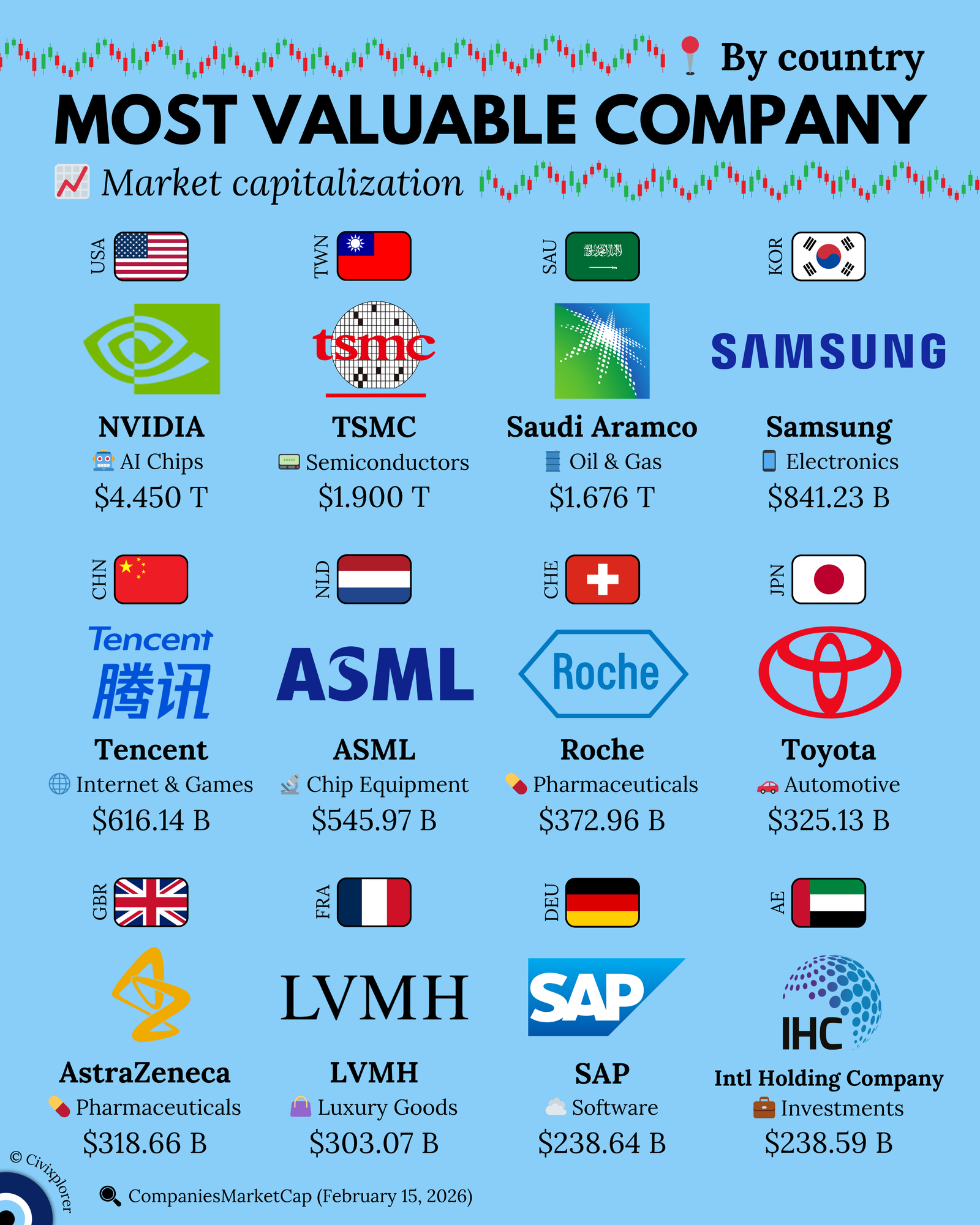
The global economic landscape in early 2026 reflects a profound transformation driven by two massive forces: generative artificial intelligence and biotechnology. This shift has redefined which companies lead their respective nations, moving away from a world once dominated by traditional banking and oil toward one built on intelligence and biological optimization.
At the forefront of this change is the "silicon triad" consisting of NVIDIA in the United States, TSMC in Taiwan, and ASML in the Netherlands. NVIDIA has reached a staggering valuation of approximately 4.45 trillion dollars, serving as the essential utility provider for the AI age. Its Blackwell and Rubin architectures are the fuel of the digital economy. This dominance is mirrored in Taiwan, where TSMC maintains a virtual monopoly on advanced chip manufacturing, making it one of the most critical geopolitical assets on the planet.
In Europe, the narrative has shifted toward healthcare and luxury. Denmark’s Novo Nordisk has risen to become a dominant force, fueled by the massive global demand for GLP-1 medicines like Ozempic and Wegovy. This success is so significant that the company's earnings have influenced the entire Danish national GDP. Meanwhile, France continues to lead through the resilience of luxury goods, with LVMH remaining a top global player despite broader economic volatility.
While technology and health are surging, traditional sectors still provide a firm foundation for many nations. Saudi Aramco remains an energy colossus with a valuation of 1.67 trillion dollars, and the banking sector continues to act as the primary economic anchor for countries like Canada, Australia, and Brazil. From the e-commerce success of MercadoLibre in Latin America to the diversified investments of the International Holding Company in the UAE, the current market rankings capture a world in the midst of a significant structural realignment.
Comments (0)
Join the Conversation
Login to share your thoughts with the community.
Login to Comment