
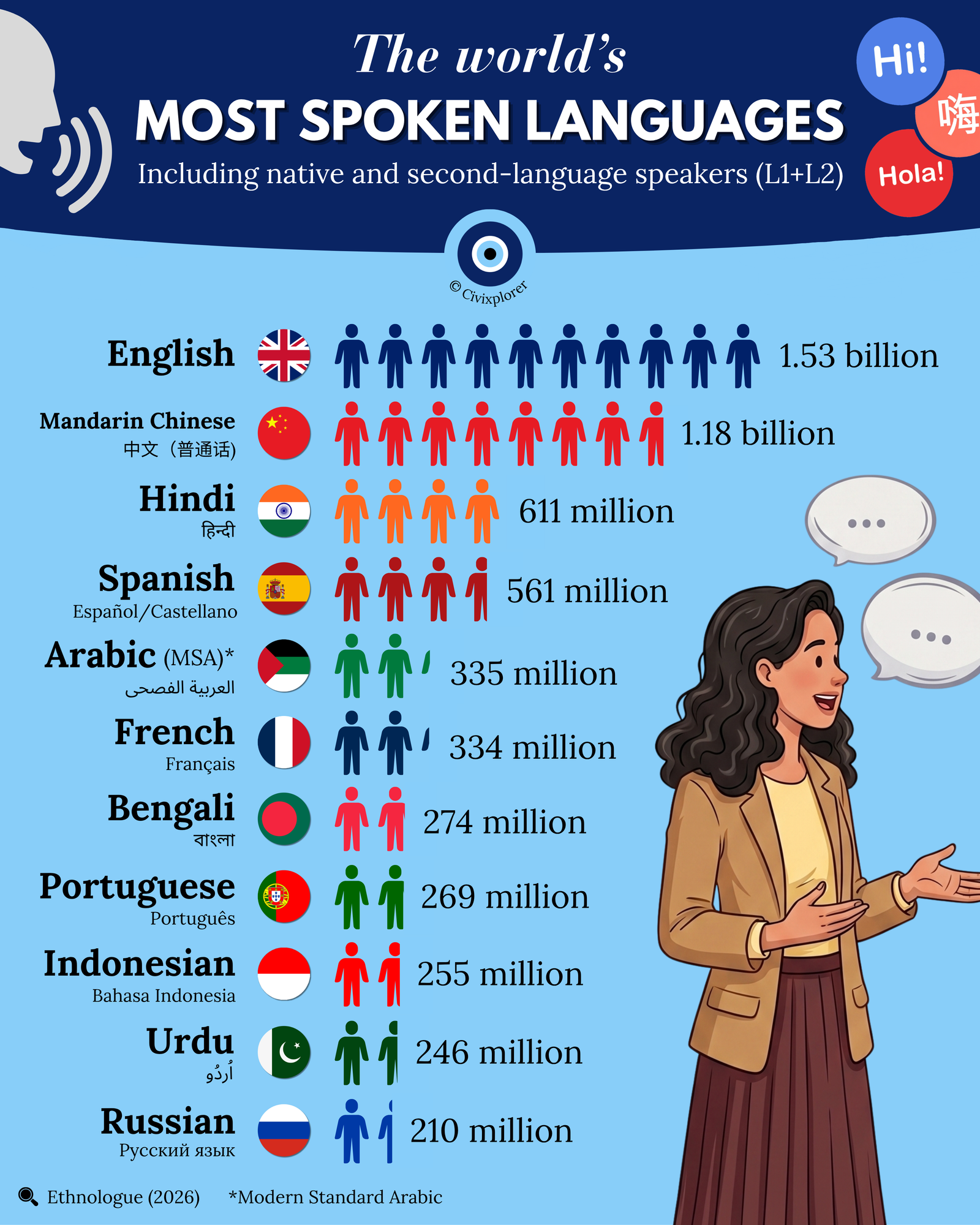
The global linguistic landscape of 2026 is a fascinating reflection of history, power, and demographic shifts. According to the latest data from the 2026 edition of Ethnologue, the ranking of the world’s most spoken languages highlights a critical distinction between first-language speakers (L1) and second-language speakers (L2). While many focus solely on mother tongues, measuring total speakers provides a more accurate sociolinguistic snapshot of how the world actually communicates.
The Global Lingua Franca: English
English remains the undisputed leader with a staggering 1.53 billion total speakers. This dominance is not a demographic accident but the result of a two-part historical process. First, the vast reach of the British Empire established English on every continent through trade and colonization. Second, the post-WWII economic and cultural supremacy of the United States cemented it as the default language for aviation, science, and the internet. With over 1.1 billion people using it as a second language, English serves as the ultimate bridge for global exchange.
The Demographic Titans: Mandarin and Bengali
In contrast to the geographic spread of English, Mandarin Chinese (1.18 billion) and Bengali (274 million) derive their massive numbers from immense population density in specific regions. Mandarin is the world’s largest language by native speakers, driven by China’s enormous population and the state's promotion of a national standard. Similarly, Bengali thrives in the densely populated Ganges-Brahmaputra delta, where high birth rates in Bangladesh and West Bengal maintain its robust numbers.
Political and Cultural Divides: Hindustani and Arabic
The data also reveals how politics and religion can split single language continuums. For example, Hindi (611 million) and Urdu (246 million) are listed separately, yet they are essentially mutually intelligible registers of the same language, Hindustani. If combined, Hindustani would easily rank as the world's third most spoken language.
Modern Standard Arabic (MSA), with 335 million speakers, presents a unique case of diglossia. While it is the formal language used in news and government across the Middle East, it is almost entirely acquired through formal education. Most Arabic speakers grow up using highly distinct regional dialects that differ significantly from this standardized version.
The Success of Language Planning: Indonesian
One of the most remarkable success stories in the ranking is Indonesian (Bahasa Indonesia) at 255 million speakers. To unify a vast archipelago of over 17,000 islands, the government adopted a standardized form of Malay as a neutral national language. Today, the majority of its speakers learn it as a second language to communicate across hundreds of distinct ethnic groups, making it a masterclass in nation-building through linguistics.
A Snapshot of World Power
Ultimately, this list is more than just raw data; it is a visual map of migration, empire, and globalization. Whether through the historical expansion of European languages like Spanish, French, and Portuguese or the demographic weight of Asia, these numbers tell the story of an increasingly interconnected planet.

Comments (0)
Join the Conversation
Login to share your thoughts with the community.
Login to Comment