
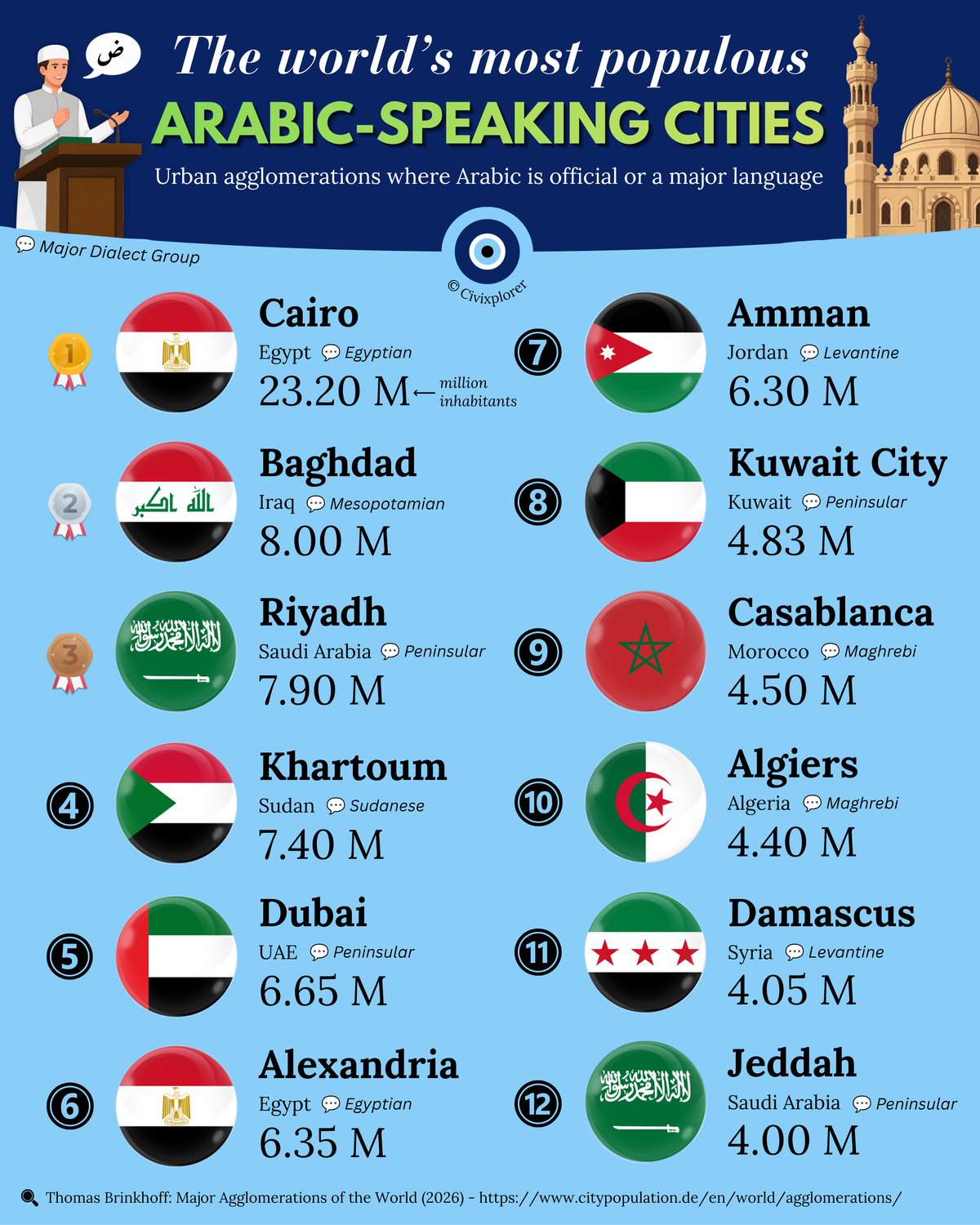
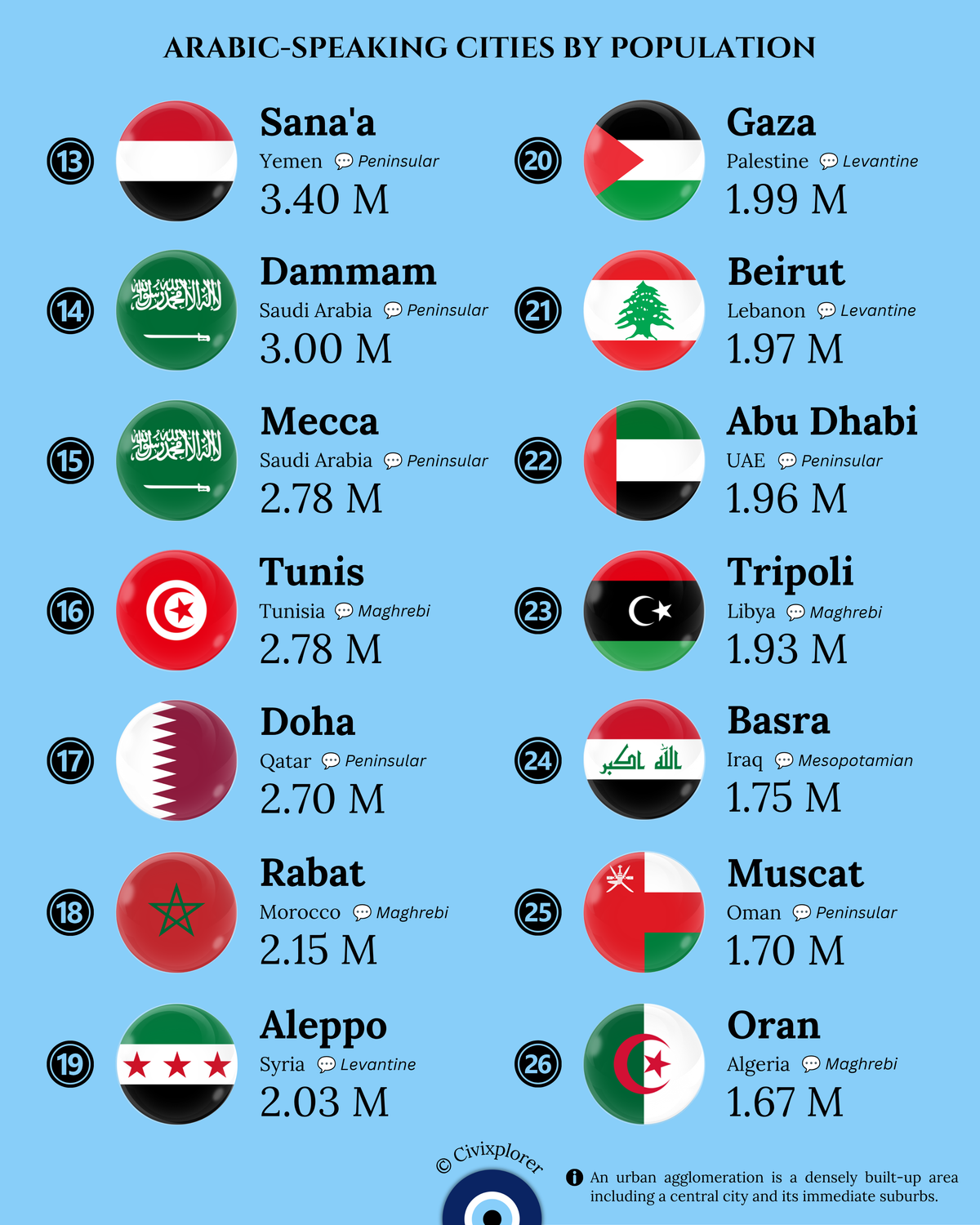
The landscape of urbanization across the Arab world presents a fascinating study of geopolitical, economic, and geographic narratives. Based on recent data from the 2026 Thomas Brinkhoff "Major Agglomerations of the World" dataset, we see a region defined by extreme centralization, rapid petroleum-funded expansion, and the deep impacts of regional migration.
The Undisputed Primacy of Greater Cairo
The most striking demographic reality is the sheer scale of Cairo. With an urban agglomeration of 23.20 million inhabitants, it is not merely the largest Arabic-speaking city; it is in a different league entirely. Cairo is nearly three times larger than the second-most populous city, Baghdad (8.00 million). This reflects Egypt's intense centralization, where political and economic power is concentrated along the narrow, habitable banks of the Nile. Greater Cairo functions as a massive, continuous metropolitan system that absorbs roughly one-fifth of Egypt’s total population.
The Gulf’s Rapid Transformation
Cities in the Gulf Cooperation Council (GCC) represent a different model of growth. Riyadh (7.90 million) and Dubai (6.65 million) have seen spectacular expansion driven by oil wealth and state-led modernization. Riyadh has transformed from a modest desert town into a sprawling horizontal metropolis, while Dubai has formed a dense coastal corridor that includes Sharjah and Ajman. A unique feature of these cities is the Expatriate Paradox; in hubs like Dubai and Doha, the vast majority of the population consists of foreign labor, yet Arabic remains the official cultural and administrative anchor.
Conflict, Displacement, and Urban Concentration
Several cities on this list tell stories of resilience and volatility. Baghdad remains a heavyweight at 8.00 million despite decades of instability. Amman (6.30 million) has seen its population artificially inflated as it serves as a regional refuge, absorbing successive waves of displaced people from neighboring conflicts. In contrast, the figures for Khartoum (7.40 million) and Gaza (1.99 million) must be viewed with caution. In these zones, war and mass displacement have disrupted the traditional relationship between the built environment and the resident population, making these numbers more of a demographic baseline than a real-time headcount.
Linguistic and Regional Diversity
The "Arabic-speaking" world is far from a monolith. While Modern Standard Arabic unites these centers in official contexts, the spoken reality is a rich tapestry of dialects. The Maghrebi dialects of Casablanca (4.50 million) and Algiers (4.40 million) are heavily influenced by Berber and French, making them distinct from the Levantine varieties of Beirut and Damascus or the Peninsular dialects of the Gulf.
Agglomeration vs. City Limits
It is crucial to understand that these rankings focus on urban agglomerations—continuously built-up areas—rather than strict administrative boundaries. For instance, Kuwait City (4.83 million) effectively encompasses nearly the entire population of the state of Kuwait, as the country functions as a city-state surrounded by desert. This methodology provides a more accurate reflection of how people actually live and move within these massive metropolitan engines.
Keywords (SEO):
Tags:

Comments (0)
Join the Conversation
Login to share your thoughts with the community.
Login to Comment