
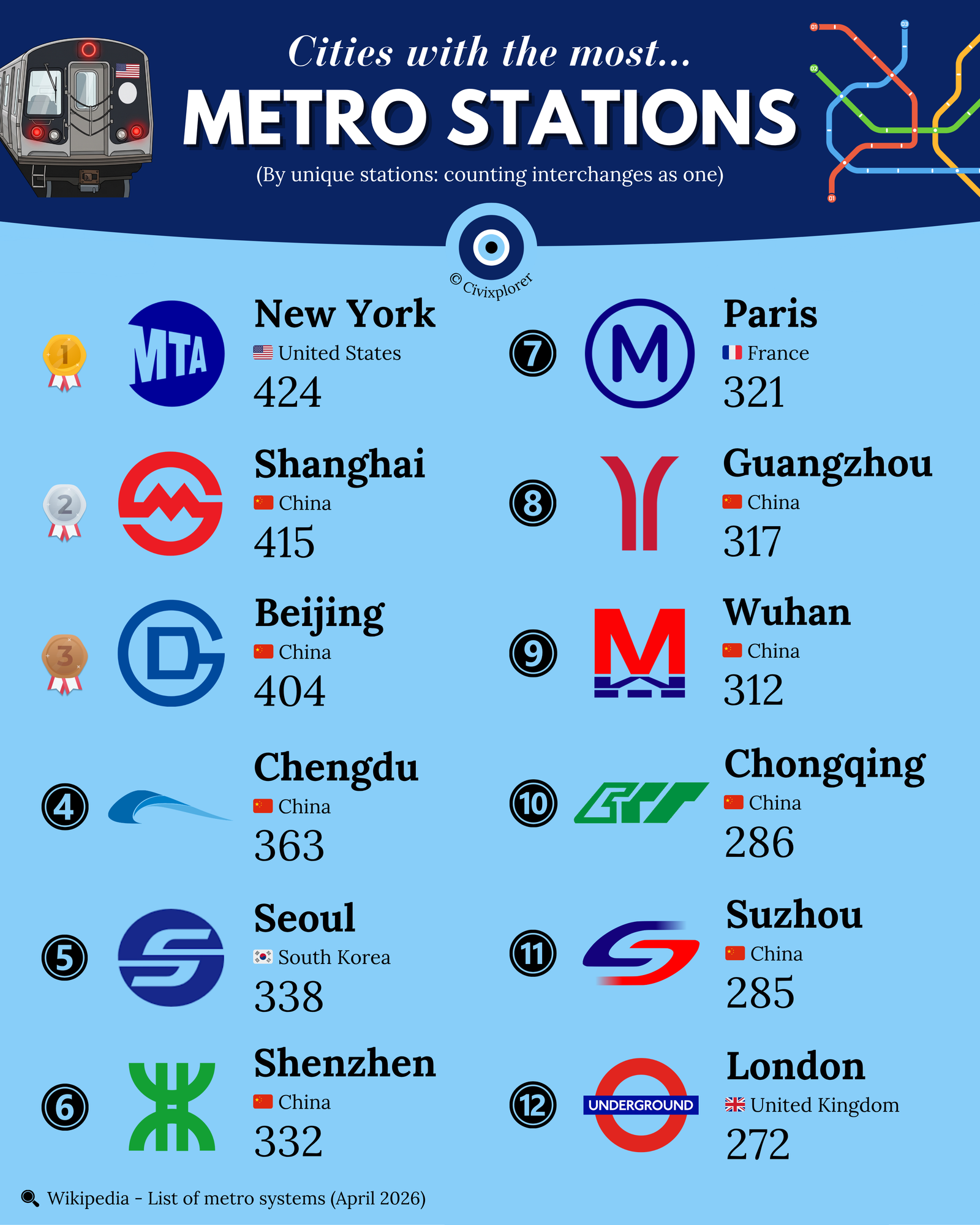
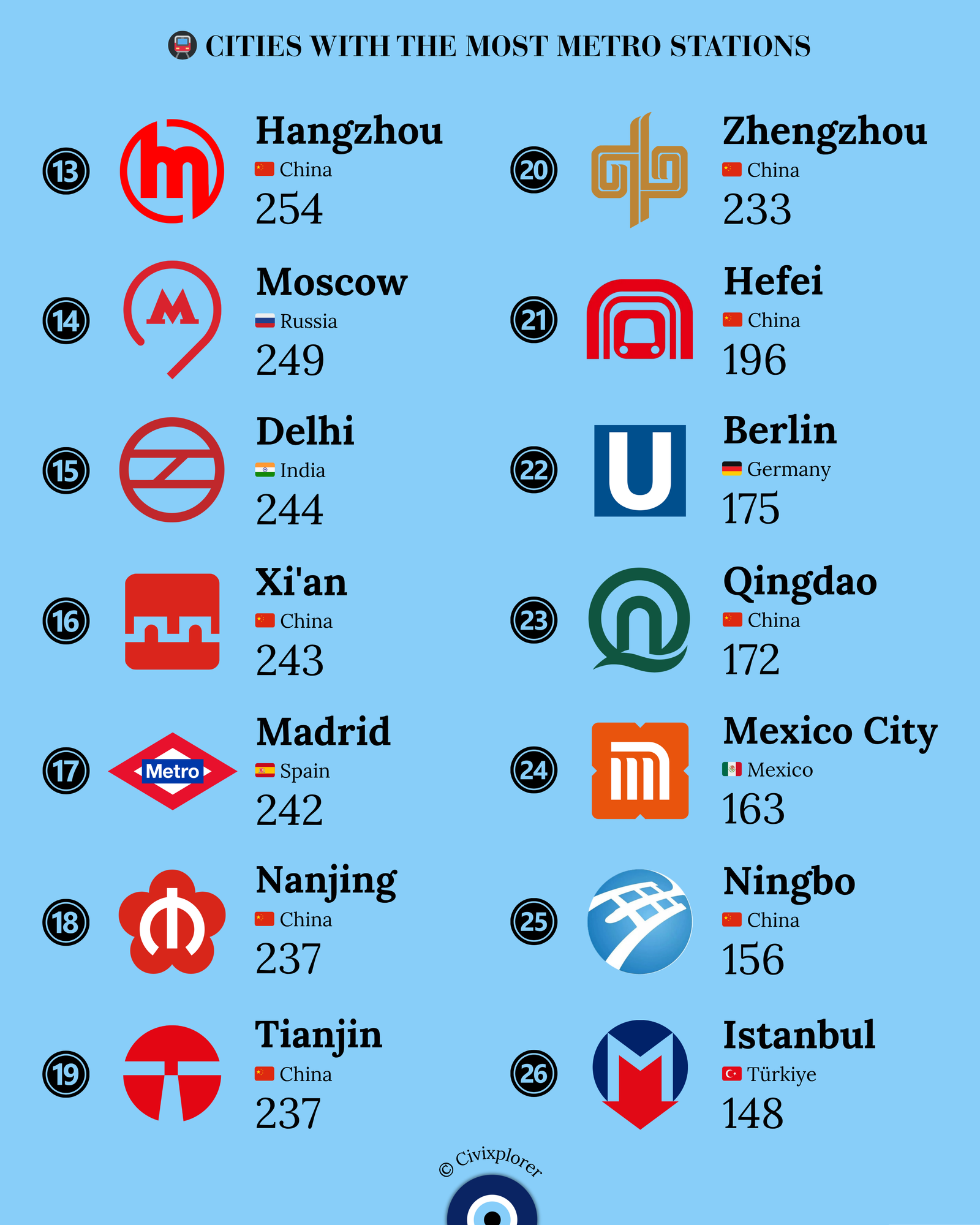
The landscape of global public transit is undergoing a seismic shift, as evidenced by the ranking of cities by their unique metro stations. This standardized metric, which counts transfer points as a single station regardless of how many lines serve them, provides a clear view of urban connectivity and infrastructure investment as of early 2026. While legacy systems in the West still hold high positions, the rapid urbanization of Asia is fundamentally rewriting the leaderboard.
The Historical Dominance of New York City
Standing at the top of the global list is New York City with 424 unique stations. This massive count is a testament to the system's century-plus head start, beginning in 1904. Interestingly, the high density of stations in Manhattan and Brooklyn is a relic of early 20th-century competition between three private companies—the IRT, BMT, and IND—who built overlapping networks to vie for riders. While New York has focused more on maintenance and accessibility in recent decades than massive expansion, its historic depth keeps it at the global #1 spot for now.
China’s Unprecedented Infrastructure Miracle
The most striking trend in modern transit is the overwhelming presence of China, which claims 15 of the top 26 cities listed. This explosive growth is the result of aggressive, state-backed urbanization strategies. For perspective, while London’s system opened in 1863, the Shenzhen Metro (332 stations) did not exist before 2004. Cities like Chengdu (363 stations) and Wuhan (312 stations) have built world-class networks from scratch in less than 20 years. Although Shanghai and Beijing trail New York slightly in station count, they have already surpassed it in total track length, reflecting a preference for long-distance lines that cover sprawling metropolitan areas.
European Density vs. Urban Sprawl
The European entries, including Paris (321 stations) and London (272 stations), highlight different philosophies in urban planning. Paris remains a global heavyweight due to its incredible inner-city density; the Métro was designed so that almost no building in the central city is more than 500 meters from a station. In contrast, London’s Underground, the world's oldest, features a more radial layout that stretches far into the suburbs, prioritizing geographic reach over sheer station frequency within the urban core.
The Rise of Global South Megacities
Beyond the established powers, the rapid ascent of the Delhi Metro (244 stations) represents a broader success story for the Global South. Since opening in 2002, it has become a vital lifeline for India’s National Capital Region. This growth underscores a definitive 21st-century shift: while older Western systems expand incrementally due to high costs and regulatory hurdles, the scale of modern metro development is now firmly driven by the rapidly urbanizing hubs of Asia.
Cities with the Most Metro Stations (2026)
| Rank | City | Country | Unique Stations |
|---|---|---|---|
| 1 | New York | United States | 424 |
| 2 | Shanghai | China | 415 |
| 3 | Beijing | China | 404 |
| 4 | Chengdu | China | 363 |
| 5 | Seoul | South Korea | 338 |
| 6 | Shenzhen | China | 332 |
| 7 | Paris | France | 321 |
| 8 | Guangzhou | China | 317 |
| 9 | Wuhan | China | 312 |
| 10 | Chongqing | China | 286 |
| 11 | Suzhou | China | 285 |
| 12 | London | United Kingdom | 272 |
| 13 | Hangzhou | China | 254 |
| 14 | Moscow | Russia | 249 |
| 15 | Delhi | India | 244 |
| 16 | Xi'an | China | 243 |
| 17 | Madrid | Spain | 242 |
| 18 | Nanjing | China | 237 |
| 19 | Tianjin | China | 237 |
| 20 | Zhengzhou | China | 233 |
| 21 | Hefei | China | 196 |
| 22 | Berlin | Germany | 175 |
| 23 | Qingdao | China | 172 |
| 24 | Mexico City | Mexico | 163 |
| 25 | Ningbo | China | 156 |
| 26 | Istanbul | Türkiye | 148 |
Comments (0)
Join the Conversation
Login to share your thoughts with the community.
Login to Comment