
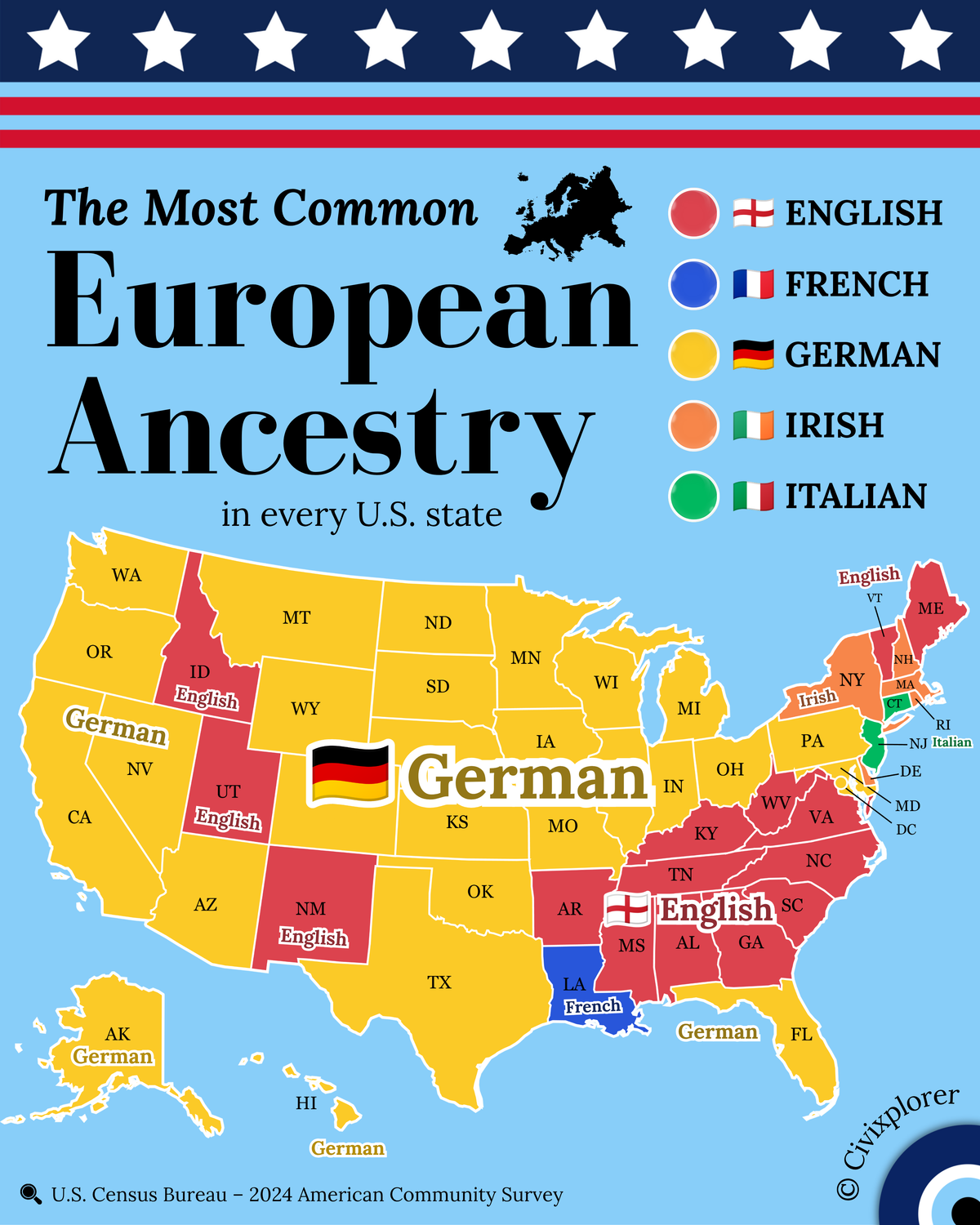
The demographic landscape of the United States carries a profound historical footprint shaped by centuries of transatlantic movement, interior migration, and regional community building. Based on data from the U.S. Census Bureau’s 2024 American Community Survey (ACS), a clear picture emerges when filtering exclusively for self-reported European heritage. Across all fifty states, just five European origins—German, English, Irish, Italian, and French—claim the top demographic spot. Crucially, this census data measures self-identified ancestral background rather than birthplace or genetic testing, capturing how families perceive their heritage over generations. By isolating European origins, the data strips away non-European pluralities to reveal the underlying historical settlement patterns that continue to define the nation's regional identity.
The most striking geographic feature on the map is the sweeping dominance of German ancestry, which forms the largest European plurality across 27 states. This massive contiguous belt stretches across the entire Midwest, Great Plains, Mountain West, and Texas. The foundation of this broad footprint was laid during 19th-century mass migrations, when over five million German immigrants arrived in search of agricultural land and economic opportunity following rural displacement and the political upheavals of 1848. Settlers established farmsteads and vibrant institutions across the German Triangle—anchored by Cincinnati, Milwaukee, and St. Louis—and expanded into the Plains, where Volga German communities from the Russian Empire homesteaded in the Dakotas and Nebraska. In western and Sunbelt states like California, Arizona, Florida, Alaska, and Hawaii, German pluralities represent a secondary wave driven by 20th-century internal migration from the Midwestern heartland.
In contrast to the interior German belt, English ancestry holds the top position in 15 states, organized into three distinct regional clusters. The largest cluster spans the rural South and Appalachia, where 17th- and 18th-century colonial British settlements remained largely untouched by late 19th-century industrial immigration waves. Recent redesigns in census survey prompts have also sparked a statistical rebound in self-reported English heritage, as families who previously identified simply as American reconnected with their colonial English roots. A second cluster exists in northern New England, where early colonial stock remained predominant in rural Maine and Vermont. Meanwhile, a unique third cluster defines the Mormon Corridor of Utah and Idaho, established during the mid-to-late 19th century when extensive Latter-day Saint missionary efforts in Great Britain brought tens of thousands of English and Welsh converts to settle the Intermountain West.
The densely populated Northeast reflects a distinct historical narrative divided between Irish and Italian migration hubs. Irish ancestry leads across 5 states—including Massachusetts, New York, New Hampshire, Rhode Island, and Delaware—tracing back to the catastrophic Great Famine of 1845–1852. Arriving with limited capital, millions of Irish refugees settled in port and manufacturing centers like Boston and New York City, creating enduring urban enclaves. Italian ancestry holds the plurality in 2 states, Connecticut and New Jersey, resulting from a concentrated late 19th- and early 20th-century migration wave where over four million immigrants, primarily from southern Italy, arrived to work in industrial corridors. Finally, French ancestry claims a singular plurality in 1 state, Louisiana. This unique identity reflects both 18th-century French colonial roots in New Orleans and the 1755 British expulsion of Acadians from eastern Canada (Le Grand Dérangement), whose descendants settled the bayous of Acadiana as Cajuns.

Comments (0)
Join the Conversation
Login to share your thoughts with the community.
Login to Comment