
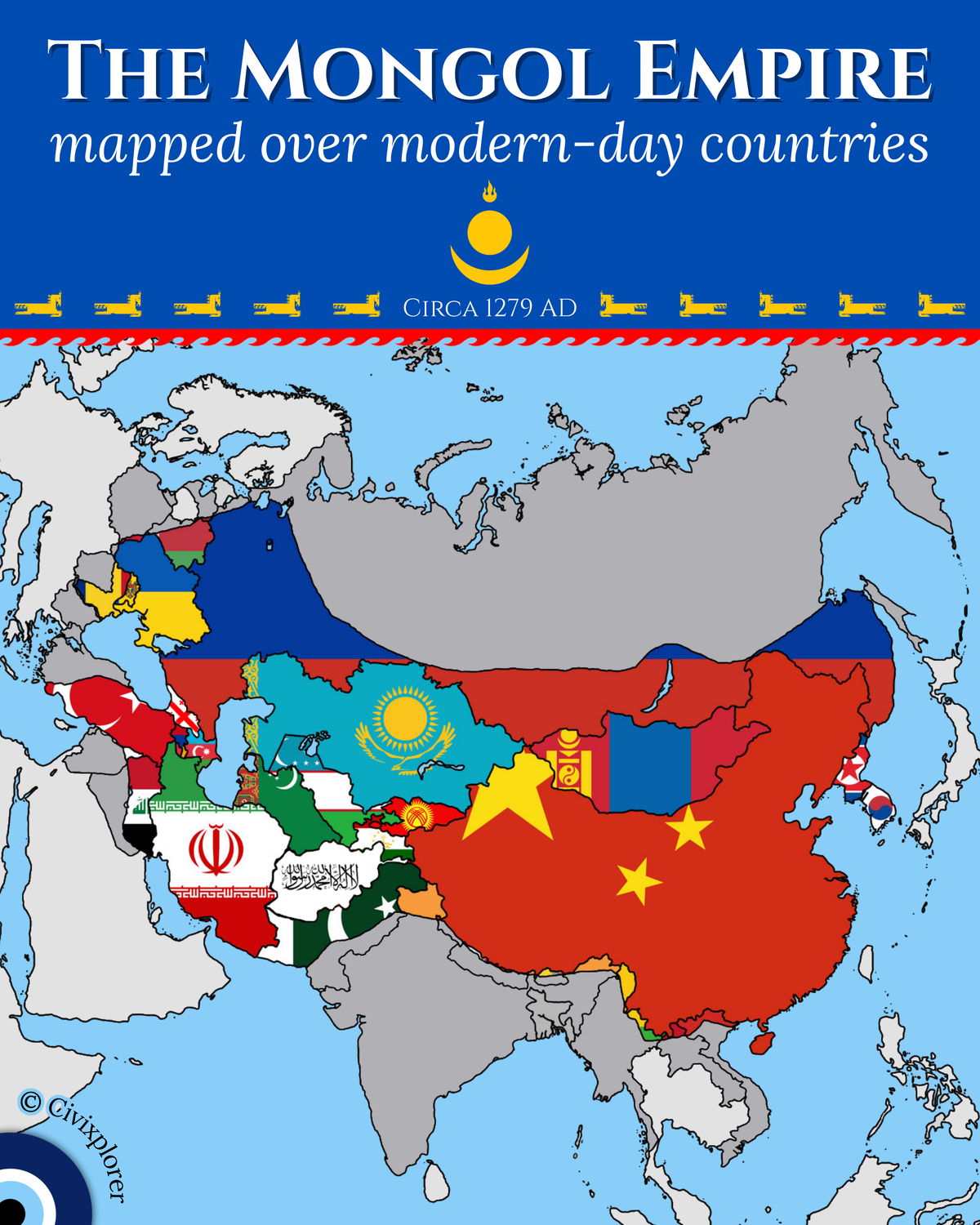
At its territorial zenith, the Mongol Empire stood as a colossus, spanning roughly 24 million square kilometers—nearly 20% of the Earth's land surface. This extraordinary feat of conquest, which began on the Central Asian steppes under Genghis Khan in 1206, eventually connected the Pacific coast to the gates of Europe. By mapping this 13th-century superpower over modern-day borders, we gain a striking perspective on the scale of its influence and the sheer number of sovereign states that now occupy its former territories.
The Significance of 1279 AD
The year 1279 AD represents the empire's absolute maximum reach. This was the year Kublai Khan, grandson of Genghis, completed the conquest of the Southern Song Dynasty at the Battle of Yamen. This victory marked the first time all of China was unified under a foreign power, the Yuan Dynasty. While the empire had already begun to fragment into four distinct khanates—the Yuan Dynasty, the Golden Horde, the Chagatai Khanate, and the Ilkhanate—they still nominally acknowledged a central Great Khan, making 1279 the pinnacle of Mongol cohesion and size.
The Four Khanates
The visual representation of the empire over today’s nations highlights four major administrative zones:
- The Yuan Dynasty: Centered in modern China and Mongolia, it also included parts of the Korean Peninsula and Siberia.
- The Ilkhanate: Encompassed the heartlands of ancient Persia, including modern Iran, Iraq, Azerbaijan, and parts of Turkey and Syria.
- The Chagatai Khanate: Occupied Central Asia, covering much of Kazakhstan, Uzbekistan, Kyrgyzstan, and Tajikistan.
- The Golden Horde: Stretched across the western steppes into modern Russia and Ukraine, reaching as far west as the Carpathian Mountains.
The Limits of a Superpower
Despite their unmatched mobility and military prowess, the Mongols faced natural and logistical barriers that defined the empire's edges. In the east, the "Kamikaze" typhoons famously thwarted two massive naval invasions of Japan. To the south, the Himalayas and India’s intense humidity protected the Delhi Sultanate, as the climate was hostile to the Mongols' famous steppe ponies. In the west, the empire’s advance into the Middle East was permanently halted by the Egyptian Mamluks at the Battle of Ain Jalut, while the sudden death of Ögedei Khan in 1241 prompted a withdrawal from Central Europe that was never fully resumed.
A Legacy of Connection
The Mongol era ushered in the Pax Mongolica, a century of relative stability that secured the Silk Road. This allowed for an unprecedented exchange of technology, culture, and ideas between the East and West. While the empire eventually dissolved into independent states, its genetic and cultural footprint remains embedded in the DNA and history of dozens of modern nations across Eurasia. By visualizing this history through a contemporary lens, we can better appreciate how a nomadic confederation fundamentally redrew the world map.

Comments (0)
Join the Conversation
Login to share your thoughts with the community.
Login to Comment