
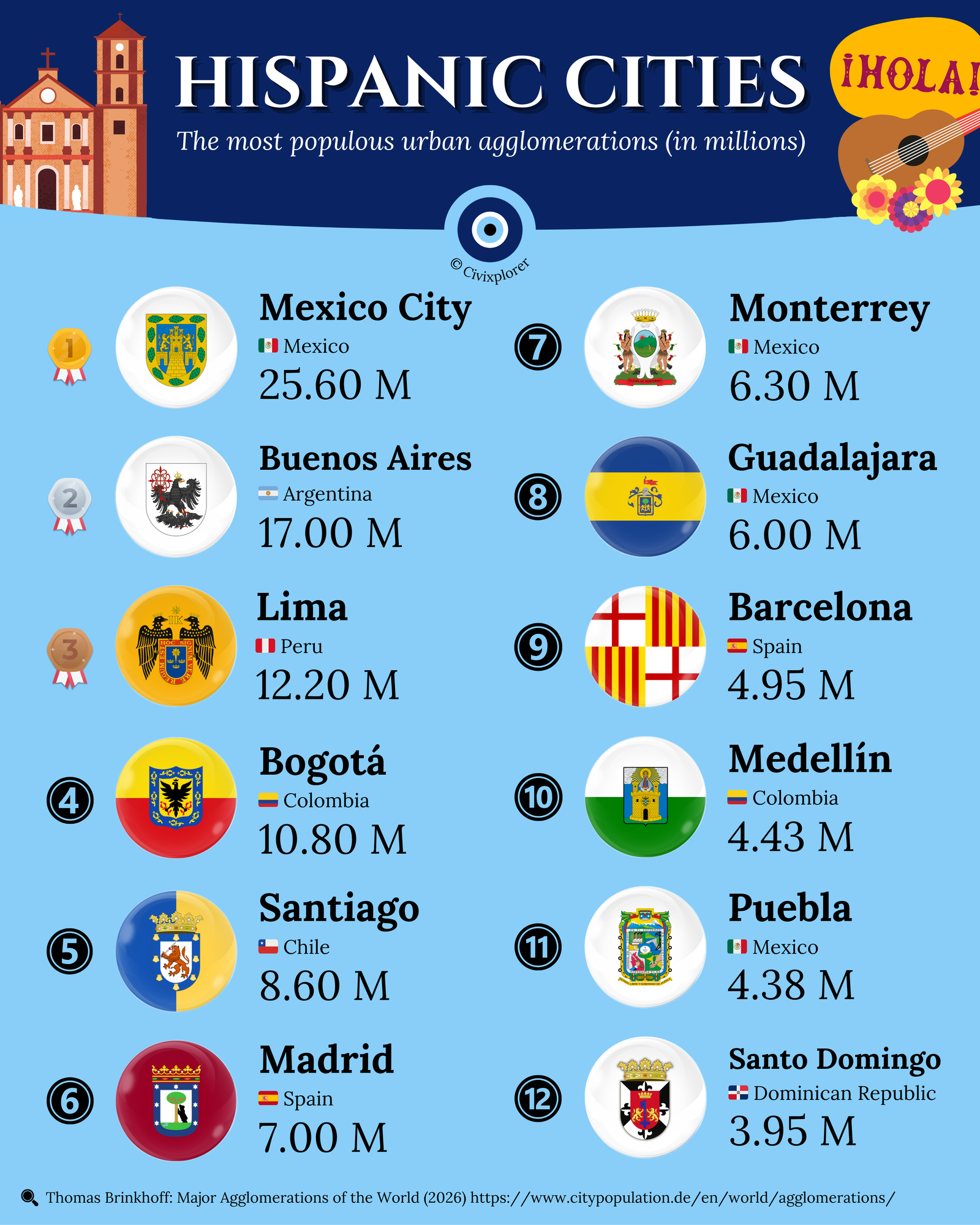
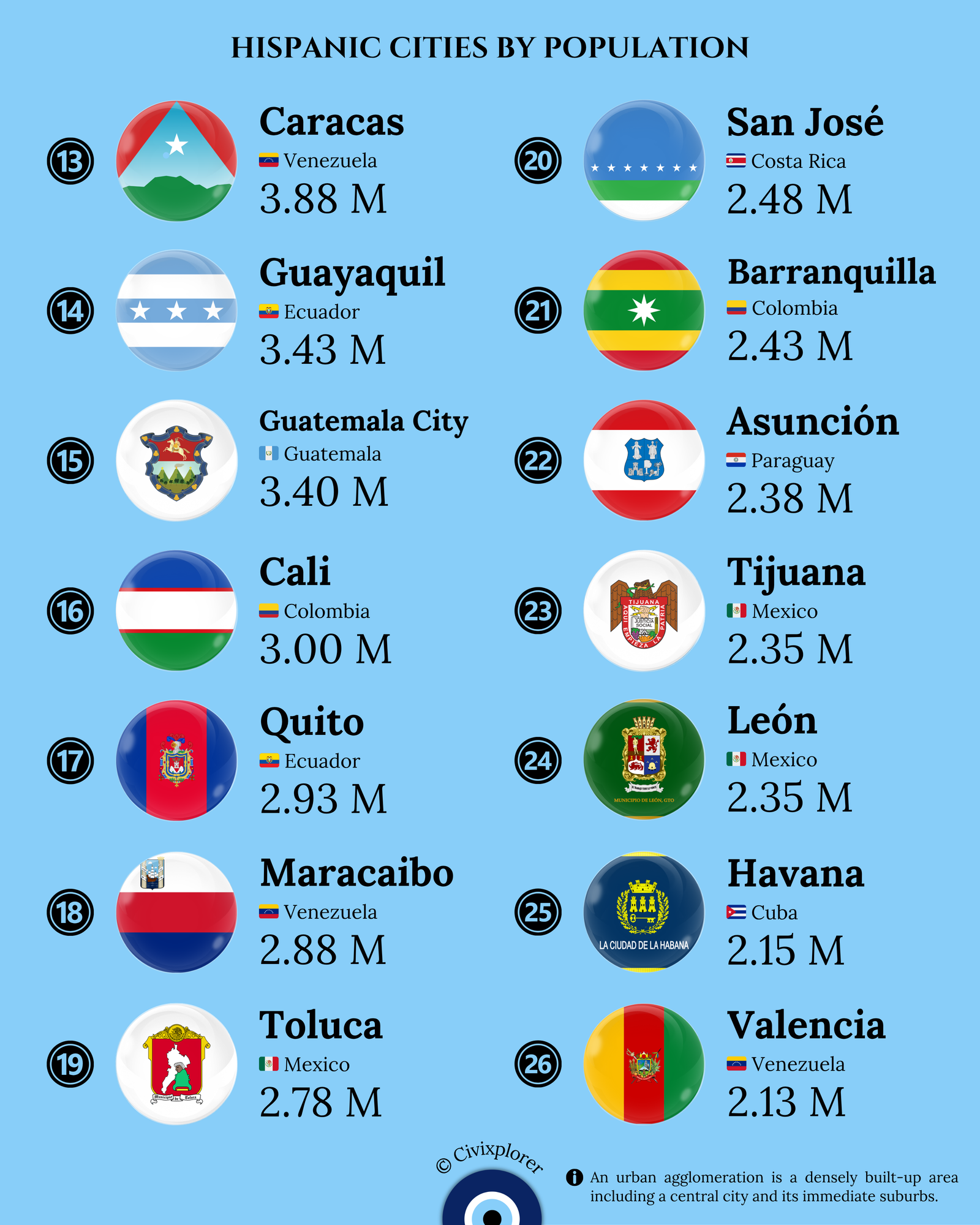
The demographic weight of the modern world is shifting, and the Spanish-speaking sphere—Hispanidad—is at the forefront of this transformation. Drawing from the latest 2026 projections by Thomas Brinkhoff’s City Population database, we can visualize a fascinating window into global urbanization and historical legacies. This data focuses specifically on Hispanic urban agglomerations: regions where Spanish is the primary language and the cultural-historical heritage is rooted in Spain. Crucially, this definition excludes Portuguese-speaking giants like São Paulo, focusing instead on the shared linguistic and colonial DNA of the Spanish-speaking world.
The Meaning of the Urban Agglomeration
To understand these massive numbers, we must first define the urban agglomeration. Unlike strict administrative city limits, an agglomeration includes the central city plus its contiguous suburbs and built-up neighboring areas. This definition captures the full metropolitan reach, reflecting how modern urbanization ignores political boundaries to create sprawling megacities.
Mexico: The Undisputed Heavyweight
The most striking revelation in the data is the overwhelming dominance of Mexico. Sitting at number one is Mexico City, with a staggering 25.60 million inhabitants. Its size is a product of centuries of centralization, having served as the heart of the Aztec Empire and later the capital of the Viceroyalty of New Spain.
However, Mexico’s power is not limited to its capital. The country claims seven of the top 26 spots, including Monterrey (6.30 M), Guadalajara (6.00 M), and Puebla (4.38 M). This multi-polar growth highlights Mexico’s status as a highly urbanized, diverse economy where secondary cities function as major industrial and tech hubs.
South American Giants and the Primate City Effect
In South America, a different trend emerges known as urban primacy. In countries like Argentina, Peru, and Chile, the national capitals are disproportionately larger than any other city, acting as massive gravitational centers for politics and commerce. Buenos Aires (17.00 M), Lima (12.20 M), and Santiago (8.60 M) exemplify this trend.
In contrast, Colombia displays a more distributed urban network. While Bogotá is a massive highland metropolis of 10.80 million, the country also features Medellín (4.43 M), Cali (3.00 M), and Barranquilla (2.43 M), reflecting a geographic landscape of mountains and valleys that encouraged the development of multiple urban cores.
The Iberian Contrast and Colonial Legacies
Perhaps the most symbolic takeaway is the comparison between the Americas and the Iberian Peninsula. While Spain is the cradle of Hispanic identity, its largest cities—Madrid (7.00 M) and Barcelona (4.95 M)—rank significantly lower than their Latin American counterparts. This highlights a centuries-long transatlantic population shift driven by explosive growth and migration in the New World.
Despite these geographic distances, a shared urban blueprint unites these cities. Most were founded or reorganized under the Laws of the Indies (1573), which mandated a standardized grid system centered around a Plaza Mayor. Whether it is the desert metropolis of Lima or the high Andean plateau of Bogotá, the historical cores of these cities still reflect this shared Spanish architectural DNA.
Conclusion: A Living Legacy
These 26 cities represent more than just statistics; they are the vibrant, living outcome of a half-millennium legacy. From the colonial historic centers to the modern industrial hubs of the U.S. border, these agglomerations continue to shape global culture, economics, and the future of the Spanish-speaking world.
| Ranking Position | City | Country | Population Figures |
|---|---|---|---|
| 1 | Mexico City | Mexico | 25.60 M |
| 2 | Buenos Aires | Argentina | 17.00 M |
| 3 | Lima | Peru | 12.20 M |
| 4 | Bogotá | Colombia | 10.80 M |
| 5 | Santiago | Chile | 8.60 M |
| 6 | Madrid | Spain | 7.00 M |
| 7 | Monterrey | Mexico | 6.30 M |
| 8 | Guadalajara | Mexico | 6.00 M |
| 9 | Barcelona | Spain | 4.95 M |
| 10 | Medellín | Colombia | 4.43 M |
| 11 | Puebla | Mexico | 4.38 M |
| 12 | Santo Domingo | Dominican Republic | 3.95 M |
| 13 | Caracas | Venezuela | 3.88 M |
| 14 | Guayaquil | Ecuador | 3.43 M |
| 15 | Guatemala City | Guatemala | 3.40 M |
| 16 | Cali | Colombia | 3.00 M |
| 17 | Quito | Ecuador | 2.93 M |
| 18 | Maracaibo | Venezuela | 2.88 M |
| 19 | Toluca | Mexico | 2.78 M |
| 20 | San José | Costa Rica | 2.48 M |
| 21 | Barranquilla | Colombia | 2.43 M |
| 22 | Asunción | Paraguay | 2.38 M |
| 23 | Tijuana | Mexico | 2.35 M |
| 24 | León | Mexico | 2.35 M |
| 25 | Havana | Cuba | 2.15 M |
| 26 | Valencia | Venezuela | 2.13 M |

Comments (0)
Join the Conversation
Login to share your thoughts with the community.
Login to Comment