
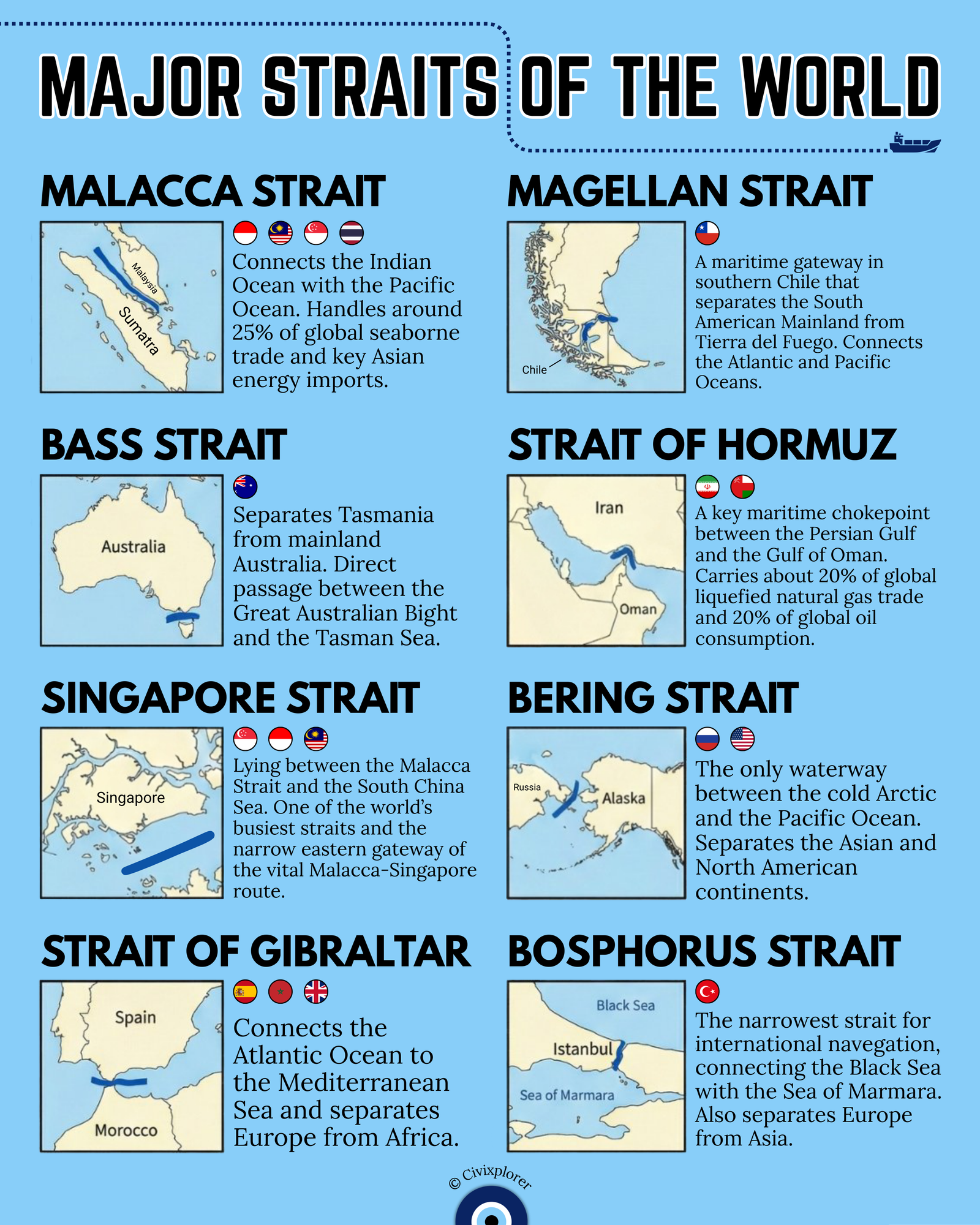
Maritime straits are far more than mere geographical curiosities; they are the vital arteries of the global economy. Approximately 90% of the world's goods by volume move across our oceans, and the vast majority of this traffic must pass through narrow, naturally formed channels known as straits. When these passages are both highly trafficked and physically narrow, they become geopolitical "chokepoints" where any disruption—whether from political instability, accidents, or piracy—can cause immediate ripples across the global supply chain.
The Strait of Hormuz stands as perhaps the most sensitive of these chokepoints. Nestled between Iran and Oman, it connects the oil-rich Persian Gulf to the open ocean. Handling roughly 20% of global oil consumption and 20% of global LNG trade, it is a linchpin for global energy security. Because alternative routes are limited, the nations bordering this strait hold significant leverage on the world stage, as any threat of closure can cause energy prices to spike worldwide.
Further east, the Malacca and Singapore Straits form a massive maritime highway between the Indian and Pacific Oceans. This corridor handles approximately 30% of all global seaborne trade, serving as the primary route for raw materials heading to manufacturing hubs in China, Japan, and South Korea. At its narrowest point, the passage is only about 1.5 miles wide, creating extreme congestion that requires expert navigation and international cooperation to manage. This heavy reliance is often referred to as the "Malacca Dilemma" for major importing nations.
The Bosphorus Strait offers a unique blend of geographical and political complexity. As the narrowest strait in the world used for international navigation, it physically splits the city of Istanbul and separates Europe from Asia. It serves as the sole maritime exit for Black Sea nations, making it a critical focus for agricultural and energy exports from the region. Its status is unique in international law, governed by the 1936 Montreux Convention, which grants Türkiye specific rights to regulate the transit of naval warships.
Beyond trade, straits like the Bering Strait carry immense historical and environmental significance. Once a land bridge that allowed the first human migrations into the Americas, it now serves as the only natural gateway between the Arctic and Pacific Oceans. As polar ice continues to melt, its relevance for future transpolar shipping routes is steadily increasing. From the strategic gateway of Gibraltar to the dramatic southern tip of the Magellan Strait, these slim blue lines on the map continue to underpin the modern world, proving that geography still dictates the flow of power and wealth.
Comments (0)
Join the Conversation
Login to share your thoughts with the community.
Login to Comment