
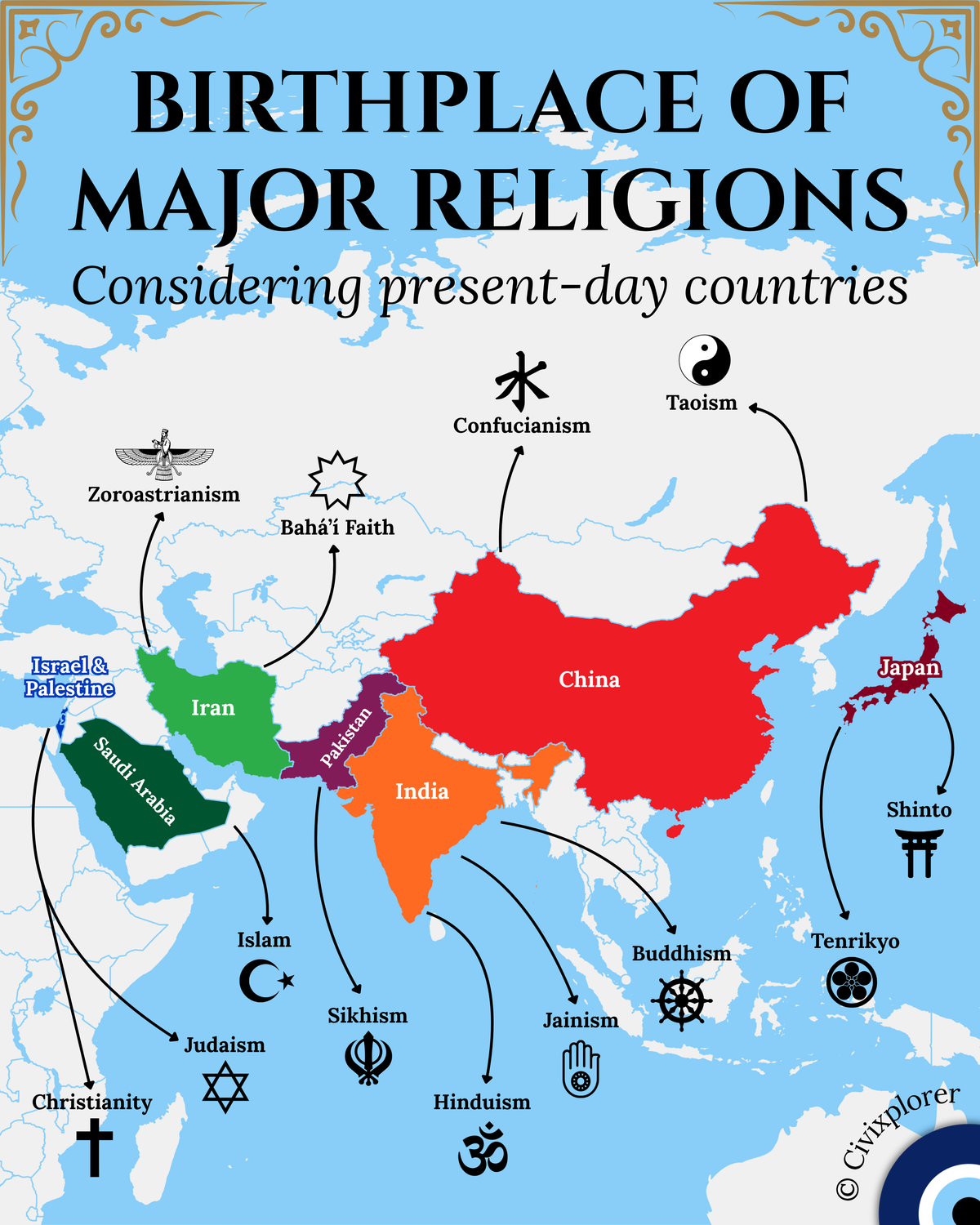
Mapping the geographical origins of the world's major belief systems reveals a striking pattern across human history. By retrofitting ancient spiritual hearths onto present-day political boundaries, we can see how twelve of the most influential religious and philosophical traditions emerged from a surprisingly concentrated band stretching across the Middle East, the Iranian plateau, South Asia, and East Asia. While contemporary national borders serve as useful modern reference points, these traditions originally developed within ancient cultural realms and interconnected empires thousands of years before today's nation-states existed.
The Near East stands as the cradle of the Abrahamic religions, where Judaism, Christianity, and Islam developed within a shared regional environment. In the southern Levant, ancient Israelite and Judean traditions evolved over centuries to form the foundation of Judaism. First-century Roman Judea and Galilee later became the birthland of Christianity, which began as a movement centered on Jesus of Nazareth before expanding across the Mediterranean world. Centered in the Hijaz region of western Arabia, Islam emerged in the seventh century through the revelations received by the Prophet Muhammad in Mecca and the establishment of the early community in Medina. Although these three traditions share monotheistic roots and scriptural connections, each developed its own distinct theological identity.
Further east, the Iranian cultural sphere gave birth to traditions separated by thousands of years of history. Zoroastrianism, one of the world's oldest surviving faiths, emerged in the ancient eastern Iranian world around the teachings of Zarathustra. In stark contrast, the Bahá'í Faith represents a nineteenth-century Iranian origin, beginning with the proclamation of the Báb in Shiraz and the foundational teachings of Bahá'u'lláh in Tehran, before its administrative center later developed in the Mediterranean.
The Indian subcontinent hosted an extraordinary intellectual flowering that produced four major world traditions. Hinduism developed over millennia through a complex synthesis of Vedic culture and regional practices without a single founder. During the Second Urbanization of the sixth and fifth centuries BCE, the Gangetic plain saw the rise of Buddhism and Jainism as independent philosophical movements. While Siddhartha Gautama was born in Lumbini in modern-day Nepal, his teachings and the institutional foundation of Buddhism took root in northern India. Millennia later, Sikhism was founded in the fifteenth century by Guru Nanak in the Punjab region, a historical territory that was later divided between modern India and Pakistan in 1947.
In East Asia, ancient China and Japan cultivated distinct ethical, philosophical, and localized spiritual systems. China produced Confucianism, focused on moral leadership and social harmony, alongside Daoism, centered on living in alignment with the natural order. In Japan, the indigenous veneration of nature and ancestral spirits evolved into Shinto, while the nineteenth century saw the founding of Tenrikyo, demonstrating that spiritual innovation continued into modern times. Ultimately, exploring these historical birthplaces reveals that while religions are born within specific ancient environments, their teachings inevitably travel, adapt, and transform across global human history.

Comments (0)
Join the Conversation
Login to share your thoughts with the community.
Login to Comment