
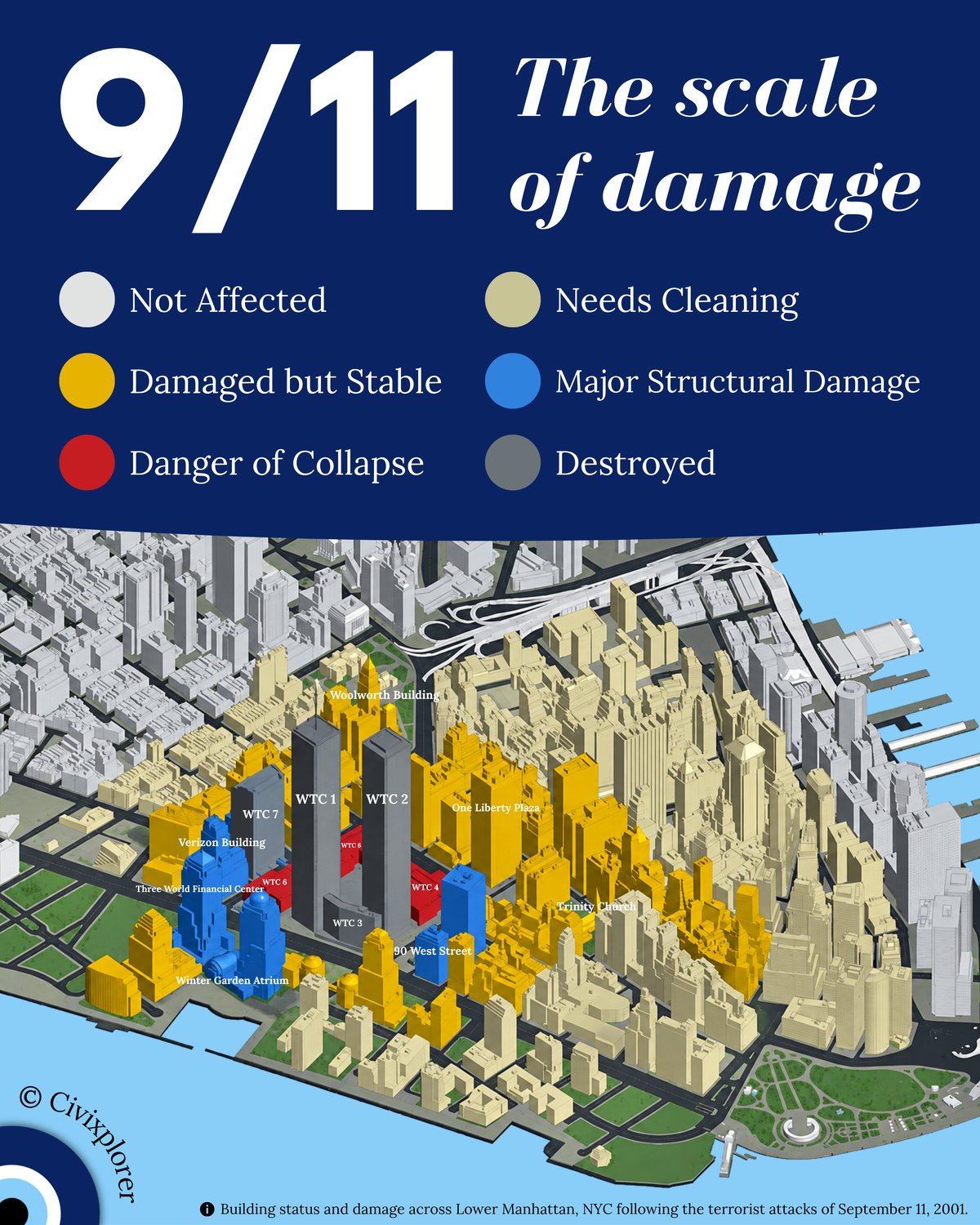
The physical impact of September 11, 2001 extended far beyond the World Trade Center towers, transforming several blocks of Lower Manhattan into an unprecedented urban disaster zone. While the collapses of WTC 1 (North Tower) and WTC 2 (South Tower) represented the central epicenter, thousands of tons of falling steel, concrete, and jet-fuel fires created a cascading wave of destruction across the surrounding Financial District. Adjacent structures in the immediate complex, including WTC 3, were overwhelmed and crushed by kinetic impact, while neighboring office towers suffered severe structural trauma and uncontrolled fires. Notably, WTC 7 collapsed hours later due to uncontrolled, fire-induced structural failure, becoming the first major steel-framed high-rise to fall primarily from fire without being directly struck by an aircraft.
Across the surrounding urban grid, an intriguing structural divide emerged based on building materials, age, and architectural engineering. Historic masonry structures, such as 90 West Street and the Verizon Building, demonstrated remarkable resilience because their heavy terra-cotta fireproofing and thick stone exteriors shielded their core frameworks from total collapse. Conversely, modern glass-and-steel designs were exceptionally vulnerable to kinetic impacts, as seen when falling debris obliterated the glass roof of the Winter Garden Atrium at the World Financial Center. This variance illustrated that while a building could appear catastrophically scarred on its exterior, superior structural shielding could preserve its stability.
Beyond immediate structural collapse, the disaster generated a far-reaching environmental fallout that reshaped Lower Manhattan. The mechanical pulverization of the towers released millions of tons of hazardous dust and pulverized concrete, creating a massive toxic plume that coated landmark buildings like Trinity Church and the Woolworth Building. This dense contamination extended well beyond the structural failure zone, requiring years of environmental remediation and complex restoration before the district fully recovered. Ultimately, the mapping of this disaster highlights the deep interdependence of modern city infrastructure, proving that catastrophic damage to central landmarks reverberates through an entire metropolitan ecosystem.

Comments (0)
Join the Conversation
Login to share your thoughts with the community.
Login to Comment