
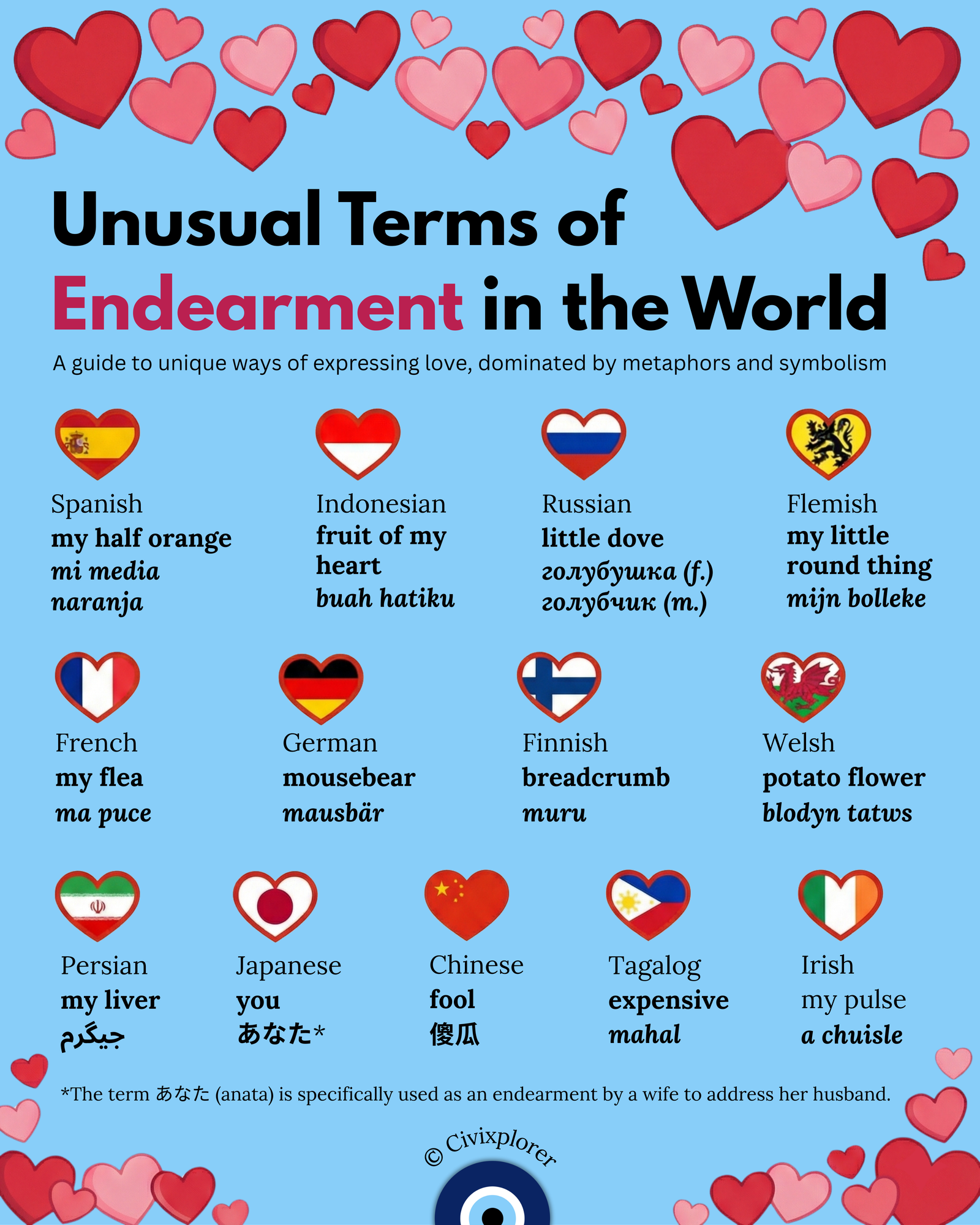
Language serves as a profound map of human intimacy, illustrating how various cultures conceptualize love through the lens of their daily lives, environments, and values. While English speakers often rely on sugary metaphors like "honey" or "sweetie," the rest of the world utilizes a diverse array of symbols—from vital organs and staple crops to tiny parasites—to express deep affection.
One of the most culturally significant metaphors is found in the Spanish phrase "mi media naranja," or "my half orange." This expression likely traces back to Plato’s Symposium, which describes a myth where humans were originally spherical creatures split in two by Zeus. The search for one's "other half" to become whole again is perfectly encapsulated by the orange, as no two halves fit together quite like the original pair.
In Persian culture, the seat of emotion is not the heart, but the liver. To call someone "jigeram" (my liver) is to describe them as your very life force. This visceral term is deeply romantic in Iranian culture, sometimes even escalating to playful expressions like "I want to eat your liver," which signifies an overwhelming "cuteness aggression" and profound closeness.
Linguistic efficiency also plays a role in how we value our partners. In Tagalog, the word "mahal" means both "love" and "expensive." This dual meaning emphasizes that a loved one is a treasure of immense value who cannot be easily replaced. Similarly, the Welsh "blodyn tatws" (potato flower) finds beauty in the essential. While the potato is a humble staple of the earth, its delicate flower represents finding hidden beauty in the resilient things that sustain life.
The animal kingdom provides endless inspiration for lovers as well. The French "ma puce" (my flea) may sound strange to outsiders, but it reflects a historical intimacy rooted in the grooming rituals of the past, or simply the idea of something small and precious. In Germany, the compound noun "mausbär" (mousebear) creates the ultimate partner: someone who possesses the small, cute qualities of a mouse and the warm, protective strength of a bear.
Even the simplest words can carry immense weight. In Japanese, "anata" is a plain version of "you," yet in the context of a traditional marriage, it is used as an intimate term of endearment. By avoiding direct names, the simplicity of the word carries a quiet, respectful affection. Whether you are a "little round thing" in Flemish or a "breadcrumb" in Finnish, these phrases prove that the most unique metaphors often make the warmest ones.
Comments (0)
Join the Conversation
Login to share your thoughts with the community.
Login to Comment