
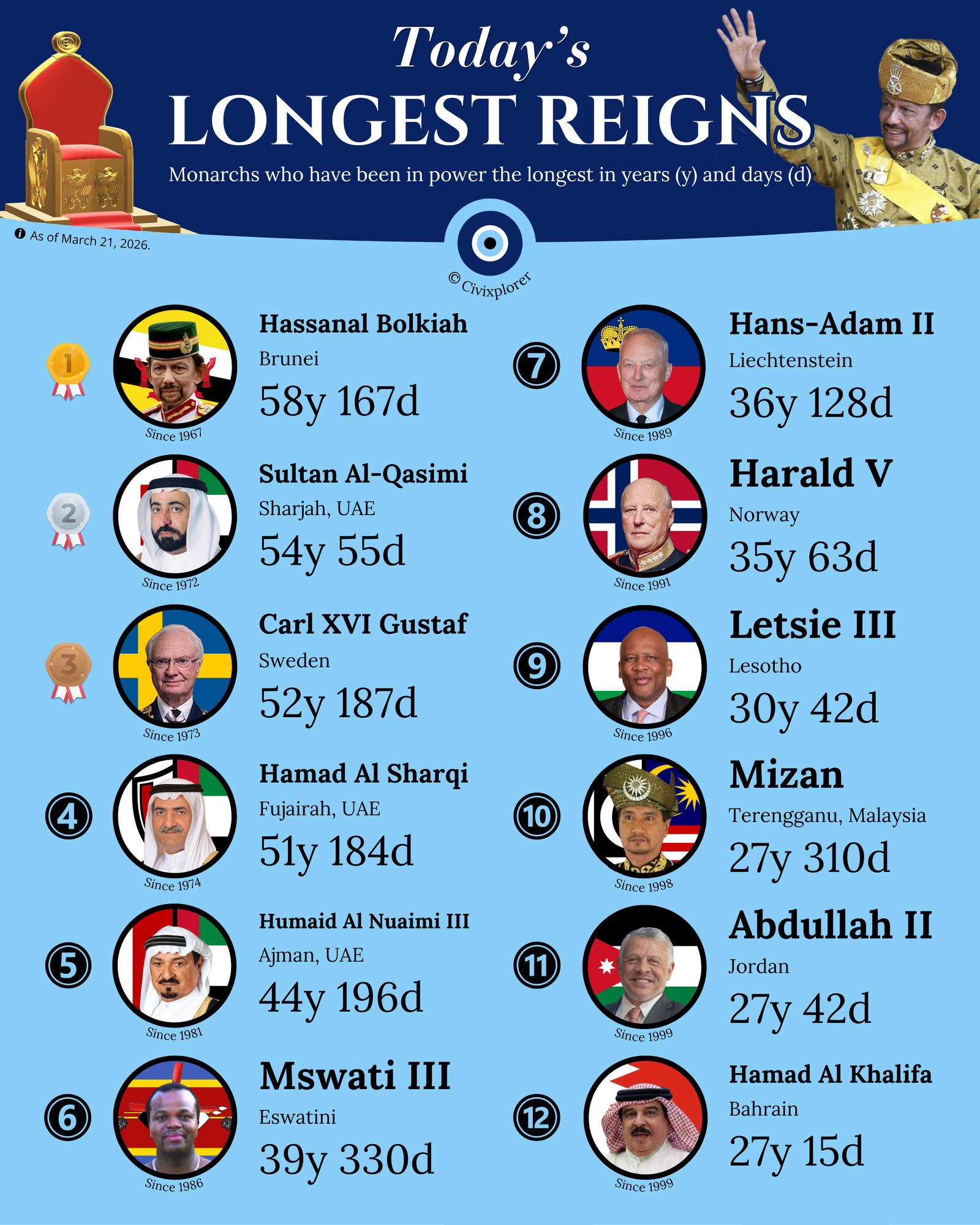
In an era defined by rapid political shifts and limited elected terms, the concept of hereditary continuity remains a powerful force in global governance. As of March 2026, the landscape of world royalty has shifted significantly following the departures of long-standing icons like Queen Elizabeth II and Queen Margrethe II. Today, a new tier of monarchs holds the mantle of longevity, representing a fascinating intersection of modern history, resource wealth, and deep-seated tradition.
At the pinnacle of this ranking stands Sultan Hassanal Bolkiah of Brunei. Taking the throne in 1967 at just 21 years old, his nearly six-decade reign has become the global benchmark for monarchical endurance. His absolute rule in oil-rich Brunei has not only funded massive national development but also sustained one of the most stable political systems in Southeast Asia, illustrating how petroleum resources can insulate a throne from the revolutionary pressures that have toppled others over the last century.
A unique aspect of the current data is the prominence of sub-national and constituent monarchs. The United Arab Emirates (UAE) features heavily, with the rulers of Sharjah, Fujairah, and Ajman all ranking among the world's longest-serving leaders. These emirs took power shortly after the UAE's formation in 1971, guiding their regions through the transition from the British-era Trucial States to becoming global hubs of trade and culture. Similarly, Malaysia’s federal system allows for state-level monarchs, like the Sultan of Terengganu, to maintain historical continuity within a modern federal framework.
In contrast to the absolute powers of the Gulf, Europe’s longest-reigning monarchs symbolize national identity rather than executive control. King Carl XVI Gustaf of Sweden (ruling since 1973) and King Harald V of Norway serve as ceremonial anchors in some of the world’s most stable democracies. Their longevity is often a result of an early age of accession and a cultural tradition where reigning until death is the standard expectation, though the 2024 abdication in Denmark shows this is slowly evolving.
Finally, the African continent is represented by King Mswati III of Eswatini, one of the world’s last remaining absolute monarchs. Having been crowned at just 18 in 1986, his high ranking is a direct result of his youthful start. Whether through diplomatic stability, vast natural resources, or deep cultural legitimacy, these leaders demonstrate that in specific corners of the globe, the crown remains a symbol of permanence in a rapidly changing world.
Comments (0)
Join the Conversation
Login to share your thoughts with the community.
Login to Comment