
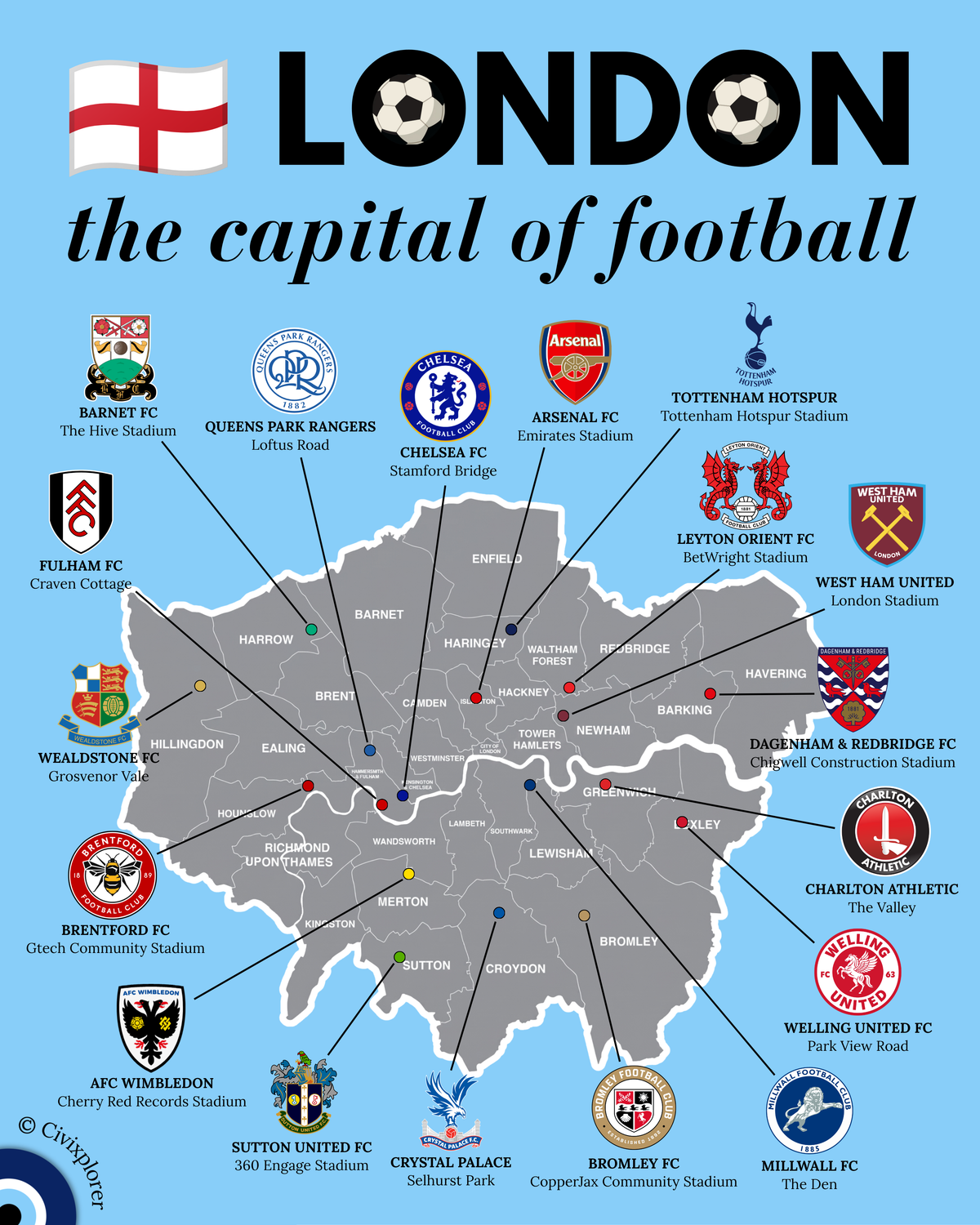
The sprawling urban landscape of Greater London is home to one of the densest and most historically rich football ecosystems on Earth. Across its thirty-two boroughs and the historic City of London, eighteen major clubs outline a sporting culture that was shaped not by a single central stadium, but by local workplaces, Victorian churches, and expanding neighborhood communities. From top-flight Premier League powerhouses like Arsenal, Chelsea, and Tottenham Hotspur to historic non-league strongholds like Wealdstone and Welling United, the spatial distribution of these teams directly reflects the social, industrial, and economic growth of the metropolis.
A closer examination of London's football geography reveals fascinating paradoxes between club identities and their physical stadium locations. Nearly half of the teams on the map operate inside boroughs different from what their historic names suggest. Chelsea FC, for example, plays at Stamford Bridge inside the Borough of Hammersmith & Fulham rather than Kensington and Chelsea, having been founded in 1905 specifically to occupy the ground after Fulham FC declined to move in. Similarly, Arsenal FC originated as an armaments factory team south of the River Thames in Woolwich before relocating north to Islington in 1913, igniting their fierce North London Derby with Tottenham Hotspur in Haringey. Millwall FC underwent a reverse cross-river migration, moving from its dockland origins on the Isle of Dogs south to Lewisham in 1910.
This spatial evolution also highlights a distinct geographical divide created by the River Thames, placing eleven clubs to the north and seven to the south. While northern and western teams historically benefited from early London Underground connections, southern clubs developed fiercely resilient followings around suburban rail corridors. The city's team badges preserve these diverse roots—from West Ham's shipyard riveting hammers and Fulham's church Sunday school origins to the fan-driven rebirth of AFC Wimbledon at Plough Lane. Coupled with London's historical role in drafting the original Laws of the Game at the Freemasons' Tavern in 1863, this interconnected network demonstrates why the capital stands as a global capital of football.

Comments (0)
Join the Conversation
Login to share your thoughts with the community.
Login to Comment