
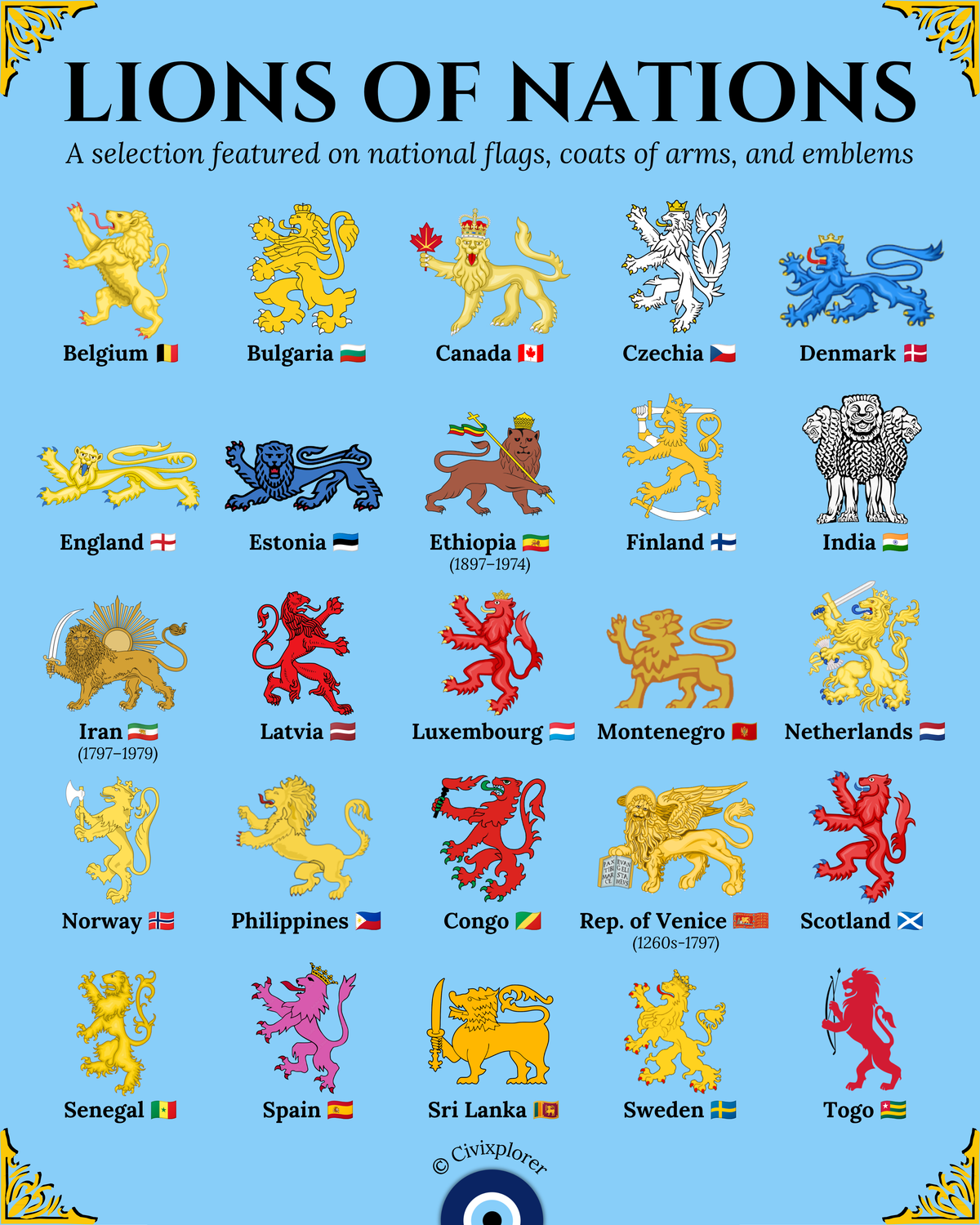
Across centuries of human history, the lion has served as a near-universal visual shorthand for courage, nobility, and sovereign power. Although many nations featuring the beast never possessed wild lion populations, medieval and early-modern elites adopted the "king of beasts" to project prestige and royal authority across geopolitical boundaries. This fascinating convergence created a global gallery where identical animal motifs encode vastly different origin stories, ranging from European chivalric courts to ancient Asian philosophies.
European heraldry represents the densest concentration of lion symbolism, where specific postures carried profound political meaning. In western and northern Europe, medieval ruling houses institutionalized beasts like the lion rampant in Scotland and Belgium, or the lion passant guardant famously associated with Richard the Lionheart's England. Certain emblems tell intricate territorial stories, such as Czechia's double-tailed lion of Bohemia or Norway's lion holding the gold-handled axe of Saint Olav. Intriguingly, symbols frequently crossed borders or survived major political shifts, as seen when Estonia inherited its three blue lions from medieval Danish conquests or when modern republics retained monarchical heraldry.
Beyond the borders of Europe, lion iconography branches into rich indigenous, religious, and political traditions. India’s state emblem derives from the 3rd-century BCE Lion Capital of Ashoka, depicting four Asiatic lions standing back-to-back to symbolize peace, courage, and Buddhist dharma rather than martial conquest. In Sri Lanka, the golden lion clutching a kastane sword roots national identity in ancient Sinhala royal heritage. Similarly, Ethiopia’s historic Lion of Judah anchored imperial legitimacy in biblical Solomonic lineage, while post-colonial African nations like Senegal, Togo, and the Republic of the Congo adopted lions to project independence, vigilance, and national defense.
Ultimately, the global proliferation of lion state emblems reveals how visual culture outlives specific regimes and dynasties. While emblems like Iran’s pre-revolutionary Lion and Sun or the winged Lion of Saint Mark of Venice represent vanished political orders, they remain powerful symbols of cultural memory and heritage. Whether repurposed through colonial inheritance like the sea lion of Manila or modified with local symbols like Canada's crest lion holding a maple leaf, these emblems demonstrate that while the lion remains a constant, its political meaning shifts dramatically across global history.

Comments (0)
Join the Conversation
Login to share your thoughts with the community.
Login to Comment