
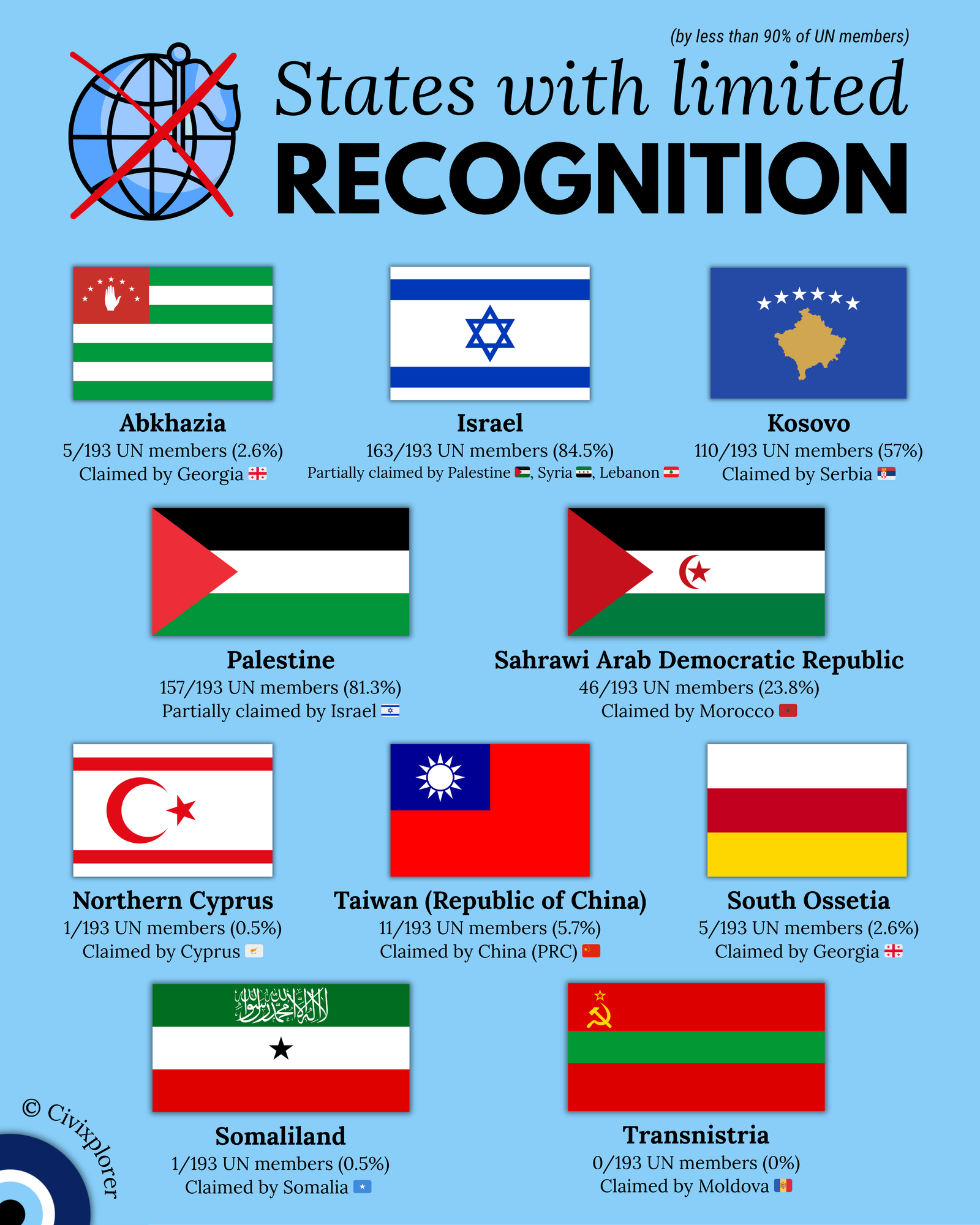
The world map is often presented as a collection of clearly defined borders and undisputed nations. However, the reality of international relations is far more complex. Formal diplomatic recognition is not always a reflection of a government's ability to control its territory or provide for its citizens; rather, it is a geopolitical tool wielded through alliances, historical grievances, and strategic power plays.
A state with limited recognition is a political entity that operates de facto as a sovereign nation—often with its own military, currency, and government—but lacks widespread acceptance from the United Nations' 193 member states. This status creates severe practical hurdles, from restricted global trade to the inability of its citizens to travel with recognized passports.
The Heavyweights: Israel and Palestine
Perhaps the most striking inclusion in this category are Israel and Palestine, two entities at the heart of one of the world's most enduring conflicts. Israel, a full UN member with a powerhouse economy, is recognized by 163 members (84.5%). Its lack of universal recognition stems from a bloc of Arab and Muslim-majority nations, a number that has shifted recently due to diplomatic severances following intense regional conflicts between 2023 and 2025.
Conversely, Palestine has seen a surge in international support, now recognized by 157 members (81.3%). This surge, particularly from European nations like Spain, Norway, and Ireland, reflects a global push toward a two-state solution. While widely accepted in the Global South, Palestine still faces major hurdles from the United States and a core group of Western powers.
Geopolitical Battlegrounds: Taiwan and Kosovo
The cases of Taiwan and Kosovo demonstrate how major global powers can suppress official statehood. Taiwan (Republic of China) is a vibrant democracy and high-tech leader, yet it is recognized by only 11 UN members. This is the direct result of the "One China" policy, where Beijing forces a binary choice: a nation cannot have official ties with both China and Taiwan.
Kosovo, which declared independence from Serbia in 2008, is recognized by 110 nations (57%), including most of the West. However, it remains locked out of the UN because Russia and China use their veto power on the Security Council to support Serbia’s territorial claims.
The "One-Recognizer" Outliers: Somaliland and Northern Cyprus
Two of the most intriguing cases involve entities recognized by only a single UN member. Somaliland had zero recognition for decades despite its internal stability. This changed dramatically on December 26, 2025, when Israel became the first UN member to officially recognize its sovereignty, driven by strategic maritime interests in the Horn of Africa.
In contrast, the Turkish Republic of Northern Cyprus remains recognized only by Türkiye. Following the 1974 intervention, the international community largely views the north as occupied territory of the Republic of Cyprus, leaving the region diplomatically isolated for half a century.
The Post-Soviet Frozen Conflicts
The collapse of the Soviet Union left a trail of "frozen conflicts" in its wake. Abkhazia and South Ossetia (both 5/193) broke away from Georgia and are recognized primarily by Russia and its close allies like Nicaragua and Venezuela. Even more isolated is Transnistria (0/193), a strip of land in Moldova that maintains its own Soviet-style administration but lacks recognition from a single UN member—not even Russia, upon which it relies for survival.
The Legacy of Decolonization: Western Sahara
Finally, the Sahrawi Arab Democratic Republic (SADR) represents the lingering disputes of the decolonization era. While it is a full member of the African Union, its recognition among UN members has shrunk to 46 (23.8%) as Morocco utilizes "checkbook diplomacy" to assert its own claim over the territory.
Ultimately, these diplomatic ghosts prove that sovereignty is fragile. In the theater of global politics, recognition is often used as both a shield and a weapon, leaving millions of people living in states that exist on the ground but remain invisible on the official world stage.
| State | UN Members Recognition | Percentage of UN Members | Primary Claimant State(s) |
|---|---|---|---|
| Abkhazia | 5 / 193 | 2.6% | Georgia |
| Israel | 163 / 193 | 84.5% | Palestine, Syria, Lebanon |
| Kosovo | 110 / 193 | 57% | Serbia |
| Northern Cyprus | 1 / 193 | 0.5% | Cyprus |
| Palestine | 157 / 193 | 81.3% | Israel |
| Sahrawi Arab Democratic Republic | 46 / 193 | 23.8% | Morocco |
| Somaliland | 1 / 193 | 0.5% | Somalia |
| South Ossetia | 5 / 193 | 2.6% | Georgia |
| Taiwan (Republic of China) | 11 / 193 | 5.7% | China (PRC) |
| Transnistria | 0 / 193 | 0% | Moldova |

Comments (0)
Join the Conversation
Login to share your thoughts with the community.
Login to Comment