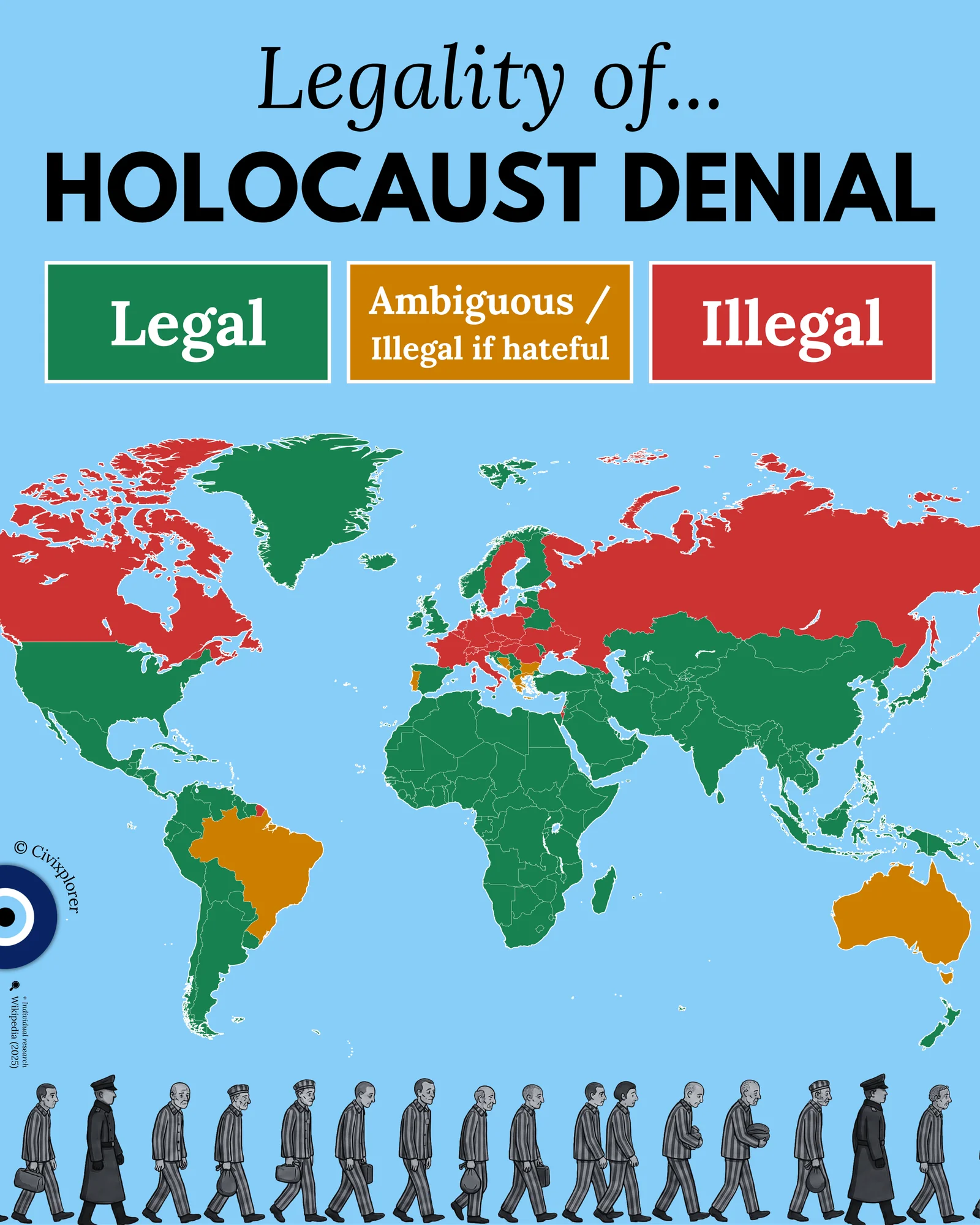
The Holocaust remains one of the most documented genocides in human history, involving the systematic murder of approximately six million Jews and millions of others by the Nazi regime between 1941 and 1945. Today, the legal landscape surrounding the denial of these facts reveals a global divide between the protection of "absolute free speech" and the prevention of hate speech and social harm.
As seen on the map, much of Europe, including Germany, Austria, France, and Poland, has strict laws criminalizing Holocaust denial. These nations often employ a "defensive democracy" framework, viewing the denial of historical atrocities as an active attempt to incite violence and rehabilitate dangerous ideologies. In 2022, Canada joined this group by amending its Criminal Code to outlaw the promotion of antisemitism through the denial or minimization of the Holocaust.
In contrast, the United States protects such speech under the First Amendment, holding that the government cannot ban expression simply because it is offensive or factually incorrect. Meanwhile, Australia maintains an ambiguous middle ground, where denial is generally illegal only if it is used to publicly humiliate or intimidate specific groups. In much of the Global South and parts of Asia, Holocaust denial remains legal, often reflecting a lack of specific legislation regarding European history or a focus on internal histories of colonialism and local conflicts rather than World War II.
Comments (0)
Join the Conversation
Login to share your thoughts with the community.
Login to Comment