
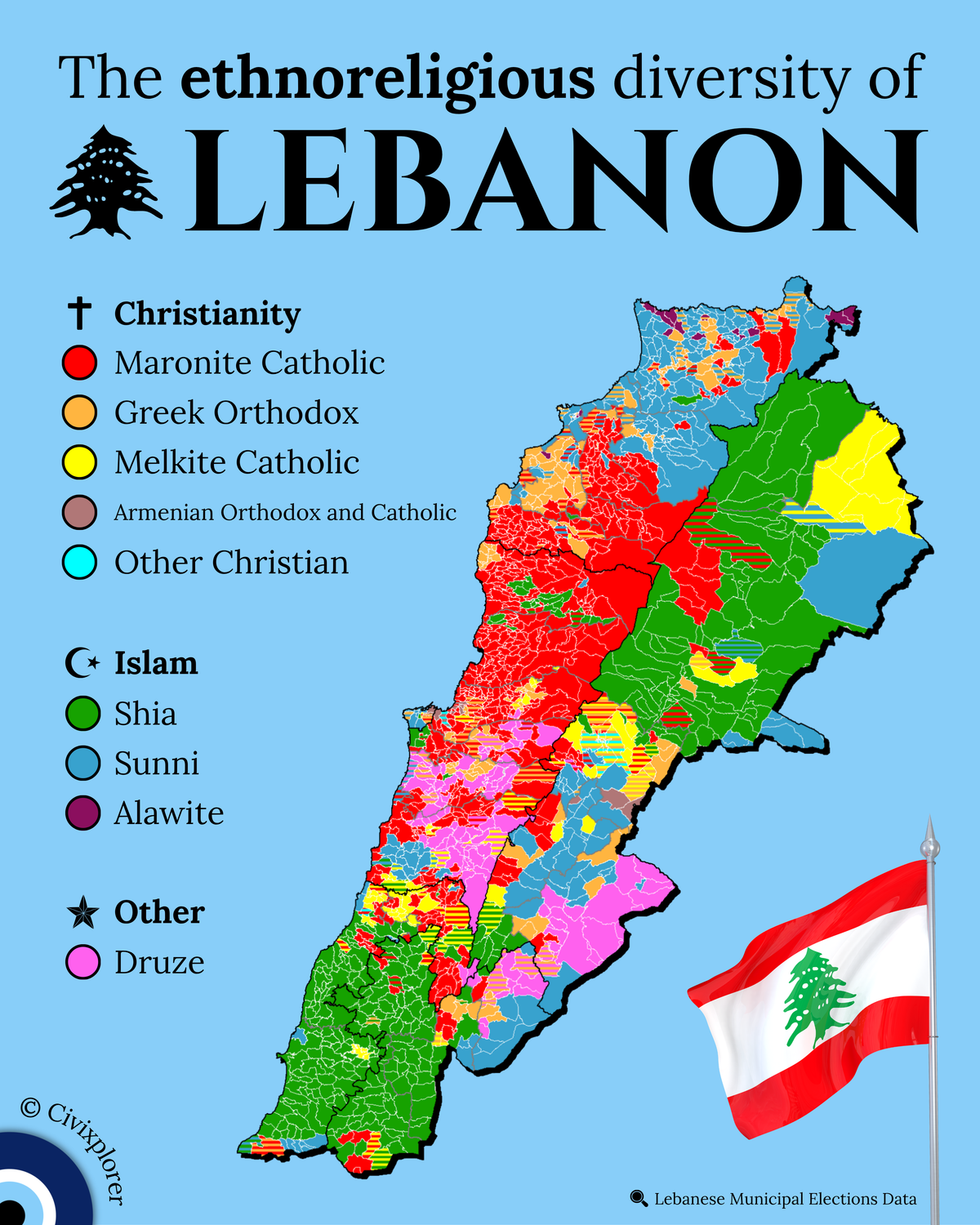
Lebanon stands as a fascinating, data-driven paradox: a small nation that functions as a high-granular sectarian mosaic. This map, based on Lebanese Municipal Elections Data, visualizes the country's extraordinary diversity at a municipal level, where each administrative unit is colored according to its dominant religious sect. Understanding this map requires looking past the colors and into the geographical, historical, and political factors that have carved these borders over centuries.
The "Census Taboo" and Data Sources
One of the most critical aspects of understanding Lebanese demographics is the lack of an official national census since 1932. Because the political power-sharing system, known as Confessionalism, is built upon the demographic balance between Christians and Muslims, an updated census is considered a "taboo" that could destabilize the nation’s political consensus. Consequently, this map relies on municipal election results, which serve as a reliable proxy for local sectarian composition because Lebanese citizens vote in their ancestral hometowns rather than where they currently reside.
The Mountain Refuge Hypothesis
The striking distribution of sects is largely a product of Lebanon's rugged topography. The Mount Lebanon range, running parallel to the coast, historically served as a natural fortress and sanctuary for persecuted minority groups. While dominant regional empires were often Sunni Muslim, the inaccessible terrain allowed groups like the Maronite Christians and the Druze to maintain their distinct religious identities and feudal autonomy for centuries. This explains why the mountainous core of the map remains heavily dominated by red (Maronite) and pink (Druze) clusters.
A Breakdown of the Sects
Lebanon officially recognizes 18 religious sects, making it the most ethnoreligiously diverse country in the Arab world.
- Christianity (~30–35% of citizens): The Maronite Catholics (red) form the historic core in central and northern Mount Lebanon. The Greek Orthodox (orange) have a significant presence in northern districts like Koura and parts of Beirut. Other groups include the Melkite Catholics (yellow), concentrated around Zahle, and Armenians (brown), who primarily arrived as refugees following the 1915 Genocide.
- Islam (~65–70%): The Shia (green) are the largest single sect, predominantly located in South Lebanon and the northern Beqaa Valley. The Sunnis (blue) are heavily concentrated in coastal urban centers like Tripoli, Sidon, and parts of Beirut. The Alawites (purple) maintain a small but significant presence in the north near the Syrian border.
- The Druze: This distinct monotheistic group (pink) is concentrated in the Chouf Mountains and southern areas like Hasbaya, maintaining a unique and highly guarded faith that emerged in the 11th century.
The Political Reality: Confessionalism
This geographical distribution is the foundation of Lebanon's government. Under the Taif Agreement, political power is divided along sectarian lines: the President must be a Maronite, the Prime Minister a Sunni, and the Speaker of Parliament a Shia. While this system preserves the 18 recognized sects, it also creates profound challenges, often leading to political paralysis and gridlock as each group holds significant influence over national decisions.
In summary, Lebanon’s map is a living, intricate mosaic. It captures a small country whose geography created safe havens for diverse groups, creating a unique identity that remains both a source of cultural pride and a test for national cohesion.

Comments (0)
Join the Conversation
Login to share your thoughts with the community.
Login to Comment