
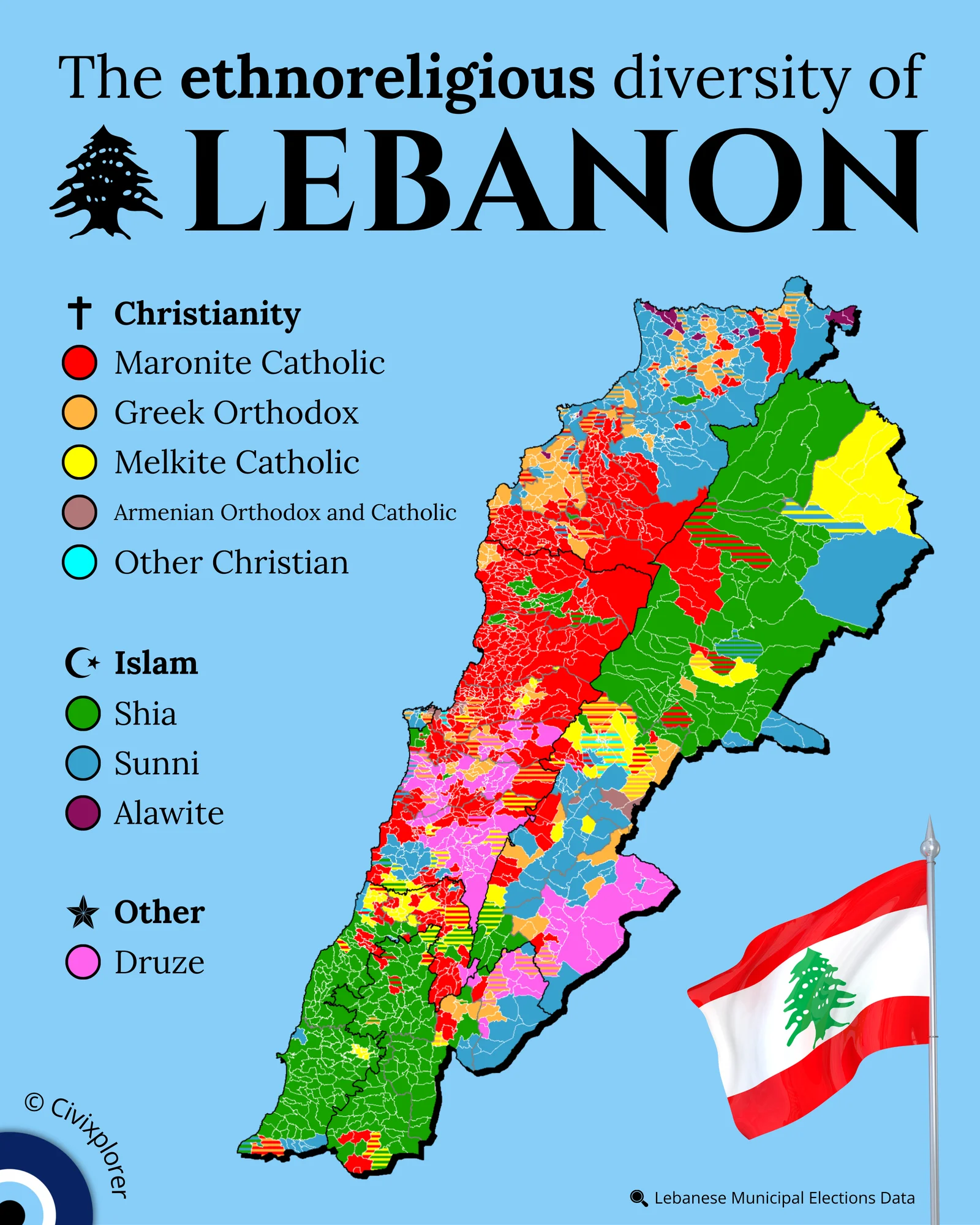
Lebanon is widely recognized as the most religiously diverse country in the Middle East, officially recognizing 18 different religious sects. This diversity is not a modern phenomenon but the result of centuries of imperial influence, migration, and its unique role as a refuge for persecuted groups. Nestled at the crossroads of the Mediterranean, the country has become a historical melting pot where Christianity and Islam have coexisted for generations.
The distribution of these groups today is largely dictated by the "National Pact" of 1943. This unique confessional system of government ensures political power is shared among the major groups: the President must be a Maronite Christian, the Prime Minister a Sunni Muslim, and the Speaker of Parliament a Shia Muslim. Because political power is tied directly to the size of each sect, demographics remain a sensitive issue; in fact, there has not been an official census in the country since 1932. While that census showed a Christian majority, modern estimates using municipal election data suggest the combined Muslim population is now larger.
Geographically, these groups are often clustered due to Lebanon's mountainous terrain, which historically provided protection for minorities. Maronite Catholics are predominantly found in Mount Lebanon and the northern coast, while Shia Muslims are concentrated in the South and the Beqaa Valley. Sunni Muslims primarily inhabit major coastal cities like Beirut and Tripoli, and the Druze community is found mostly in the Chouf Mountains.
The resulting map looks like a complex mosaic. Areas with "striped" or patchwork patterns indicate regions where no single group holds an absolute majority, reflecting a history of deep cultural synthesis alongside periods of intense sectarian conflict, such as the Lebanese Civil War. Today, maintaining this delicate balance is central to Lebanese politics, as every major policy must be negotiated across these diverse communities.
Comments (0)
Join the Conversation
Login to share your thoughts with the community.
Login to Comment