
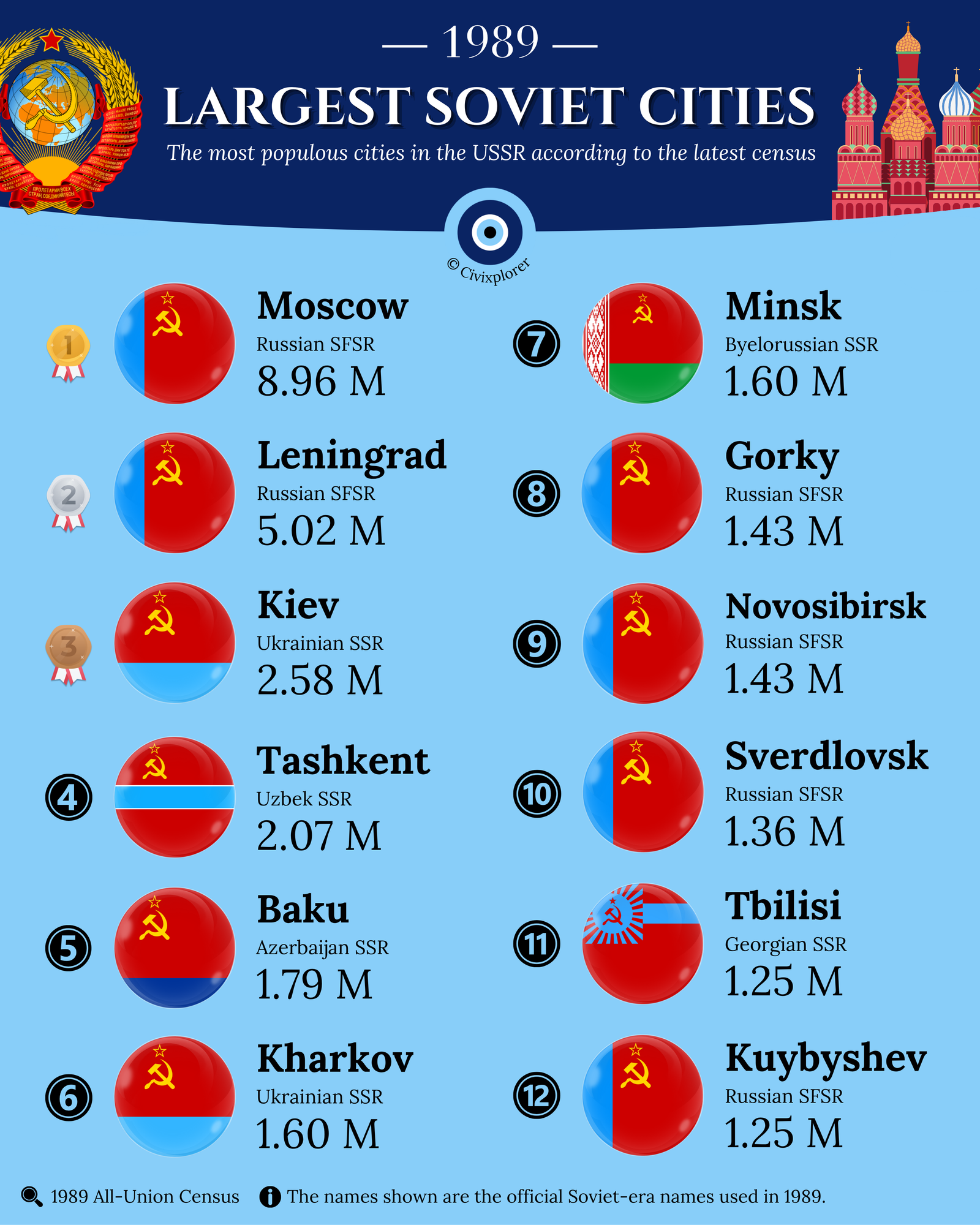
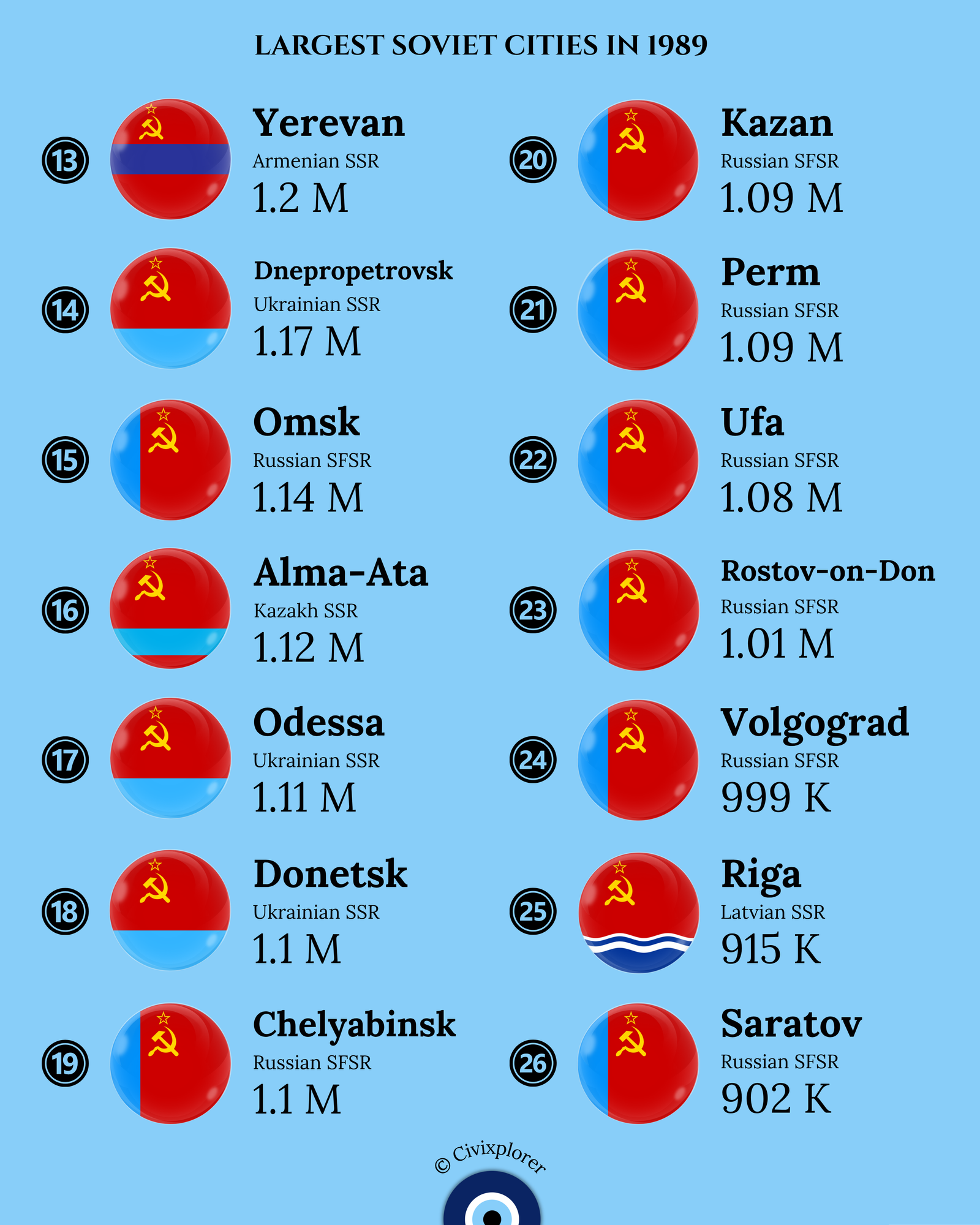
The 1989 All-Union Census captures a unique demographic snapshot of the Soviet Union just two years before its ultimate dissolution. At this moment, the USSR was the third-most populous country in the world, with a population that was 66% urban. This data represents the absolute peak of Soviet state-planned demographics and aggressive industrialization.
The ranking is dominated by the Slavic Core, with the majority of the largest cities concentrated in the Russian SFSR and the Ukrainian SSR. Moscow and Leningrad (now St. Petersburg) acted as the undisputed political and cultural hearts of the empire, with Moscow nearing 9 million inhabitants. In Ukraine, cities like Kiev, Kharkov, and Donetsk surged as the industrial and agricultural engines of the union.
A striking pattern in this data is the strategic growth of republic capitals. The Soviet government deliberately developed cities like Minsk, Baku, and Tbilisi into centralized administrative hubs to project a modern image. Tashkent stands out as a remarkable outlier in fourth place. Following a devastating earthquake in 1966, a union-wide reconstruction effort transformed it into a Central Asian showcase, drawing workers and planners from across the USSR.
Many of these urban giants were industrial behemoths born from Stalin-era five-year plans or wartime relocations. During World War II, factories were moved eastward to the Ural Mountains and Volga River, fueling the explosive growth of cities like Sverdlovsk (Yekaterinburg) and Chelyabinsk. The nomenclature of the time also reflected political ideology, with historical names replaced to honor communist figures—most of which were reverted after 1991.
Ultimately, these figures represent a frozen moment in time. While Moscow continued to grow after the collapse, many of these industrial hubs faced significant population declines in the 1990s due to economic shifts and emigration. This list is not just a ranking, but a portrait of a deliberately engineered empire at the very moment it began to unravel.
Comments (0)
Join the Conversation
Login to share your thoughts with the community.
Login to Comment