
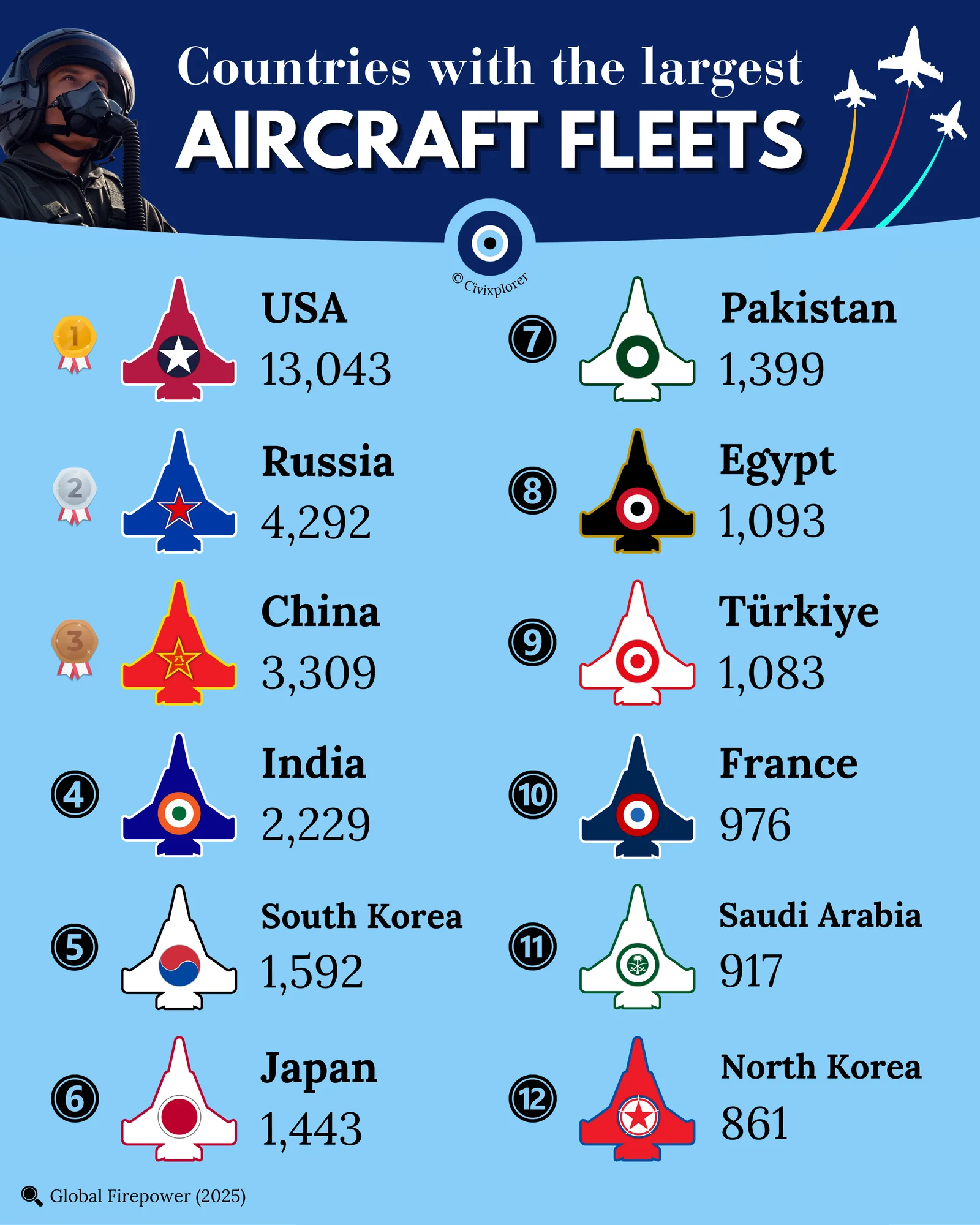
The landscape of global aerial reach in 2025 is defined by a staggering disparity in numbers and technological capabilities. While total military aircraft figures include everything from advanced stealth fighters and heavy bombers to transport planes and trainers, these numbers serve as a primary indicator of a nation's ability to project power and defend its borders.
The most significant takeaway from recent data is the overwhelming scale of the United States' fleet. With over 13,000 aircraft, the U.S. maintains more military planes than the next five nations combined, including Russia, China, India, South Korea, and Japan. This "hyper-power" status is driven not just by raw quantity, but by specialized "force multipliers." The U.S. is uniquely equipped with a massive fleet of tankers for mid-air refueling and heavy-lift transports, allowing it to operate globally while most other nations remain regional players.
In the race for the second and third positions, we see a contrast between an aging giant and a rising challenger. Russia continues to maintain high numbers, but its fleet faces immense pressure due to its ongoing regional conflicts and the strain of international sanctions on equipment maintenance. Conversely, China is focused on rapid modernization. Rather than focusing solely on volume, Beijing is phasing out older Soviet-style airframes in favor of domestically produced 5th-generation stealth fighters like the J-20, aiming for technological parity with the U.S. in the Pacific.
Regional tensions also dictate the rankings for several other nations. The high positions of India and Pakistan are a direct result of their long-standing border rivalry, with both nations investing heavily to maintain a deterrence balance. Similarly, the divide between South and North Korea presents a classic case of quality versus quantity. While North Korea maintains a significant number of aircraft, many are obsolete designs from the mid-20th century. South Korea, despite a smaller total, operates a vastly more advanced fleet featuring modern stealth technology.
Interestingly, many major European powers appear "missing" from the top of the individual list. This is a strategic choice within the NATO framework, where European nations share the burden of air defense. While individual numbers for countries like Germany or the UK may be lower, the combined air power of the European bloc remains a formidable force, prioritizing high-tech precision over sheer volume.
Comments (0)
Join the Conversation
Login to share your thoughts with the community.
Login to Comment