
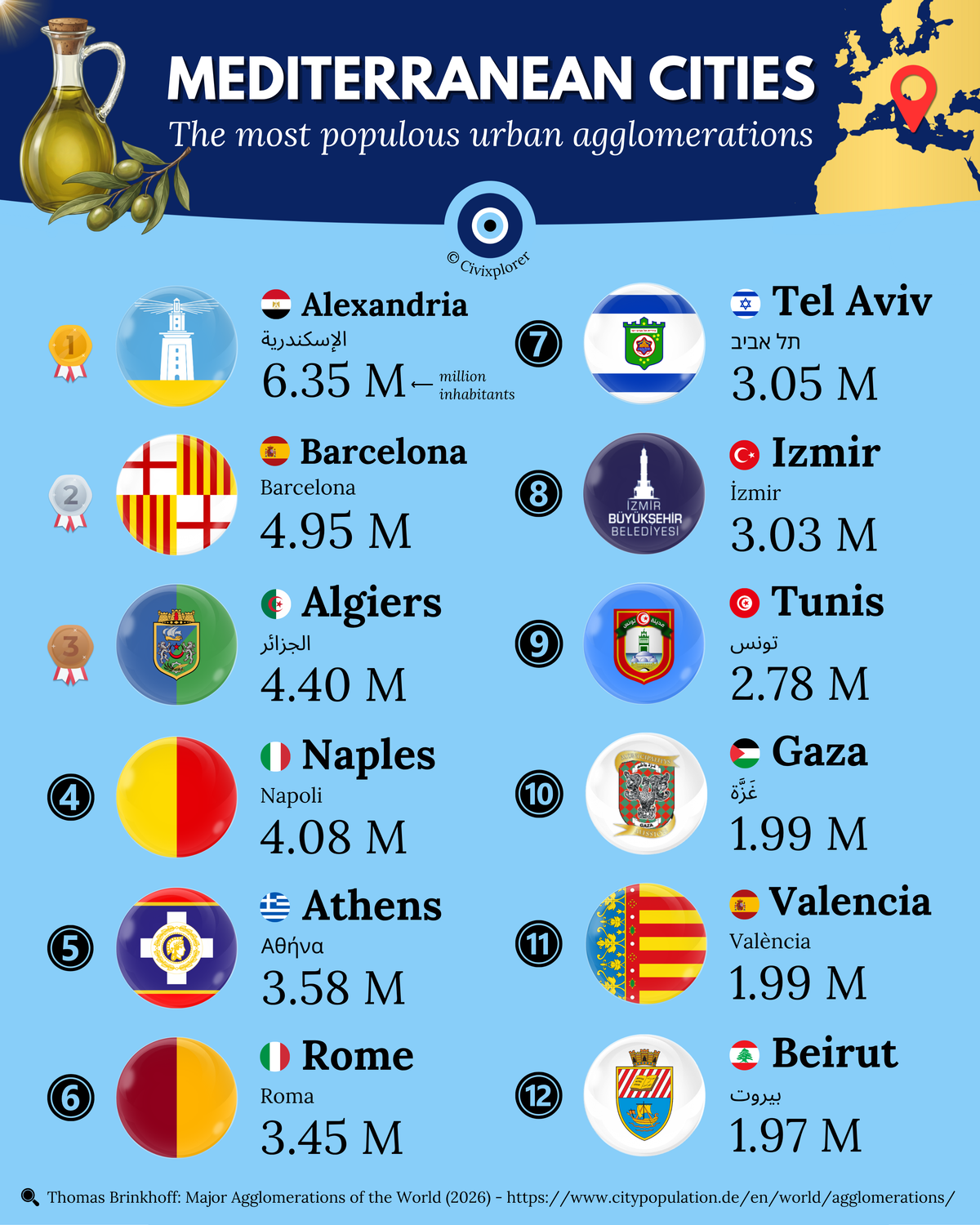
The Mediterranean basin has long been the world’s most interconnected urban system, serving as a maritime highway that links Europe, North Africa, and the Levant. Today, this historic region is defined by a continuous chain of coastal metropolitan regions where population density is shaped by geography, trade, and demographic shifts.
To truly understand the modern Mediterranean, we must look at urban agglomerations rather than strict municipal borders. While a "city proper" is defined by invisible political lines, an urban agglomeration measures the continuous, built-up urban footprint. This methodology reveals the true economic and demographic gravity of these coastal giants, favoring metropolitan areas that have absorbed surrounding suburbs into a single, sprawling continuum.
The Great North-South Demographic Divide
The most significant trend within this ranking is the contrast between the aging Global North and the youthful Global South. European hubs like Barcelona (#2), Naples (#4), and Rome (#6) belong to nations experiencing demographic stagnation. Their high rankings are maintained primarily through historical density and international immigration.
In contrast, the MENA region (Middle East and North Africa) is experiencing explosive growth. Cities such as Alexandria (#1), Algiers (#3), and Tunis (#9) are products of high fertility rates and rapid rural-to-urban migration. These "primate cities" often concentrate a massive percentage of their national population and industrial power within a single coastal corridor.
Investigating the Standouts
1. The Supremacy of Alexandria (6.35 M): Anchored in the Nile Delta, Alexandria remains Egypt’s primary Mediterranean-facing hub. Its massive population is a result of hyper-concentration along the limited habitable land of the Delta, functioning as a vital industrial and commercial valve for a nation of over 110 million people.
2. The European Magnet: Barcelona (4.95 M): While the municipality of Barcelona is geographically constrained by the sea and mountains, its economic gravity has fused it with surrounding cities like Badalona and Sabadell. It remains a powerful Mediterranean economic axis, sustained by its status as a global cultural and financial powerhouse.
3. The Italian Paradox: Naples (4.08 M) vs. Rome (3.45 M): Interestingly, the Naples agglomeration ranks higher than Rome. While Rome has a larger municipal population, its borders include empty agricultural land. Naples, squeezed between the sea and Mount Vesuvius, has developed into a hyper-dense, continuous sprawl that represents a larger unbroken concrete footprint than the capital.
4. Forced Agglomeration in Gaza (1.99 M): The inclusion of Gaza at #10 highlights a unique case of geographic confinement. Due to strictly enforced territorial borders and high fertility rates, multiple municipalities have bled into one another, creating an urban environment of extreme density out of sheer necessity.
5. The "Gush Dan" of Tel Aviv (3.05 M): Tel Aviv is the undisputed technological engine of the Levant. Its ranking reflects the polycentric sprawl known as Gush Dan, where adjacent cities have merged into a modern, high-density metropolitan system built on service and tech industries.
A Shared Cultural Mosaic
Despite the linguistic and religious diversity of these twelve cities, they are bound by the Mediterranean Sea as a structuring force. From the ancient foundations of Athens and Izmir to the resilient coastal identity of Beirut, these megacities share a climate and a maritime history that continues to drive global trade and migration. The enduring presence of symbols like olive oil and the Nazar (evil eye) across these shores serves as a reminder that the Mediterranean remains a unified cultural ecosystem, even as its urban centers reach unprecedented scales.

Comments (0)
Join the Conversation
Login to share your thoughts with the community.
Login to Comment