
Since the last ice age, the Earth has lost nearly 20 million km² of forest cover, with half of that loss occurring since 1900 due to expanding agriculture and industrialization. Today, forests cover approximately 30% of our land—roughly 40 million km²—distributed unevenly across the planet based on climate, ecology, and human choices.
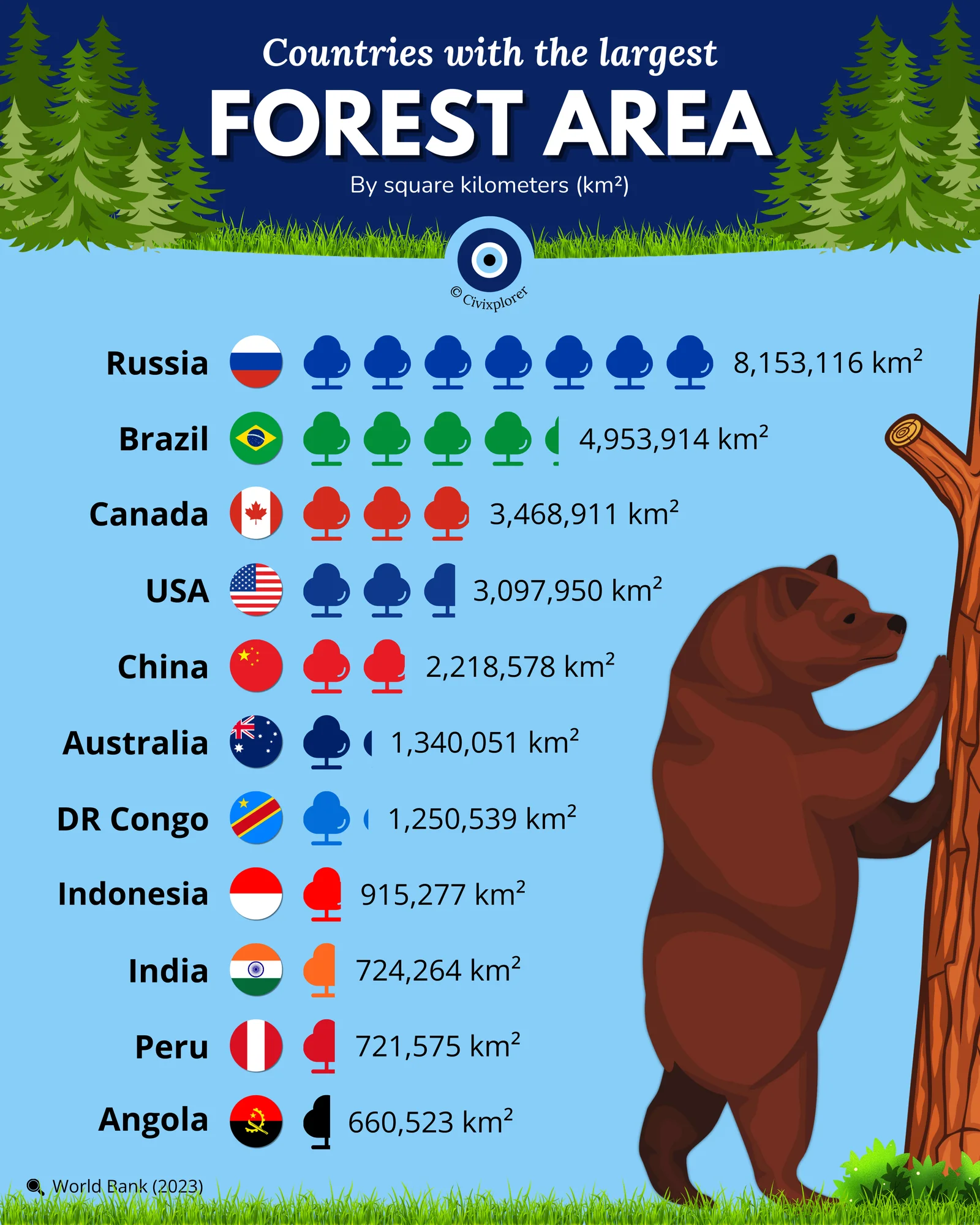
The global distribution of this greenery is dominated by the "Big Five": Russia, Brazil, Canada, USA, and China. Together, these five nations hold more than half of the world's total forest area. Russia is the clear frontrunner with over 8.1 million km², largely thanks to the Siberian Taiga, a massive carbon sink that remains thinly settled.
Forest types vary significantly by latitude. Northern giants like Russia and Canada are defined by vast Boreal forests, while nations like Brazil, DR Congo, and Indonesia serve as "tropical titans". Brazil, home to the largest share of the Amazon, is the world's primary hub for biodiversity, supporting a high density of species per square kilometer.
Interestingly, the rankings aren't solely determined by natural landmass. China has utilized aggressive reforestation programs, such as the "Great Green Wall," to combat desertification and increase its cover to over 2.2 million km². India similarly maintains a high rank through strict conservation laws and community-led initiatives despite its high population density.
Ultimately, the health of our global climate is disproportionately tied to the domestic policies of these few governments. Whether it is managing wildfires in the Taiga or logging in the Amazon, these nations steward the resources that balance the global carbon cycle.
Comments (0)
Join the Conversation
Login to share your thoughts with the community.
Login to Comment