
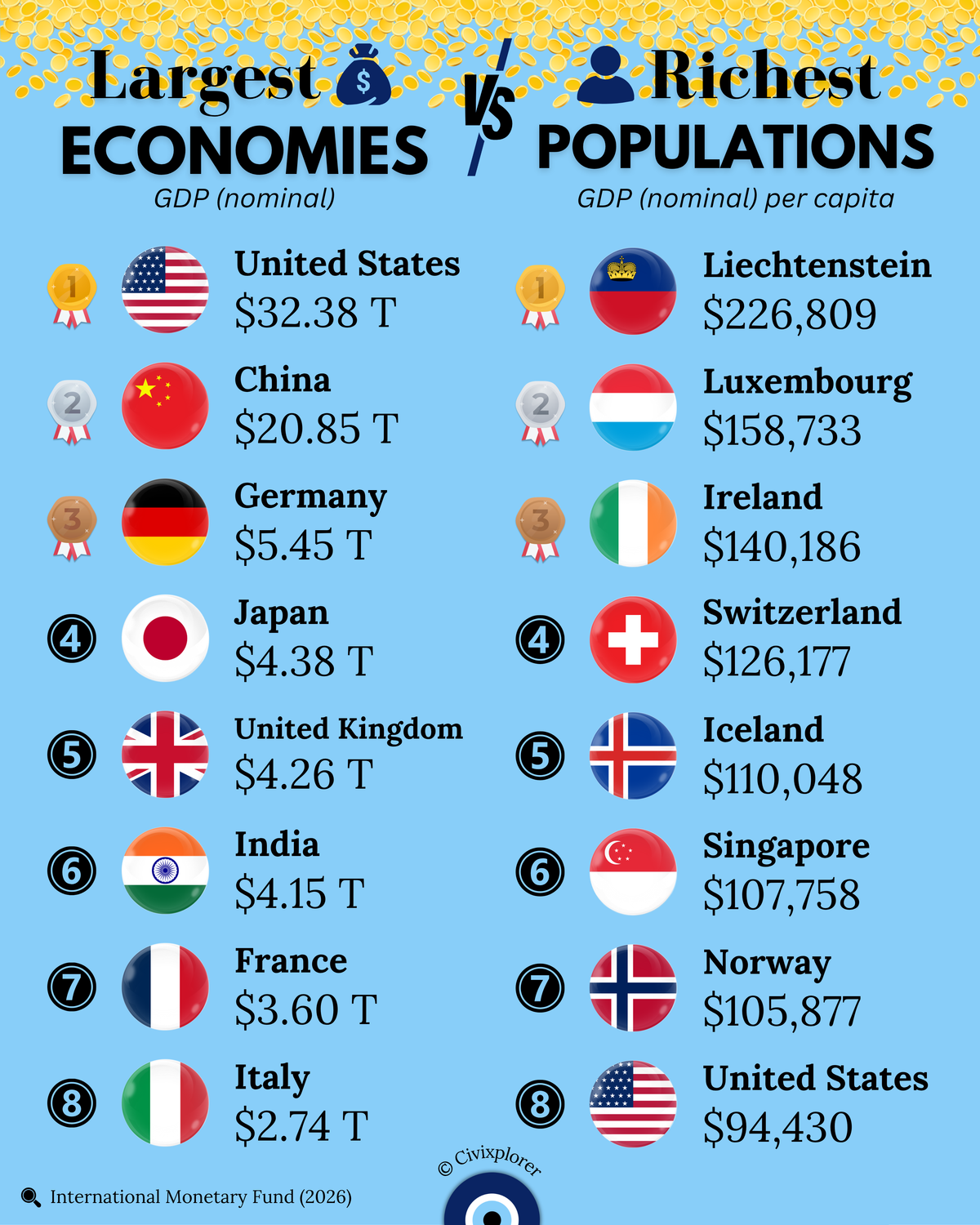
The global economic landscape is often viewed through two distinct lenses: the total power of a nation and the average prosperity of its people. Understanding the difference between Nominal GDP and Nominal GDP per capita is essential for grasping how wealth is generated and distributed across the globe. While the former measures the total market value of all goods and services produced within a country, the latter divides that output by the resident population, serving as a proxy for the average living standard.
The Giants of Scale: Total Economic Power
At the top of the total GDP rankings, we find the demographic and industrial heavyweights. The United States remains the world’s largest economy, projected at over $32 trillion. It represents a unique "American Exception," as it is the only nation to appear in the top eight of both total size and per capita wealth. This dominance is driven by a combination of high productivity, global currency hegemony, and a massive, self-sufficient domestic market.
China and India also hold prominent positions due to their sheer scale. With populations exceeding 1.4 billion people each, their total economic output is massive. However, when that wealth is distributed across their billions of citizens, they transition into middle-income nations that do not yet appear on the "richest" list. Germany presents a remarkable case, ranking as the third-largest economy despite having a significantly smaller population than the US or China, thanks to its world-leading engineering and high-value exports.
The Wealthy Microstates: Quality Over Quantity
When we shift the focus to GDP per capita, the map changes entirely. The list is dominated by small European nations and specialized financial hubs. Liechtenstein and Luxembourg take the lead, but these figures require context. In both cases, the numbers are "artificially" inflated by cross-border commuters. These workers contribute to the GDP (the numerator) but are not residents (the denominator), resulting in staggering per capita figures that don't always reflect the average household income.
The Distortion of "Leprechaun Economics"
Ireland currently ranks as one of the richest populations globally, yet economists often warn against taking its GDP at face value. This phenomenon, sometimes called "Leprechaun Economics," is driven by Ireland’s status as a corporate tax haven. Massive multinational corporations domicile their intellectual property and book global profits there, causing the GDP to skyrocket without necessarily increasing the material living standards of the average Irish resident.
Resource Wealth and the Nordic Advantage
Nations like Norway and Iceland demonstrate how small populations combined with vast natural resources can create immense per-person output. Norway’s wealth is anchored by its petroleum sector, which is managed through the world’s largest sovereign wealth fund to ensure long-term stability. Similarly, Iceland leverages abundant geothermal energy to power energy-intensive industries and high-value tourism.
Beyond the Numbers
While these rankings are indispensable for economic analysis, they do not tell the whole story. Neither metric directly measures income inequality, health, or overall well-being. A country can be an economic powerhouse on paper while its citizens face high costs of living or wealth gaps. To truly understand the "eye of the world," one must look at how these economic forces interact with geography, policy, and population dynamics to shape the reality of human life.

Comments (0)
Join the Conversation
Login to share your thoughts with the community.
Login to Comment