
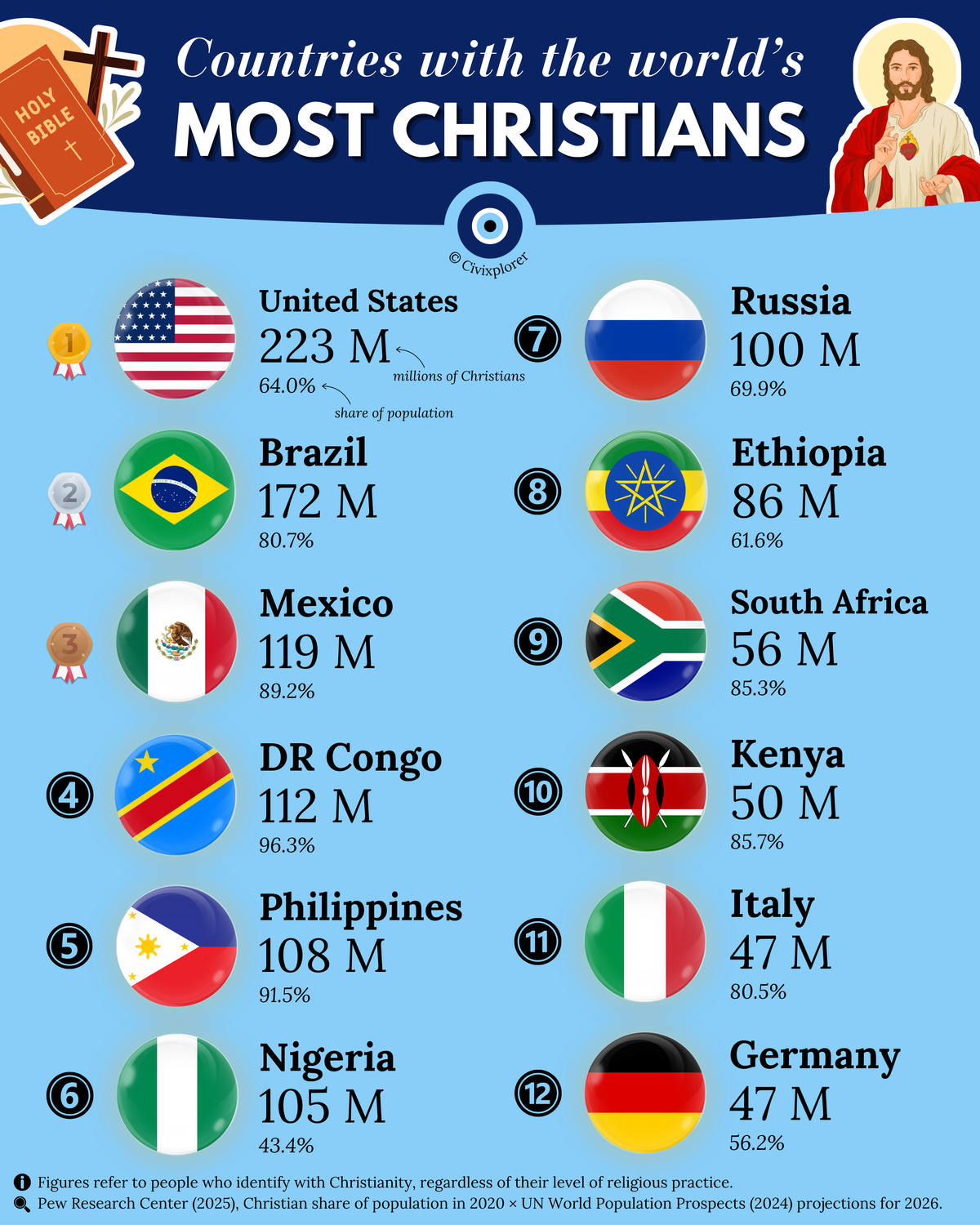
The global landscape of religion is undergoing a monumental demographic redistribution. While Christianity remains the world's largest religious group with over 2.2 billion adherents, its geographical center of gravity has decisively moved away from historical European centers toward Sub-Saharan Africa and Latin America. By combining Pew Research Center's religious affiliation shares with United Nations 2026 population projections, current global rankings highlight how regional fertility rates, youth demographics, and natural population growth are redrawing the world's religious map.
The United States continues to hold the top position globally, housing an estimated 223 million Christians. However, its leading status is primarily a function of its vast total population rather than an exceptional concentration of believers, as 64.0% of the population identifies as Christian—a proportion that has experienced steady secularization in recent decades. In contrast, Latin American demographic powerhouses Brazil and Mexico take second and third places with 172 million (80.7%) and 119 million (89.2%) Christians respectively, rooted in centuries of Catholic heritage alongside a rapid contemporary expansion of evangelical and Protestant movements.
The most profound structural transformation is occurring across Sub-Saharan Africa, which officially surpassed Europe between 2010 and 2020 to become the primary global hub of Christianity. The Democratic Republic of the Congo ranks fourth overall with 112 million Christians, boasting the highest Christian proportion on the entire list at 96.3%. With a population expanding by roughly 3% annually, DR Congo demonstrates how high fertility rates drive exponential increases in absolute religious numbers. Meanwhile, Nigeria presents a compelling demographic case, holding sixth place with 105 million Christians despite Christians forming a 43.4% minority of its total population. Because of Nigeria's massive multi-hundred-million total population, its Christian community easily outnumbers those of historic European heartlands.
Examining regional nuances reveals vastly different historical pathways of faith transmission. While high proportions in Latin America, the Philippines (108 million, 91.5%), and the Democratic Republic of the Congo stem from centuries of European colonial history and missionary activity, Ethiopia stands out as a remarkable exception. Ranking eighth with 86 million Christians (61.6%), Ethiopia's dominant Christian tradition—the Ethiopian Orthodox Tewahedo Church—traces its indigenous lineage back to the 4th-century Kingdom of Aksum, long predating European colonial expansion. Further south, South Africa (56 million, 85.3%) and Kenya (50 million, 85.7%) illustrate how rapid population growth continues to elevate African nations above aging Western societies in absolute demographic terms.
Across Europe, opposite demographic pressures—characterized by low fertility, aging populations, and widespread religious disaffiliation—have led to noticeable declines in Christian numbers. Russia holds seventh place with 100 million Christians (69.9%), though religious identity there frequently reflects cultural and national belonging rather than active church attendance. Meanwhile, Italy and Germany anchor the bottom of the top twelve with 47 million Christians each. Germany’s lower Christian share of 56.2% reflects formal church resignations and secularization across Western Europe, demonstrating how countries with historically dominant religious institutions are ceding their positions in global demographic rankings to rapidly growing nations in the Global South.
It is essential to recognize that these figures represent demographic projections rather than contemporary headcount censuses. By applying fixed 2020 religious affiliation percentages to projected 2026 total population counts, these rankings illustrate the powerful impact of population momentum. Shifts in country positions—such as African nations overtaking European countries—are driven overwhelmingly by differential birth rates rather than sudden mass religious conversions. Ultimately, the worldwide trajectory of faith is determined not only by changing personal beliefs, but by where global human population growth takes place.

Comments (0)
Join the Conversation
Login to share your thoughts with the community.
Login to Comment