
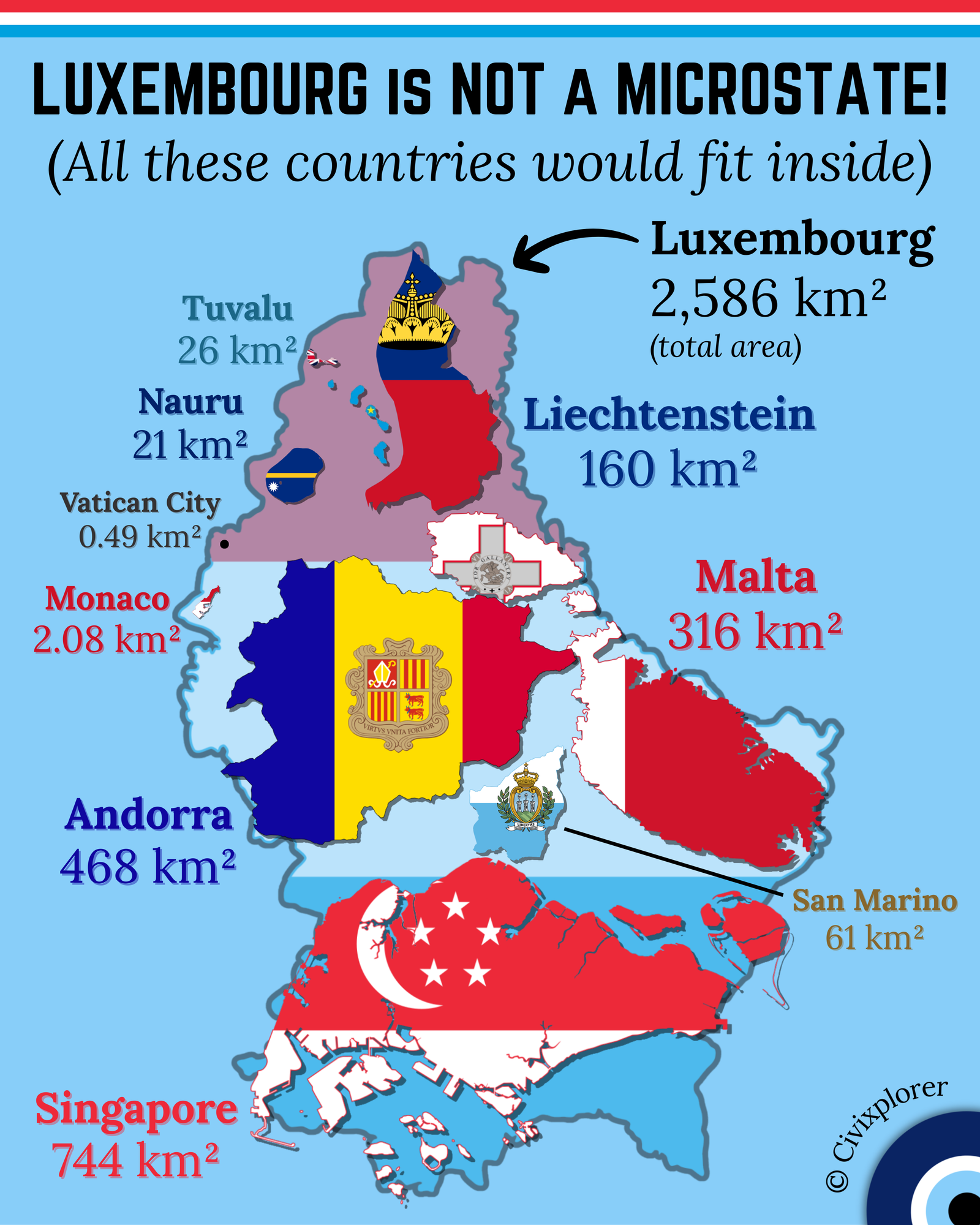
Luxembourg is frequently tucked away in the mental drawer of "tiny nations," largely because it is nestled between European giants like France, Belgium, and Germany. However, a closer look at the data reveals that this Grand Duchy is far more significant than the "microstate" label suggests.
Defining the Microstate
In political geography, there is no single legal definition, but experts generally use specific thresholds to classify these entities. A common quantitative cutoff is a land area of less than 1,000 square kilometers or a population under 500,000. Additionally, many true microstates are "protected states" that delegate key attributes of sovereignty—such as defense or foreign affairs—to larger neighbors.
Why Luxembourg Bypasses the Label
Luxembourg sits at 2,586 square kilometers, making it more than two and a half times larger than the standard 1,000 km² threshold. With a population exceeding 650,000, it also easily clears the demographic bar for a small state. Unlike entities such as Monaco or San Marino, Luxembourg maintains full sovereign independence, its own military, and a robust, independent foreign policy. It is a founding member of the UN, NATO, and the EU, hosting several critical European institutions like the European Court of Justice.
The Visual Reality
The scale of Luxembourg is best understood when compared to recognized microstates. You could simultaneously fit nine other countries—including Malta, Liechtenstein, Vatican City, and even the economic titan Singapore—within its borders. While Singapore is a global power player, its 744 km² area technically places it in the geographic microstate category, whereas Luxembourg remains firmly in the league of small, self-reliant nations. Historically, the country was even larger before 19th-century territorial losses, reinforcing its evolution into a viable, independent grand duchy rather than a survival-dependent enclave.
Comments (0)
Join the Conversation
Login to share your thoughts with the community.
Login to Comment