
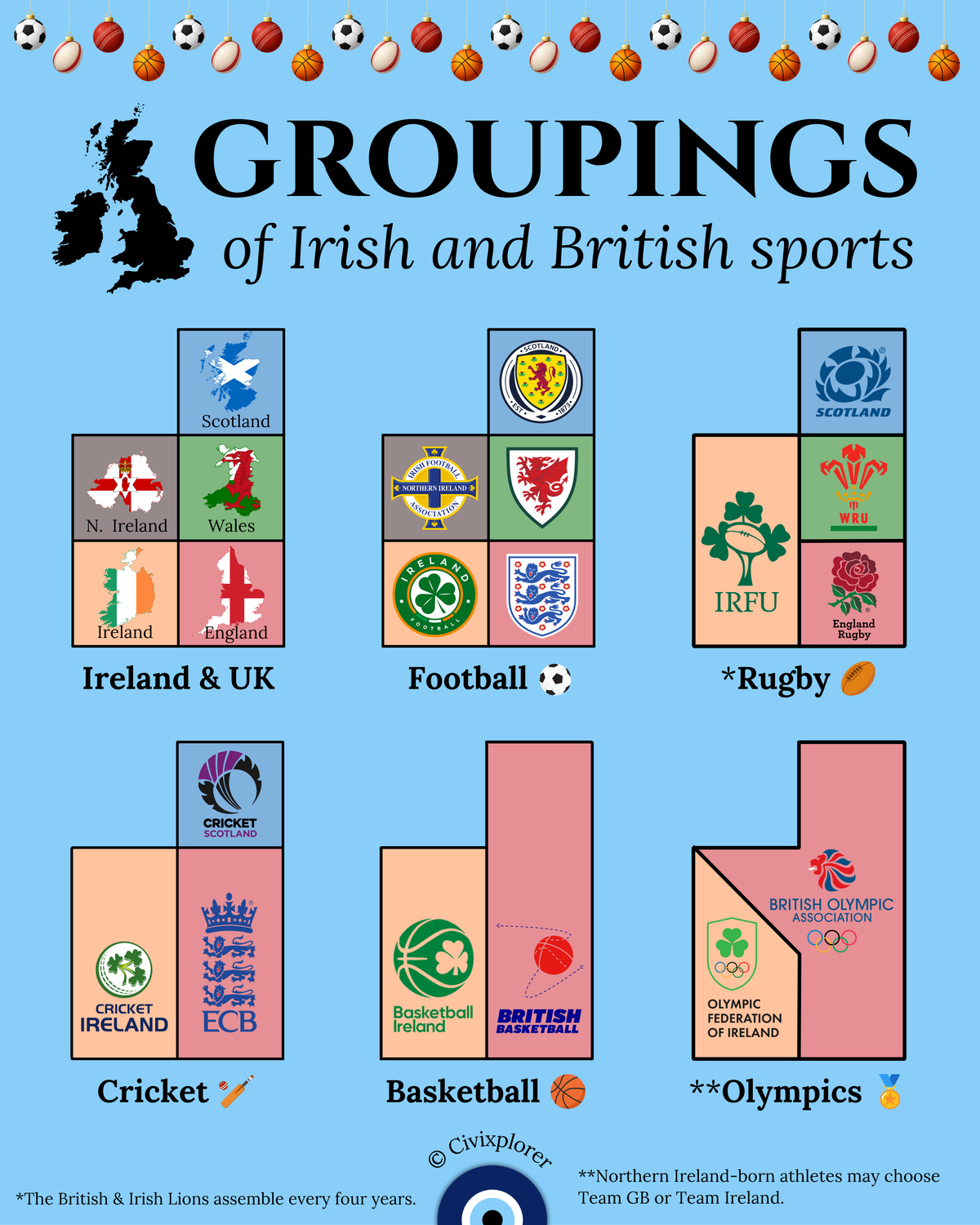
The geopolitical map of the British Isles defines two sovereign states—the United Kingdom and the Republic of Ireland—alongside the four constituent nations of the UK: England, Scotland, Wales, and Northern Ireland. However, international sporting representation rarely follows these constitutional borders. Instead, the sporting landscape forms a fascinating patchwork of institutions shaped by history, Victorian traditions, and political compromises.
Association Football represents the clearest alignment with political fragmentation. Across the region, five distinct national teams compete independently in FIFA competitions. The original Irish Football Association (IFA) was founded in Belfast in 1880 to govern the entire island, but political partition in 1921 led southern clubs to break away and establish the Football Association of Ireland (FAI) in Dublin. Meanwhile, the UK’s four "Home Nations" maintain separate international teams due to their historic privilege as the founders of modern football.
In contrast, Rugby Union operates on a unified, all-island basis through the Irish Rugby Football Union (IRFU), which was established in 1879 before political partition occurred. To preserve competitive strength and maintain institutional unity, rugby leaders chose to keep a single national team representing both the Republic of Ireland and Northern Ireland, adopting the neutral anthem "Ireland's Call" for international fixtures. Furthermore, every four years, players from England, Scotland, Wales, and Ireland unite to form the prestigious British & Irish Lions touring squad. Cricket displays a hybrid model where Cricket Ireland governs the whole island, Scotland fields its own national team, and Welsh cricket is absorbed into the England and Wales Cricket Board (ECB).
Basketball similarly pairs an all-island Irish governing body with British Basketball, which unified England, Scotland, and Wales to enhance competitive standing for the 2012 London Olympics. Perhaps the most delicate arrangement exists in the Olympic Games, where representation is divided between Team GB and Team Ireland. Under the landmark Good Friday Agreement of 1998, athletes born in Northern Ireland hold the unique birthright to identify as British, Irish, or both, granting them the legal right to choose whether to compete for Team GB or Team Ireland.
Ultimately, Northern Ireland sits at the complex intersection of these sporting structures, showcasing how historical governing bodies often outlast modern geopolitical changes. From pre-partition unions to modern peace treaties, the sporting map of the British Isles demonstrates that national representation in sport is an evolving legacy of history rather than a simple line drawn on a map.

Comments (0)
Join the Conversation
Login to share your thoughts with the community.
Login to Comment