
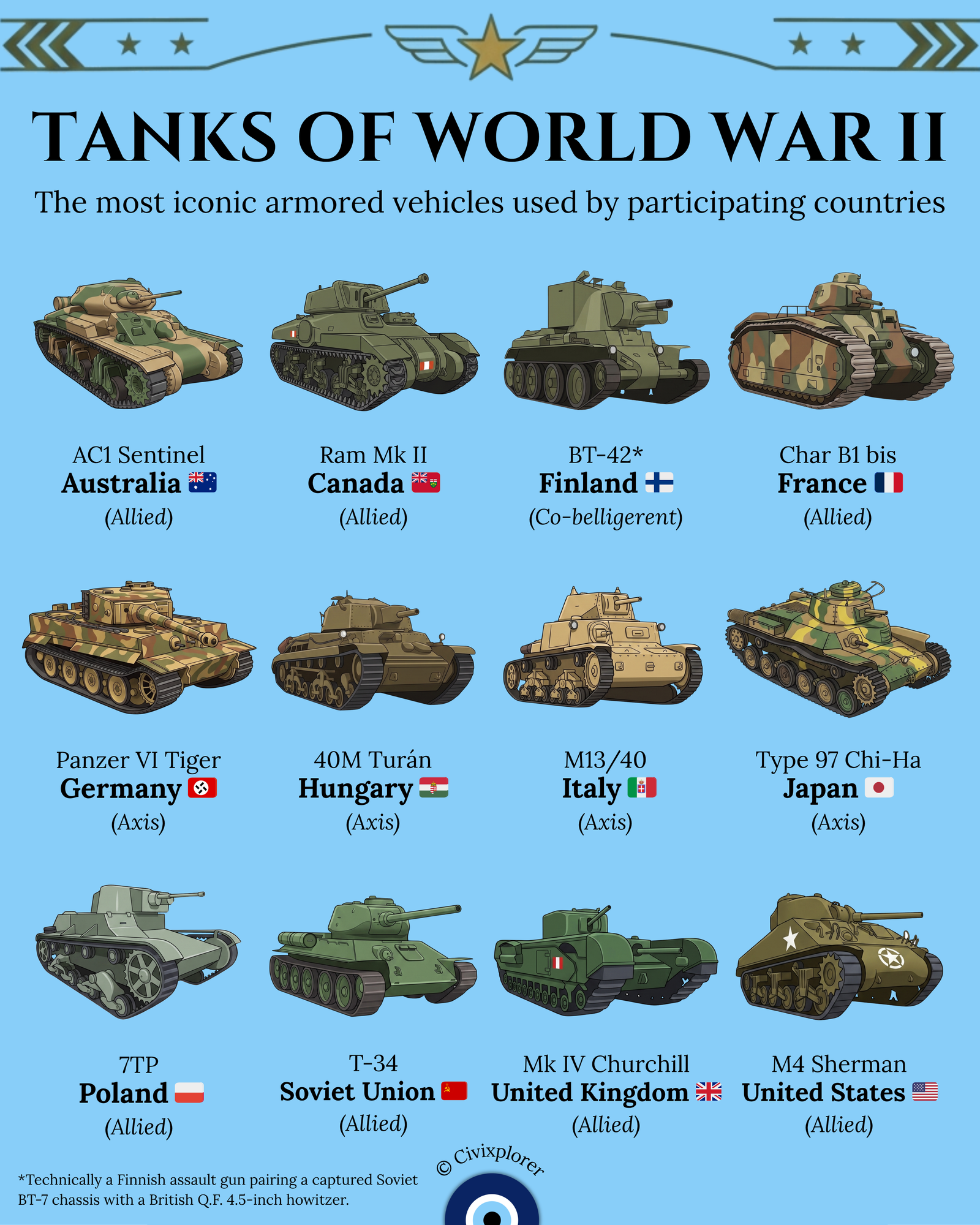
The landscape of World War II was fundamentally reshaped by the roar of engines and the clatter of treads. Tanks were not merely instruments of destruction; they were the ultimate expressions of a nation’s industrial capacity, military doctrine, and strategic priorities. From the mass-produced workhorses of the Allies to the over-engineered "beasts" of the Axis, each machine tells a unique story of survival and innovation.
The Clash of Engineering Philosophies
The conflict highlighted a fascinating divide in engineering. The United States and the Soviet Union prioritized strategic logistics and mass production. The M4 Sherman, for instance, was designed to be "good enough" and easily repairable, fitting perfectly into the cargo holds of ships to be deployed by the tens of thousands. Similarly, the Soviet T-34 revolutionized tank design with its sloped armor and wide tracks, allowing it to traverse deep mud and snow that swallowed its rivals. Its sheer numbers and brutal effectiveness eventually overwhelmed the technical perfection of its enemies.
In contrast, German doctrine often favored tactical superiority. The Tiger I (Panzer VI) remains perhaps the most mythic tank of the war, boasting a devastating 88 mm gun and thick armor that made it nearly invincible in one-on-one engagements. However, these machines were expensive, mechanically fragile, and produced in far smaller numbers, representing a gamble on quality over quantity.
Defiance and Innovation from Smaller Nations
Beyond the major powers, the war forced smaller nations and dominions to innovate under extreme pressure. Poland’s 7TP was a trailblazer, being the first tank in Europe powered by a diesel engine, while France’s Char B1 bis was a rolling fortress that proved nearly immune to standard anti-tank guns during the 1940 campaign.
Logistical crises also birthed unique designs like the Australian AC1 Sentinel. Lacking heavy industrial rolling mills, Australian engineers created the world's first single-piece cast hull. Meanwhile, the Finnish BT-42 serves as a testament to wartime resourcefulness; it was a "Frankenstein" tank created by mounting British howitzers onto captured Soviet chassis to fight on the Eastern Front.
The Legacy of Mechanized Warfare
Whether it was the Mk IV British Churchill, designed for the rugged terrain of infantry support, or the Japanese Type 97 Chi-Ha, optimized for island-hopping and jungle mobility, these vehicles reflected the geographical realities of their theaters. The victory of the Allies was, in many ways, a victory of mass production and adaptable design over bespoke, complex engineering. Today, these twelve tanks remain the primary reference points for the evolution of armored warfare and the shifting alliances of the 20th century.

Comments (0)
Join the Conversation
Login to share your thoughts with the community.
Login to Comment