
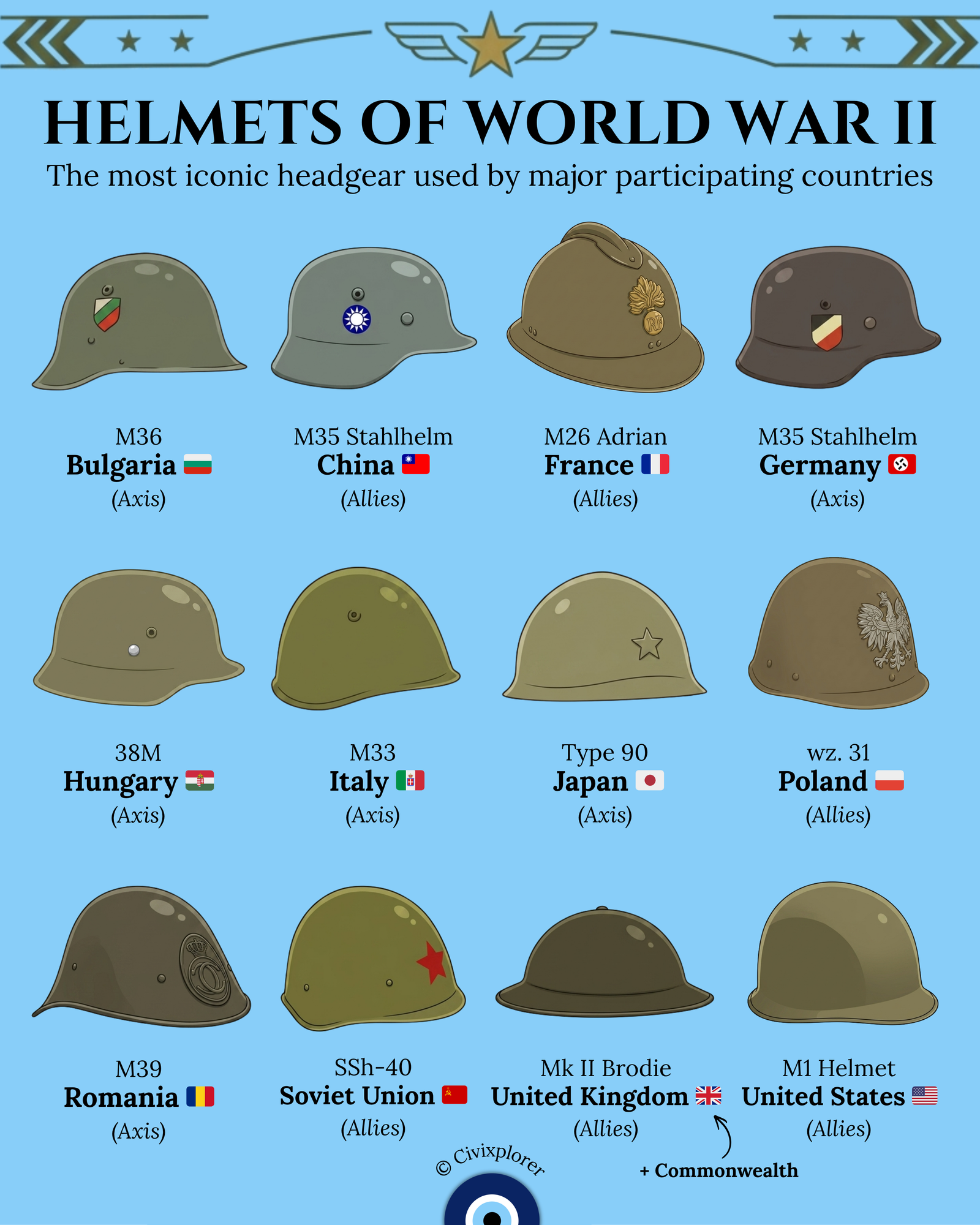
The silhouette of a soldier is often defined by the shape of their headgear. During World War II, the combat helmet evolved from a simple protective tool into a powerful symbol of national identity and industrial capability. These steel shells were not designed to be bulletproof against direct fire; instead, they were engineered to protect soldiers from the leading cause of head wounds on the modern battlefield: artillery fragments and shrapnel.
Many of the helmets seen in the early years of the conflict were actually direct descendants of World War I designs. The French M26 Adrian, for example, was a slightly modernized version of the 1915 original—the first modern steel helmet ever issued. Similarly, the British Mk II Brodie, famously known as the "tin hat" or "soup bowl," retained its wide-brimmed shape designed for trench warfare, prioritizing overhead protection but leaving the sides and back of the head vulnerable.
In contrast, the German M35 Stahlhelm represented a more comprehensive approach to protection. With its distinctive flared rim and side vents, it offered superior lateral coverage. This design was so effective that it influenced allies and enemies alike. One of the most fascinating historical anomalies of the war was the use of the German-made M35 by China. Due to pre-war military cooperation, elite Chinese divisions fought Japanese expansion while wearing German headgear, illustrating the fluid nature of pre-war geopolitics.
As the war progressed, industrial pragmatism took center stage. The Soviet SSh-40 became a triumph of mass production—a rugged, simple steel shell that could be stamped out by the millions to equip the Red Army. Meanwhile, the United States introduced the M1 "steel pot" in 1941. This revolutionary two-piece system featured a heavy outer steel shell and a lightweight inner liner, providing unprecedented comfort and versatility for soldiers in diverse climates.
Other nations showcased their own unique industrial stories. Poland’s wz. 31 stood as a symbol of national defiance with its anti-glare finish, while Romania’s M39 was actually a Dutch design, purchased before the country aligned with the Axis powers. Even Japan’s Type 90 and Italy’s M33 reflected their respective national priorities, balancing weight and protection with the resources available to them.
Ultimately, these helmets tell a story of global trade, military doctrine, and the brutal arithmetic of industrial warfare. They were the final line of defense for millions of soldiers and remain, to this day, the most recognizable icons of the 20th century's greatest conflict.

Comments (0)
Join the Conversation
Login to share your thoughts with the community.
Login to Comment