
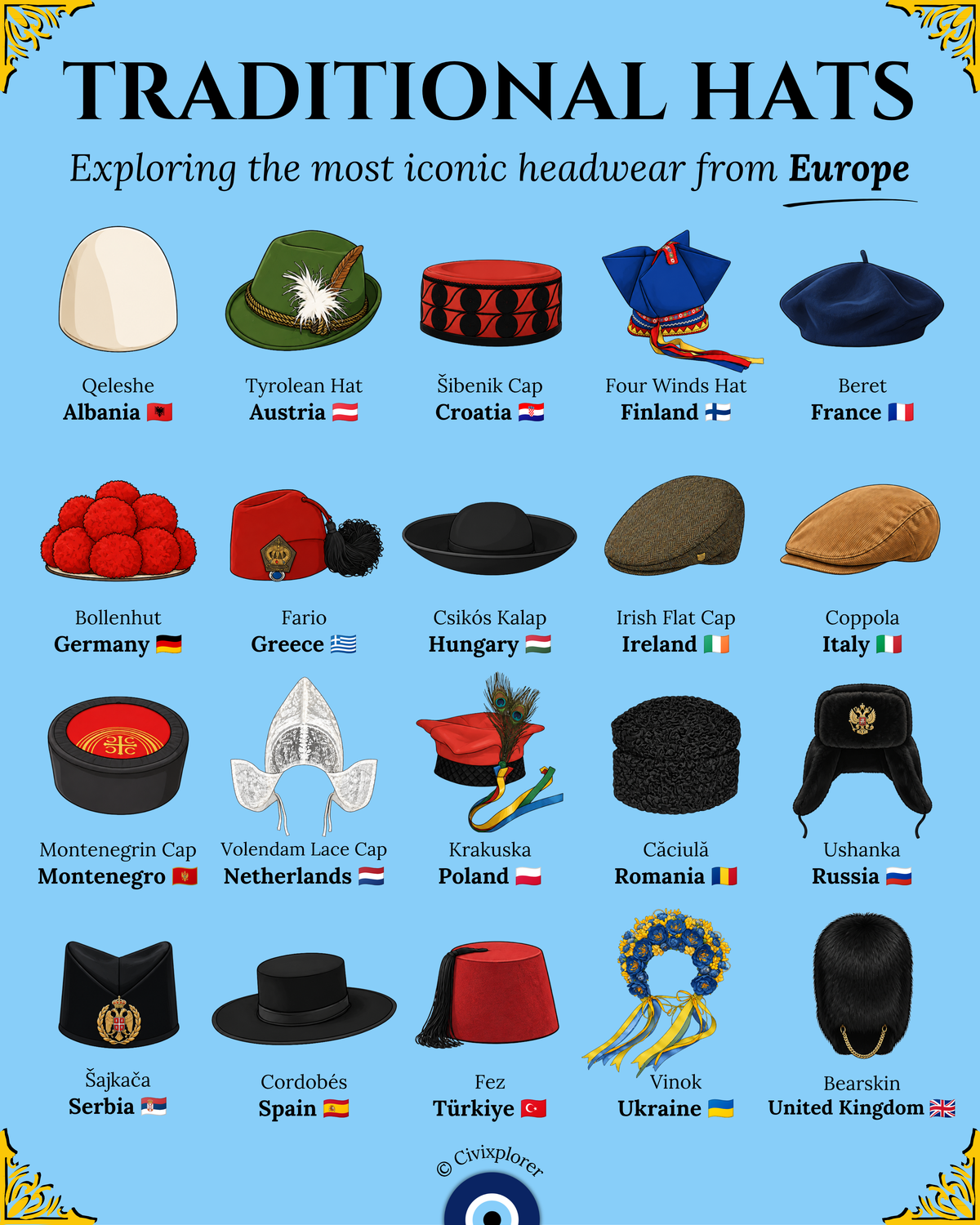
The diversity of European headwear is a testament to how geography, climate, and social structures shape human identity. From the sun-drenched coasts of the Mediterranean to the frozen tundras of the north, a simple hat can reveal a person’s occupation, religion, and national history. While many of these items were originally practical tools for survival, they evolved into powerful symbols of national pride during the 19th and 20th centuries.
Survival and Climate: Insulation in the North
In regions where the environment is a constant challenge, headwear is designed for protection. The Russian Ushanka is perhaps the most globally recognized example of this. Named after its characteristic ear flaps (ushi), it became a standardized symbol of the Soviet military in the 20th century, though its roots lie in ancient fur hats designed to withstand extreme sub-zero temperatures. Similarly, the Căciulă of Romania and the Four Winds Hat of the Sámi people in Finland represent an adaptation to cold. The four points of the Sámi hat were historically stuffed with down feathers to provide extra insulation, representing the cardinal directions and the indigenous heritage of the Arctic.
Mountain Identity: Felt and Folklore
The Alps and the Balkans produced some of the most distinctive felted headwear in history. The Austrian Tyrolean hat originated as functional mountain gear, with a brim to protect from rain and a "Gamsbart" (a brush made of chamois hair) as a prestigious ornament. In the Balkans, the Albanian Qeleshe (or plis) stands as one of the oldest styles in Europe. This white, brimless felt cap is a marker of northern highland culture and is often linked by historians to ancient Illyrian traditions. Meanwhile, the Serbian Šajkača, with its unique inverted-boat shape, transitioned from the headgear of river soldiers to a primary symbol of national military service and identity.
Symbolism and Resistance
Many European hats are "wearable historical texts." The Montenegrin Cap features a black border symbolizing mourning for historical struggles and a red top representing the blood shed for liberty. In modern times, the Ukrainian Vinok has undergone a powerful transformation. Once a pre-Christian floral wreath representing maidenhood and protection, it has surged as a modern symbol of cultural resilience and national sovereignty.
The Power of Military and Social Signaling
Some hats were designed purely to intimidate or indicate status. The British Bearskin was adopted by the Foot Guards after the Battle of Waterloo to make soldiers appear taller and more formidable. In Germany, the Bollenhut is a masterclass in social signaling; while it is often used as a generic symbol for the country, it actually belongs to only three villages in the Black Forest. The color of the pom-poms indicates a woman's marital status: red for unmarried and black for married.
Mediterranean Practicality
In the south, hats emphasize sun protection and regional flair. The Spanish Cordobés hat reflects the equestrian and flamenco culture of Andalusia, with a wide, flat brim designed for long days under the sun. Similarly, the Italian Coppola became a staple of Sicilian rural life, originally influenced by flat caps brought by trade but eventually becoming a legendary marker of Mediterranean identity.
Understanding these hats allows us to see Europe not just as a collection of borders, but as a complex tapestry of shared cultures that often cross modern political lines.


Comments (0)
Join the Conversation
Login to share your thoughts with the community.
Login to Comment