
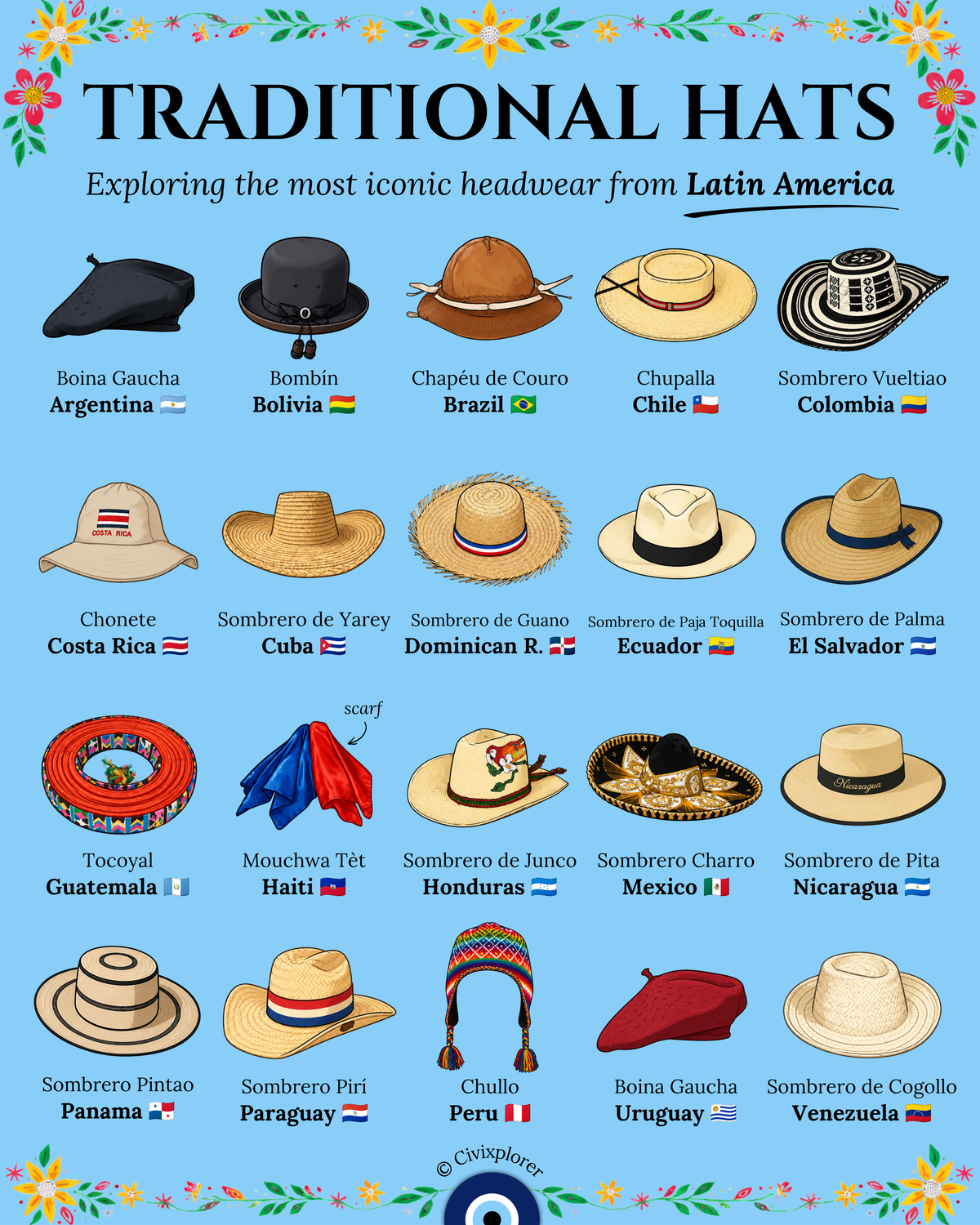
The geography of Latin America is a land of extremes, ranging from the freezing peaks of the Andes to the humid Caribbean coasts. This diversity is perfectly reflected in the region’s traditional headwear, which serves as a living map of indigenous botany, colonial trade routes, and cultural resistance. While many outsiders might use the word "sombrero" to describe any hat from the region, the truth is that each piece is a unique "small piece of history worn on the head," representing a synthesis of environmental necessity and social identity.
The origins of these garments are found in the blending of three distinct worlds. Indigenous traditions provided the foundation, with civilizations like the Quechua and Aymara developing sophisticated weaving techniques using alpaca and llama fibers long before European arrival. European influences introduced during colonization brought silhouettes like the beret and the bowler hat, which were quickly adapted to local materials. Finally, African and Afro-Latin influences are deeply visible in the vibrant headwraps of the Caribbean, such as the Haitian mouchwa tèt, which symbolize cultural continuity and resilience.
One of the most fascinating examples of cultural adaptation is the Bolivian bombín. Originally a British bowler hat intended for railway workers, it was adopted by indigenous Aymara and Quechua women—known as cholitas—in the early 20th century. Today, it is a fierce symbol of indigenous matriarchal pride. Similarly, the Ecuadorian Sombrero de Paja Toquilla represents a major historical correction. Often erroneously called the "Panama Hat" because it was popularized by workers on the Panama Canal, this masterpiece of craftsmanship is actually native to Ecuador’s coastal regions and is recognized by UNESCO as Intangible Cultural Heritage.
In Colombia, the Sombrero Vueltiao showcases the "Zenú Mathematics" of the indigenous people. Woven from caña flecha, its quality is determined by the number of fiber pairs used in the braid; the finest versions are so flexible they can be folded into a pocket without losing their shape. Further south, the Brazilian Chapéu de Couro (leather hat) served as "arid armor" for cowboys navigating the thorny scrub forests of the northeast. It eventually transformed from protective work gear into a powerful icon of rebellion and regional identity.
From the wide-brimmed Sombrero Charro of Mexico, designed as a masterpiece of thermal engineering to cast a full-body shadow, to the Chullo of Peru, which provides essential insulation in high-altitude environments, these items communicate a person’s profession, region, and social standing at a glance. They prove that headwear in Latin America is never just a fashion accessory; it is a functional tool and a badge of national pride that tells the story of a continent's soul.

Comments (0)
Join the Conversation
Login to share your thoughts with the community.
Login to Comment