
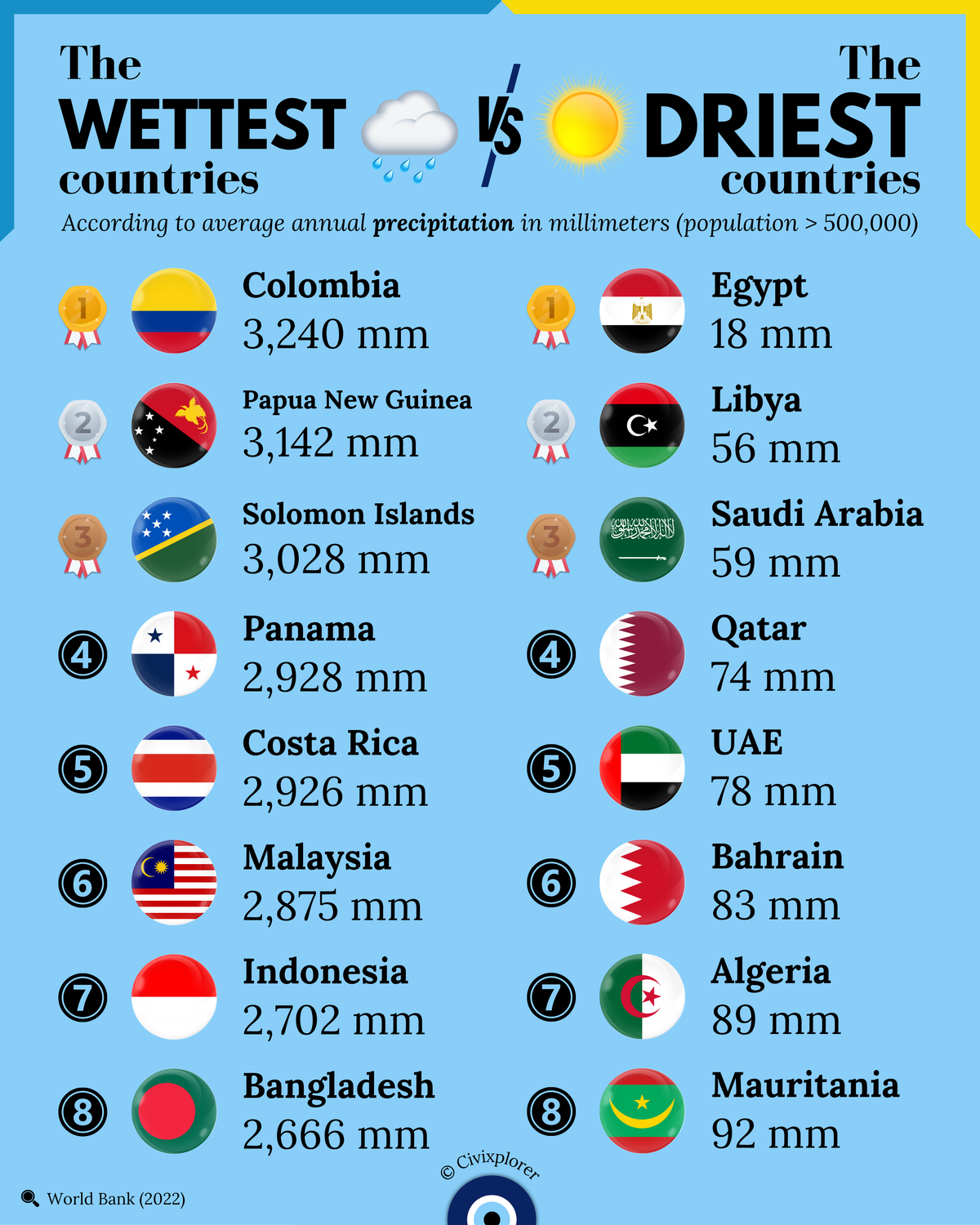
The staggering diversity of Earth’s climate is perhaps most visible when comparing how much water falls from the sky. On one end of the spectrum, some nations are perpetually drenched in tropical downpours, while others may not see a single drop for years. This infographic, utilizing World Bank data, highlights a meteorological disparity that is difficult to fathom: Colombia, the wettest country on Earth, receives an average of 3,240 mm of rain annually—roughly 180 times more than Egypt, which records a mere 18 mm per year.
The Methodological Filter: Why Population Matters
To provide a meaningful comparison of nation-states, a statistical filter was applied to this data, excluding territories with populations under 500,000. This is a crucial distinction, as it omits several hyper-saturated microstates. For instance, São Tomé and Príncipe receives nearly as much rain as Colombia but is excluded due to its smaller population. On the dry side, the filter has less impact, as the world’s most arid nations, such as Egypt, Libya, and Saudi Arabia, all maintain significant populations despite their lack of water.
The Equatorial Rain Engines
The wettest countries on this list are almost exclusively located within the equatorial belt. This region is dominated by the Intertropical Convergence Zone (ITCZ), a low-pressure band where trade winds collide, forcing humid air upward to cool and condense into torrential daily rains.
Colombia takes the top spot due to a "perfect geographical storm." It is the only South American nation with coastlines on both the Pacific and Caribbean, providing two limitless reservoirs of moisture. When these winds hit the towering Andes Mountains, a process called orographic lift occurs, squeezing out extreme precipitation. This is most evident in the Chocó region, where localized rainfall can exceed 10,000 mm per year. Other high-ranking nations like Papua New Guinea (3,142 mm) and the Solomon Islands (3,028 mm) rely on their rugged island topography and warm surrounding seas to capture massive amounts of maritime humidity.
The Subtropical Highs: Why Deserts Are Dry
On the opposite end, the world’s driest countries are unified by their placement along the Subtropical High-Pressure belts. In these zones, cool, dry air from the upper atmosphere steadily descends. As this air sinks, it warms and compresses, which dynamically suppresses cloud formation and evaporates any existing moisture.
Egypt stands as the extreme outlier with its 18 mm average. Almost the entire nation is enveloped by the hyper-arid Sahara Desert. This raises a fascinating paradox: how does a nation of over 110 million people thrive in the driest place on Earth? The answer lies in the Nile River, an "exotic river" that transports water from the rain-drenched highlands of East Africa through thousands of kilometers of desert to sustain Egyptian civilization.
The Maritime Desert Paradox
A unique phenomenon occurs in the Gulf states like Qatar (74 mm) and the UAE (78 mm). Despite being surrounded by water and experiencing oppressive humidity, they receive virtually no rain. This is caused by a temperature inversion, where a layer of warm air traps cooler, humid air near the surface, preventing it from rising and condensing into rain clouds. Consequently, these nations must rely on advanced technology, such as desalination, to support their modern economies.
Ultimately, these national averages illustrate that rainfall is controlled less by proximity to water and more by how the atmosphere moves that water. Whether through the lush rainforests of the tropics or the hyper-arid sands of the Sahara, geography remains the ultimate architect of life on Earth.

Comments (0)
Join the Conversation
Login to share your thoughts with the community.
Login to Comment