Laughter is a universal human experience, but in the digital realm, the way we express joy is filtered through local alphabets, keyboard layouts, and unique internet subcultures. While "haha" is understood globally, different regions have developed their own phonetic onomatopoeias, numerical puns, and keyboard-driven slang that reveal a great deal about cultural identity in the 21st century.
The Phonetic Illusion
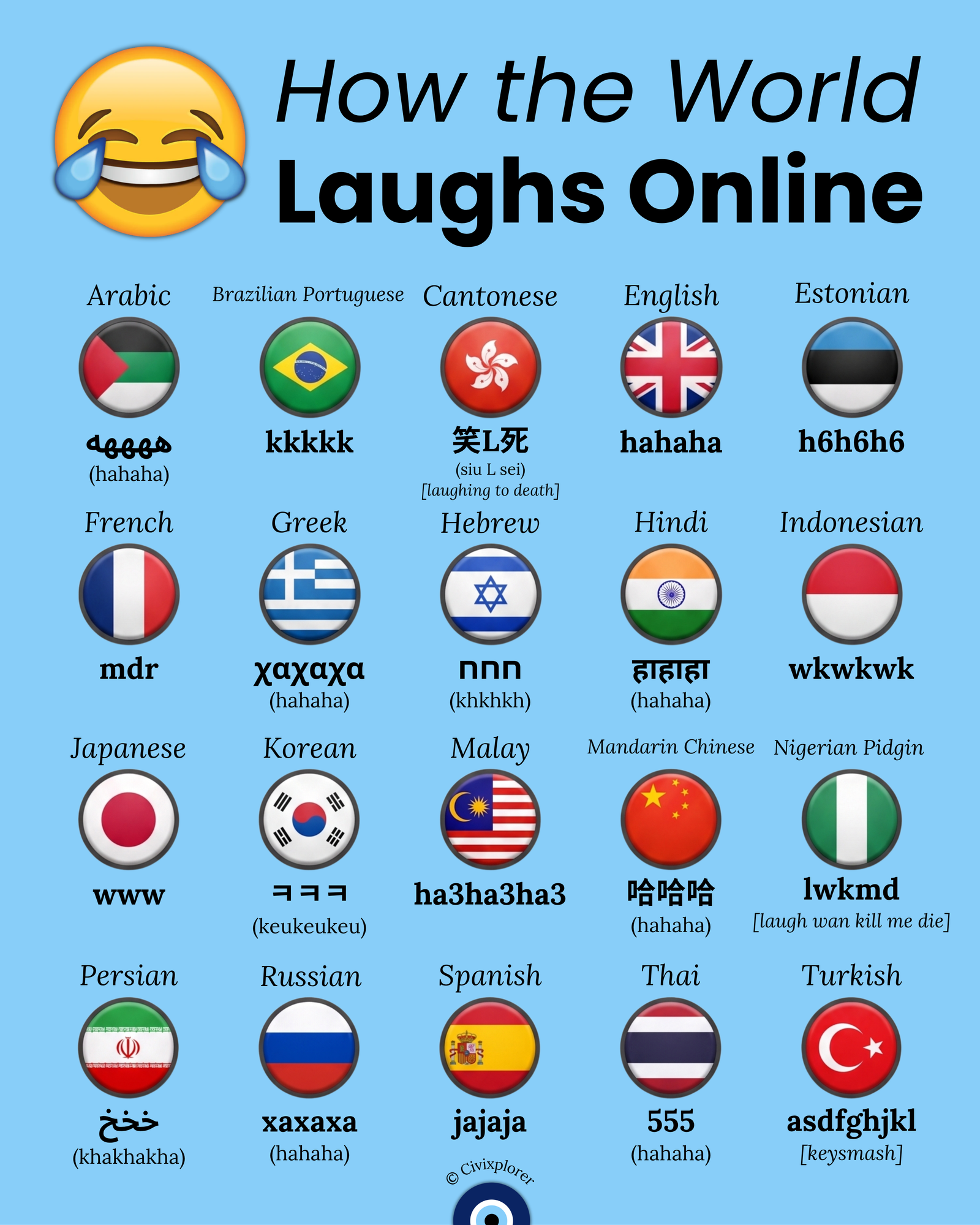
Many of the most common written laughs are simply phonetic translations of the "hahaha" sound. In Spanish (jajaja), the letter "j" produces the aspirate "h" sound. Similarly, in Russian (xaxaxa) and Greek (χαχαχα), the characters "x" and "χ" represent a voiceless velar fricative, which sounds like a breathy "h" or a soft throat-clearing "kh." Even in Hebrew (חחח) and Persian (خخخ), the guttural sounds of the native script are used to mimic a natural, throaty chuckle. These are not different sounds, but rather the same sound adapted to the rules of different alphabets.
Numerical Puns and Shorthand
One of the most ingenious adaptations comes from Thailand, where the number 5 is pronounced as "ha." Consequently, typing 555 is a lightning-fast way to type "hahahaha." A similar logic applies to Estonian (h6h6h6), which originated from early internet limitations where the letter "õ" was difficult to type on non-standard keyboards, leading users to substitute it with the number 6. In Southeast Asia, Malay and Indonesian users often use "ha3"; because repetition is used to pluralize words in these languages, the "3" acts as a mathematical command to repeat the "ha" syllable three times.
Keyboard Convenience and Gamer Culture
The physical layout of our devices often dictates our digital vocabulary. In Indonesia, the popular wkwkwk laugh emerged from cybercafes and gaming culture. Because players needed to keep their hands near the WASD keys for movement, the "w" and "k" keys became the most efficient way to signal amusement without looking away from the screen.
In Japan, the term www stems from the word warau (to laugh). On early message boards, users shortened this to "w." When typed in a long string, the letters resemble blades of grass, which led to the creation of the slang term kusa (grass). Today, a Japanese user might simply type the kanji for "grass" to signify they are "laughing out loud." Meanwhile, in Turkey, the asdfghjkl keyboard smash is a common sign of being so overwhelmed by laughter that coherent typing becomes impossible.
Hyperbolic Acronyms
When sound isn't enough, some cultures turn to dramatic acronyms to convey their reaction. The French mdr (mort de rire) is the direct equivalent of "dying of laughter." In Nigeria, the Pidgin acronym lwkmd (laugh wan kill me die) takes this hyperbole further, turning a simple joke into a life-or-death event. Similarly, Cantonese users use 笑L死 (siu L sei), which translates to "laughing to death," with the "L" serving as a phonetic intensifier for added emphasis.
These digital conventions are more than just quirks; they are a testament to human ingenuity. By bending rigid tools like QWERTY keyboards and numeric pads to fit our emotional needs, we have created a rich, global mosaic of shared joy that proves "haha" is never just "haha."
Comments (0)
Join the Conversation
Login to share your thoughts with the community.
Login to Comment