
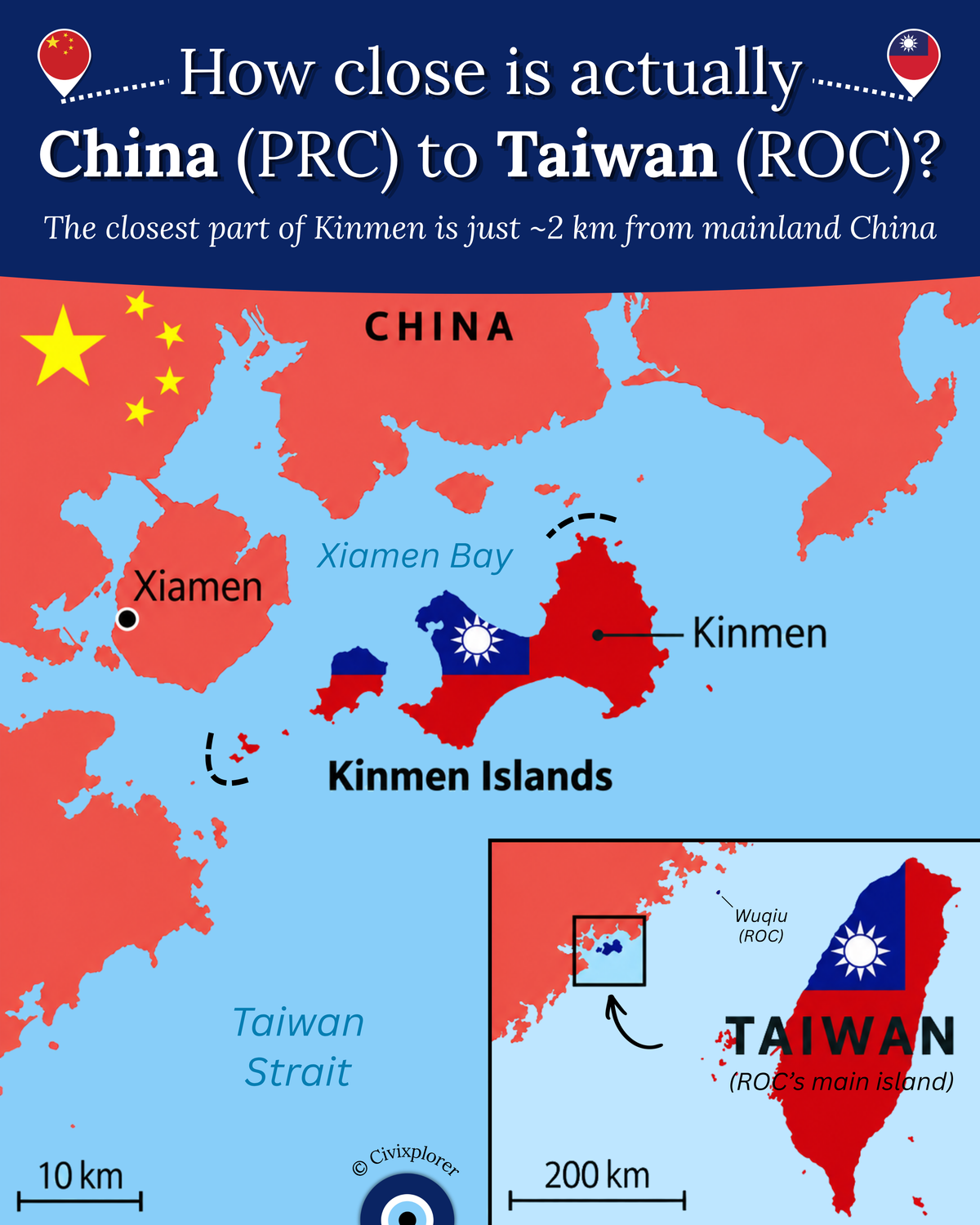
While the main island of Taiwan lies roughly 180 to 200 kilometers across the Taiwan Strait, the Kinmen Islands present one of the most astonishing geographic anomalies in global politics. Situated directly within Xiamen Bay off the coast of Fujian province, this Taiwan-controlled archipelago sits extraordinarily close to mainland China. At the closest point, such as the Mashan observation post, the distance between Kinmen and Chinese territory narrows to roughly 2 kilometers at low tide. From the shores of Greater Kinmen, the urban skyline of Xiamen is clearly visible across the water, creating a surreal geopolitical front line where a democratic territory rests practically on the doorstep of a massive one-party state.
Understanding why an island group merely two kilometers from the mainland flies the flag of the Republic of China (ROC) requires looking back to the conclusion of the Chinese Civil War in 1949. As the Chinese Communist Party consolidated power across mainland China, Chiang Kai-shek's Nationalist forces retreated to Taiwan while retaining control of strategic offshore island outposts including Kinmen and Matsu. In October 1949, the People's Liberation Army launched an ambitious amphibious invasion during the Battle of Guningtou, sending over 9,000 troops across the narrow strait in wooden vessels. Caught off guard by low tides and fierce ROC defenses, the landing force was completely defeated, an unexpected victory that decisively halted the communist momentum to invade the main island of Taiwan and established Kinmen as a fortified borderland.
During the tense decades that followed, Kinmen became a primary Cold War flashpoint, enduring heavy artillery bombardments during the Second Taiwan Strait Crisis of 1958 when hundreds of thousands of shells rained down on the islands. Yet historical analysis reveals that Mao Zedong ultimately refrained from seizing Kinmen, relying on a strategy known as the tether theory. By allowing Nationalist forces to maintain territory immediately adjacent to Fujian, Beijing ensured that Taiwan remained geographically, historically, and politically tied to the concept of One China. Conquering Kinmen would have completely severed Taiwan from the mainland, potentially encouraging the Nationalist government or its American allies to declare a separate independent state rather than treating the dispute as an unfinished civil war.
In the decades since martial law was lifted in 1992, Kinmen has undergone a dramatic transformation from a heavily fortified military outpost into a vital conduit for cross-strait engagement. Under the Mini Three Links policy established in 2001, regular passenger ferry services connect Kinmen directly with Xiamen in just thirty minutes, facilitating daily trade, tourism, and deep family connections across the channel. Economic integration deepened further in 2018 with the completion of a 16-kilometer underwater pipeline supplying fresh drinking water directly from Fujian province to the island. While Kinmen remains a sensitive geopolitical flashpoint where Taiwanese administration meets mainland Chinese proximity, its unique everyday reality reflects a complex balance of shared cultural ties, economic reliance, and a fragile status quo.

Comments (0)
Join the Conversation
Login to share your thoughts with the community.
Login to Comment