
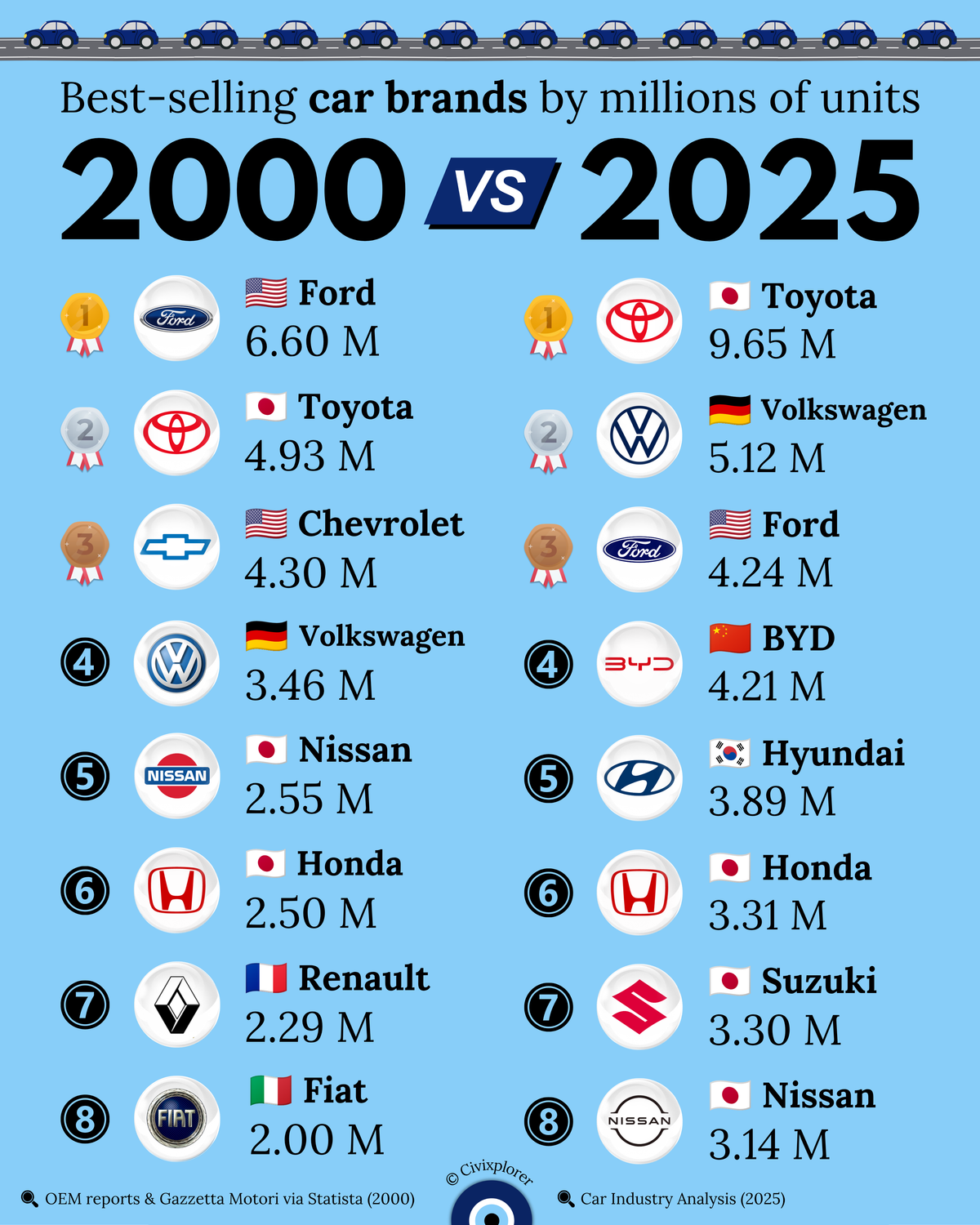
Between 2000 and 2025, the global automotive market experienced a profound quarter-century structural realignment, moving the center of industry dominance away from traditional Western manufacturing hubs and toward Asian powerhouses. At the turn of the millennium, Western legacy automakers controlled five of the top eight global single-brand positions, led by Ford, Chevrolet, Volkswagen, Renault, and Fiat, alongside Japanese leaders Toyota, Nissan, and Honda. By 2025, that dynamic had completely inverted, with Asian car manufacturers capturing six of the top eight spots worldwide. Traditional European stalwarts like Renault and Fiat, as well as American icon Chevrolet, fell entirely out of the top global leaderboard, leaving Volkswagen and Ford as the sole Western representatives among global volume leaders.
The single largest driver of this transformation was Toyota’s spectacular global expansion, as the brand nearly doubled its single-marque volume from 4.93 million units in 2000 to a dominant 9.65 million units in 2025. Toyota achieved this massive lead through a truly global footprint and an early, aggressive commitment to gasoline-electric hybrid technology across its core vehicle lineups. Conversely, major Detroit automakers underwent a strategic retreat from global volume, with Ford’s sales contracting from 6.60 million to 4.24 million units and Chevrolet exiting the top rankings altogether as both parent companies prioritized profit margins and high-margin light trucks over low-margin sedans and underperforming international markets. Meanwhile, Volkswagen expanded its core brand deliveries from 3.46 million to 5.12 million units, heavily reliant on its deep market presence in China despite emerging competitive pressures from domestic electric vehicle manufacturers.
The most dramatic arrival on the global stage belongs to BYD’s unprecedented electric surge, rising from a battery producer in 2000 to the fourth-largest global car brand with 4.21 million vehicles sold in 2025. Driven by China’s rapid adoption of New Energy Vehicles, in-house battery production, and aggressive export expansion, BYD redefined the speed at which modern automakers can scale. Concurrently, South Korea's Hyundai climbed to fifth place with 3.89 million units by establishing a reputation for reliability, localized manufacturing, and design innovation. Further reinforcing Asia's dominance, Suzuki secured seventh place with 3.30 million units, propelled by Maruti Suzuki’s overwhelming market share in India’s fast-expanding economy. Together, these shifts highlight how 21st-century automotive leadership has moved decisively toward brands that mastered hybrid versatility, captured emerging mass markets, or vertically integrated the global electric transition.

Comments (0)
Join the Conversation
Login to share your thoughts with the community.
Login to Comment