
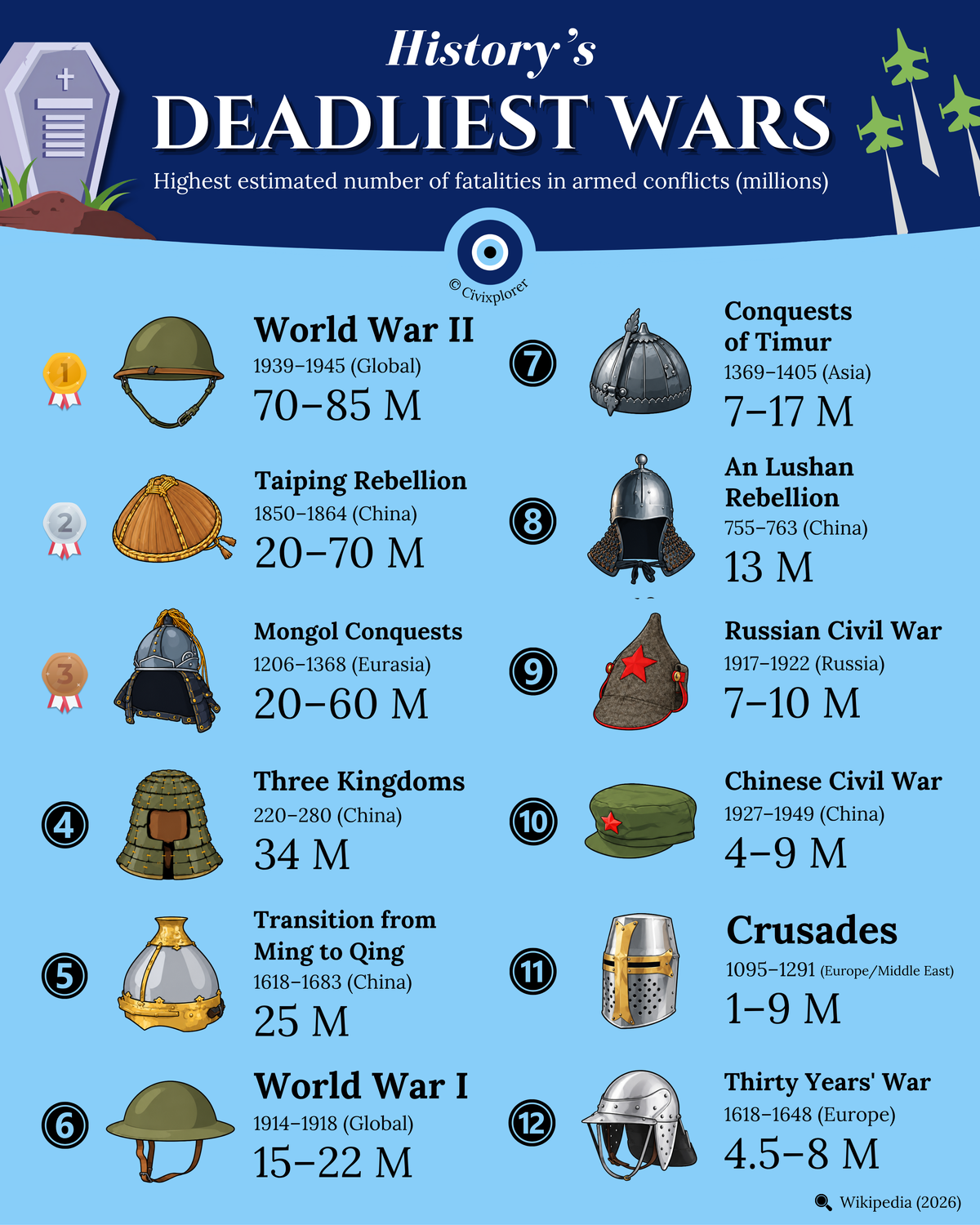
Visual rankings of the world's most catastrophic armed conflicts present a staggering look at the scale of human suffering throughout history. From the overwhelming destruction of World War II at the top of absolute casualty lists to the sprawling devastation of the Taiping Rebellion and the Mongol conquests, these numbers serve as stark reminders of historical violence. However, looking beyond headline figures reveals that historical war totals measure far more than battlefield casualties, reflecting deep methodological nuances, varying evidence quality, and complex demographic shifts across centuries.
In almost every major conflict prior to the modern era, direct military combat accounted for only a minor fraction of overall deaths. The vast majority of casualties resulted from the secondary impacts of warfare: widespread famine, lethal disease epidemics, forced displacement, and systemic societal collapse. When armies destroyed agricultural heartlands and disrupted vital trade routes, the resulting starvation and illness killed far more civilians than soldiers on the front lines. Conflicts such as the Thirty Years' War in Central Europe or the prolonged Ming–Qing transition in China were defined by this severe demographic dislocation, where civilian communities bore the heaviest burden long after military campaigns had moved on.
A prominent feature in global mortality rankings is the heavy concentration of internal Chinese conflicts, including the Three Kingdoms period, the An Lushan Rebellion, and the Chinese Civil War. This representation is primarily driven by China's vast historical population density combined with its long tradition of bureaucratic record-keeping. However, relying on ancient imperial censuses presents significant accounting challenges. Significant drops in registered taxpayers following major rebellions frequently reflected administrative collapse, mass flight, and unrecorded migrations rather than direct fatalities. For instance, the traditional thirty-four million casualty estimate attributed to the Three Kingdoms era largely stems from comparing census registers before and after imperial fragmentation, illustrating how government disruption can artificially inflate war death estimates.
Evaluating wars purely by absolute fatalities also obscures their relative demographic impact on humanity. While twentieth-century industrial warfare produced unprecedented absolute numbers due to higher global populations, pre-modern campaigns often wrought far greater proportional devastation. World War II resulted in an estimated seventy to eighty-five million fatalities, representing roughly three to four percent of the contemporary world population. In contrast, the high-end estimates for the Mongol conquests during the thirteenth century suggest that up to fifteen percent of the global population perished, fundamentally altering human demographics to a degree unmatched by modern conflicts. Note that military campaigns like the Spanish conquest of the Aztec Empire are exceptionally excluded from direct warfare casualty rankings, as the overwhelming majority of deaths stemmed from imported Old World disease epidemics rather than armed combat.
Ultimately, ranking the deadliest conflicts in human history requires evaluating the reliability of surviving historical evidence alongside raw figures. While modern conflicts like World War I and World War II benefit from extensive government documentation and demographic census cross-checking, ancient and medieval tolls rely on broad ranges and chroniclers' accounts. Recognizing these distinctions allows us to understand the true drivers of historical mortality and appreciate the full human cost of global warfare beyond simple statistics.

Comments (0)
Join the Conversation
Login to share your thoughts with the community.
Login to Comment