
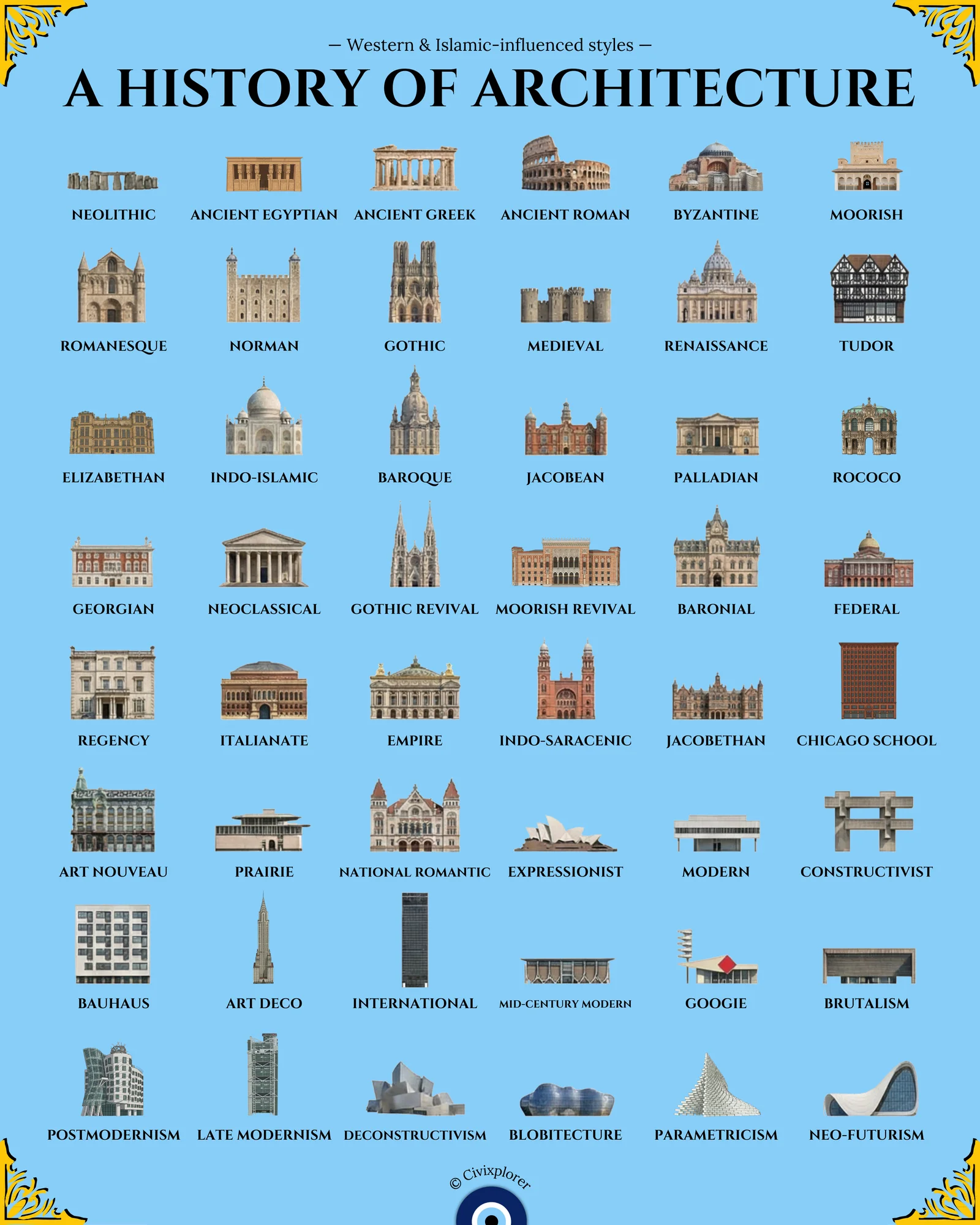
The evolution of architecture serves as a chronological family tree, tracing the lineage of Western and Islamic-influenced styles. This journey begins with the structural necessity of the Neolithic era and moves toward the data-driven, fluid forms of the modern day. One of the most significant early shifts occurred during the transition from the heavy, thick walls of the Romanesque period to the soaring heights of the Gothic era. This change was fueled by the invention of the pointed arch and flying buttress, which allowed architects to open up walls for massive stained-glass windows.
As societies progressed, a pattern of revival cycles emerged during the 18th and 19th centuries. Styles like Neoclassical and Gothic Revival were born as reactions against the perceived excess of previous eras, such as Rococo. Architects looked backward to find national identity and moral order amidst rapid industrial change. However, the industrial revolution eventually forced a radical departure with the birth of the Chicago School. Driven by the invention of the elevator and steel-frame construction, this era paved the way for the Bauhaus and International styles, which famously championed the idea that form must follow function.
By the late 20th century, a creative revolt against the "glass box" austerity of Internationalism led to Postmodernism and Deconstructivism. Postmodernism reintroduced color and irony, while Deconstructivism challenged stability with fragmented, non-rectilinear shapes. Today, we have reached the digital frontier, where styles like Parametricism and Blobitecture are defined by advanced computer algorithms. These technologies allow for the organic, flowing curves of Neo-Futurism, exemplified by the works of architects like Zaha Hadid, where buildings are "grown" through software rather than traditional lines.
Comments (0)
Join the Conversation
Login to share your thoughts with the community.
Login to Comment