
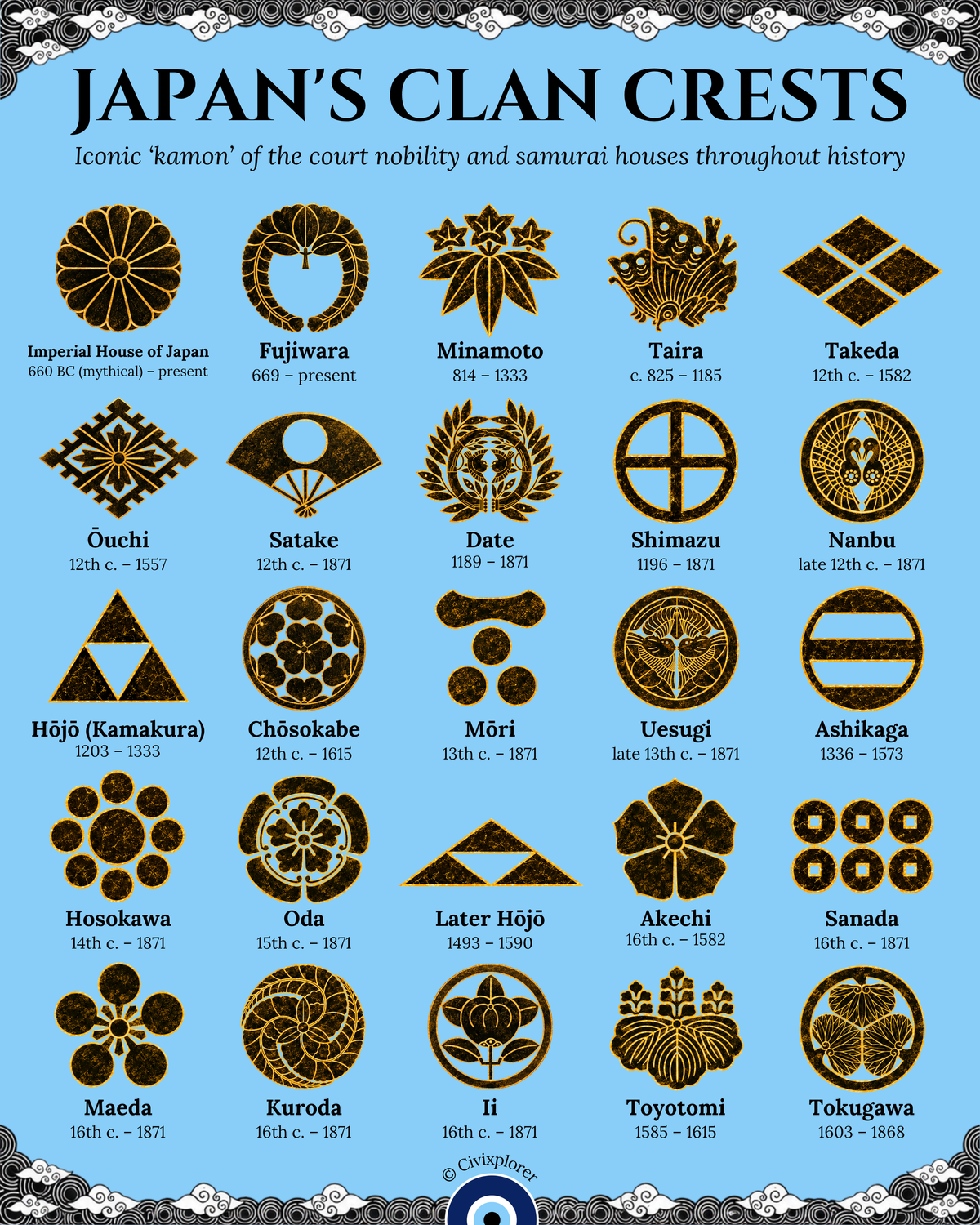
Japanese family crests, known as kamon, represent one of the most elegant and durable heraldic systems in world history. Emerging during the Heian period around the tenth century, these stylized emblems were originally developed by court aristocrats to adorn their ox-drawn carriages, clothing, and household furnishings. Because noble rank dictated road priority in classical Kyoto, visual symbols served a practical purpose by signaling lineage and status long before taking on military significance. Over time, these delicate patterns derived from plants, geometry, and celestial bodies expanded into an essential visual language across Japanese society.
As civil warfare intensified during the late twelfth century, warrior lineages adapted kamon for crucial battlefield recognition. Displayed prominently on banners, armor, and flags, these bold designs allowed samurai commanders to instantly distinguish friend from foe amidst the chaos of battle. Unlike medieval European heraldry, Japanese crests prioritized visual legibility and graphic simplicity, favoring symmetrical silhouettes that could be recognized across long distances. Prominent warrior houses adopted iconic motifs, such as the Minamoto gentian blossoms and the Taira swallowtail butterfly crests.
Beyond identification, kamon were deeply entwined with ancestral mythology and martial philosophy. The Sanada clan proudly wore the rokumonsen—six coins representing the toll required to cross the Buddhist river to the afterlife—signaling to enemies that their warriors fought without fear of death. Other emblems claimed divine backing, such as the three dragon scales associated with the Kamakura Hōjō clan. Under powerful unifiers, crests became potent symbols of political legitimacy and social control. Toyotomi Hideyoshi used the imperial paulownia emblem to solidify his governance, while the Tokugawa shogunate enacted strict laws restricting their triple hollyhock crest to enforce absolute authority.
The vast majority of traditional kamon feature an enduring appreciation for nature and botanical motifs. Emblems ranging from the sixteen-petaled imperial chrysanthemum to cascading wisteria and plum blossoms reflected seasonal poetry and ancestral devotion. Although the Meiji Restoration abolished the feudal domain system in 1871, ending the political rule of samurai houses, their heraldic tradition survived. Today, tens of thousands of unique kamon designs remain a vital element of Japan’s visual heritage and global cultural identity.

Comments (0)
Join the Conversation
Login to share your thoughts with the community.
Login to Comment