
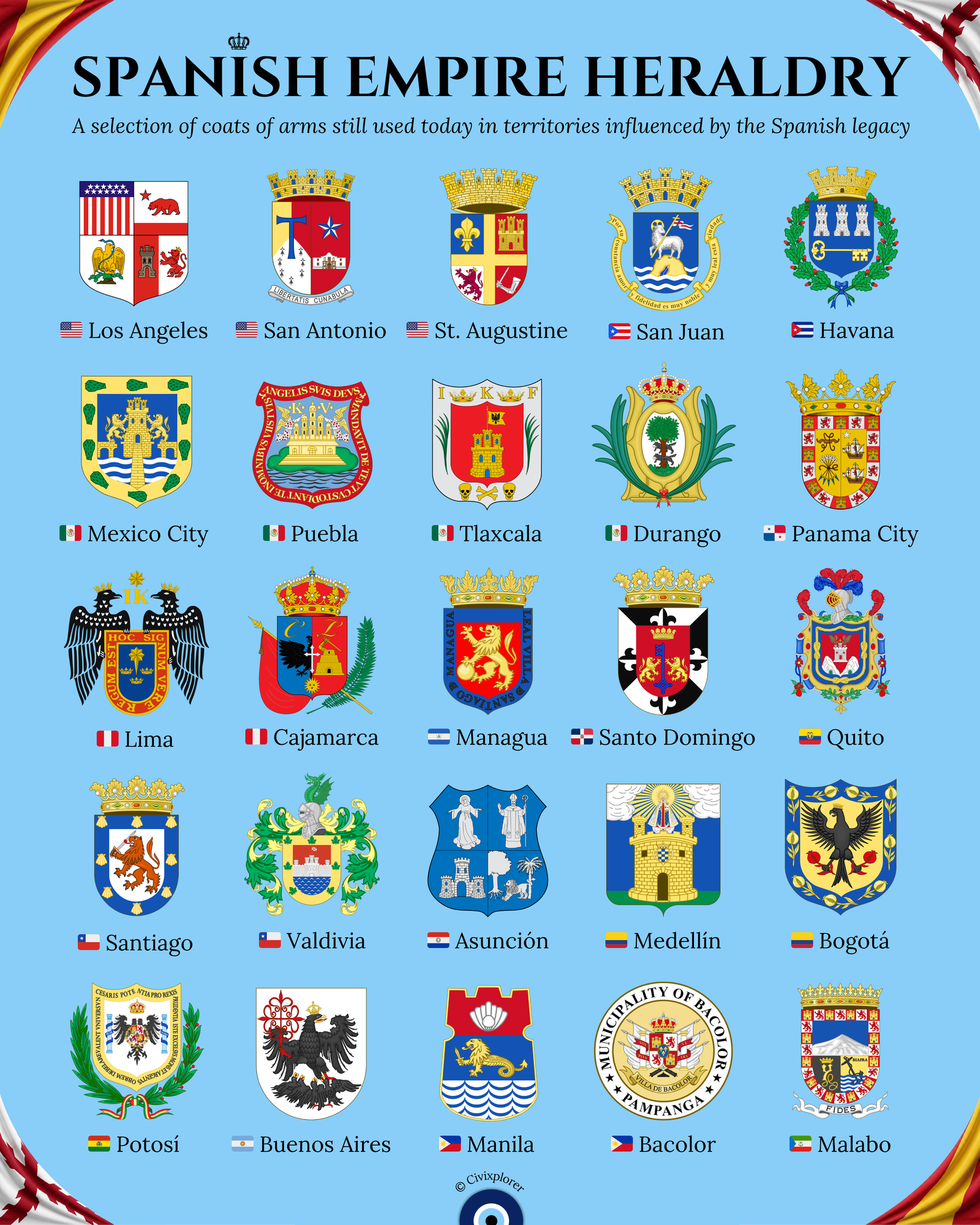
The heraldry of cities and subdivisions across the Americas, the Philippines, and Equatorial Guinea offers a fascinating visual record of early globalization. These symbols are not merely historical artifacts; they represent the deep institutional and cultural roots established during the era of the Spanish Empire, one of the largest and longest-lasting in world history. Far from being relics of the past, these coats of arms continue to shape the civic identity of modern, independent cities that were once part of a global "composite monarchy".
The Foundation of the Global Municipality
To understand these symbols, one must look at the Spanish imperial model, which was profoundly urban. Unlike other colonial models focused solely on resource extraction, the Spanish Crown incorporated overseas territories as viceroyalties and kingdoms. The foundation of a city was a legal act; a settlement did not officially exist until it received a royal charter and a Coat of Arms granted by the monarch. These shields represent the genesis of these cities as recognized civic entities, embodying legal status and royal favor. This system followed the Laws of the Indies, which regulated urban planning, from grid layouts to the central plazas that still define many of these global hubs.
Decoding the Heraldic Language
Spanish heraldry uses a specific visual vocabulary to communicate authority and history. The most ubiquitous elements are the golden castle and the purple lion, representing the kingdoms of Castile and León, the core of the Spanish Crown. These appear in the arms of cities as diverse as San Juan, St. Augustine, and Manila.
During the 16th century, the reign of the House of Habsburg introduced the black, often double-headed eagle. This imperial symbol—evoking the Holy Roman Empire—is prominently featured in the arms of Lima, Bogotá, and Buenos Aires. Furthermore, royal crowns surmounting these shields signify the direct patronage of the monarch, while religious motifs like crosses and lambs reflect the evangelizing mission that accompanied imperial expansion.
Global Case Studies: History in Stone and Color
Individual shields often tell specific geopolitical and social stories:
- Tlaxcala (Mexico): Granted in 1535, these arms were a reward for the indigenous alliance between the Tlaxcaltecs and the Spanish against the Aztec Empire. It is a rare example of heraldry requested by and granted to an indigenous polity, symbolizing their incorporation into the imperial framework.
- Havana (Cuba): Featuring three stone castles and a golden key, this shield reflects the city’s strategic role as the "Key to the New World" and the gathering point for the Spanish treasure fleets.
- Manila (Philippines): Granted by Philip II in 1596, this shield features a unique "Sea-Lion"—a creature half-lion and half-dolphin—symbolizing the extension of Spanish martial and royal authority across the oceans to the edge of Asia.
- Potosí (Bolivia): Its heraldry reflects the city’s historic wealth derived from silver mining, an economic engine that funded global trade for centuries.
A Living Cultural Legacy
Today, these coats of arms appear on city halls, flags, and official seals from Los Angeles to Santiago. They represent a "usable past," serving as a tangible link to the 16th-century foundations of modern Latin America and beyond. By preserving these symbols, modern cities choose to honor their layered histories, blending European heraldic structures with local, indigenous, and regional identities to produce a unique Hispanic cultural heritage.

Comments (0)
Join the Conversation
Login to share your thoughts with the community.
Login to Comment