
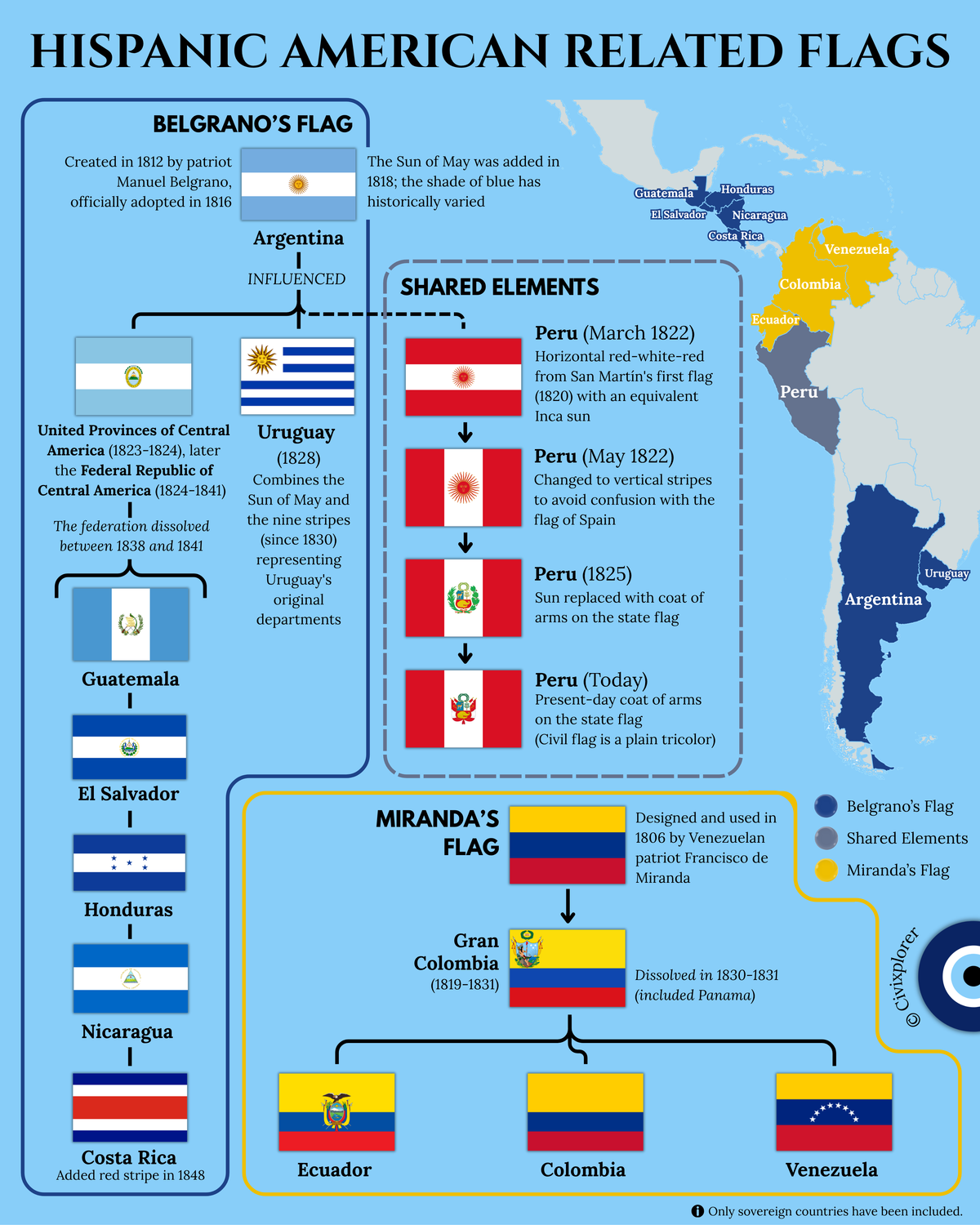
The national flags of Spanish-speaking America are far more than decorative emblems; they are visual records of revolutionary alliances and anti-colonial solidarity. Almost every modern banner across Central and South America traces its design back to two foundational lineages: the light-blue-and-white triband created by Argentine patriot Manuel Belgrano and the primary-colored tricolor designed by Venezuelan revolutionary Francisco de Miranda. Understanding these two origins reveals how regional wars of independence and short-lived political federations sculpted the visual map of Latin America.
Belgrano’s flag, created in 1812 and officially adopted by Argentina in 1816, introduced the iconic light-blue-and-white horizontal design, later embellished in 1818 with the golden Sun of May representing the May Revolution and the Inca deity Inti. This Argentine palette traveled north through maritime campaigns, notably when French-Argentine privateer Hippolyte Bouchard flew the colors along Central American coasts. Inspired by this symbol of anti-Spanish resistance, the United Provinces of Central America adopted the blue-white-blue layout in 1823. Following the federation's dissolution, Guatemala, El Salvador, Honduras, Nicaragua, and Costa Rica preserved these colors, with Costa Rica adding a central red stripe in 1848 inspired by the French Revolution. Meanwhile, Uruguay adapted Belgrano's colors and solar emblem, combining them with nine horizontal stripes to represent its original departments.
While some flags evolved through political alliances, others changed due to practical wartime necessities. In Peru, General José de San Martín introduced a diagonal red-and-white flag in 1820, legendarily inspired by flamingos over Pisco Bay. By March 1822, Peruvian authorities transitioned the design to horizontal red-white-red stripes anchored by an Inca sun. However, on chaotic battlefields, horizontal red-and-white stripes proved dangerously easy to confuse with the horizontal red-and-yellow ensign of Spain. To prevent friendly fire, Peru rotated its stripes vertically in May 1822 before replacing the central sun with the national coat of arms in 1825, establishing the vertical tricolor flown today.
The second major flag family stems from Miranda’s tricolor, first raised in 1806. Deeply influenced by European color theory and discussions with Johann Wolfgang von Goethe, Miranda assigned territorial meaning to his design: yellow for continental wealth, blue for the Atlantic Ocean barrier, and red for Spanish rule. This yellow-blue-red banner became the national standard of Gran Colombia from 1819 to 1831. Following the republic's collapse, Ecuador, Colombia, and Venezuela each inherited Miranda's palette, adapting the stripe proportions, coats of arms, and star arrangements while retaining the primary colors that celebrate their shared revolutionary heritage.

Comments (0)
Join the Conversation
Login to share your thoughts with the community.
Login to Comment