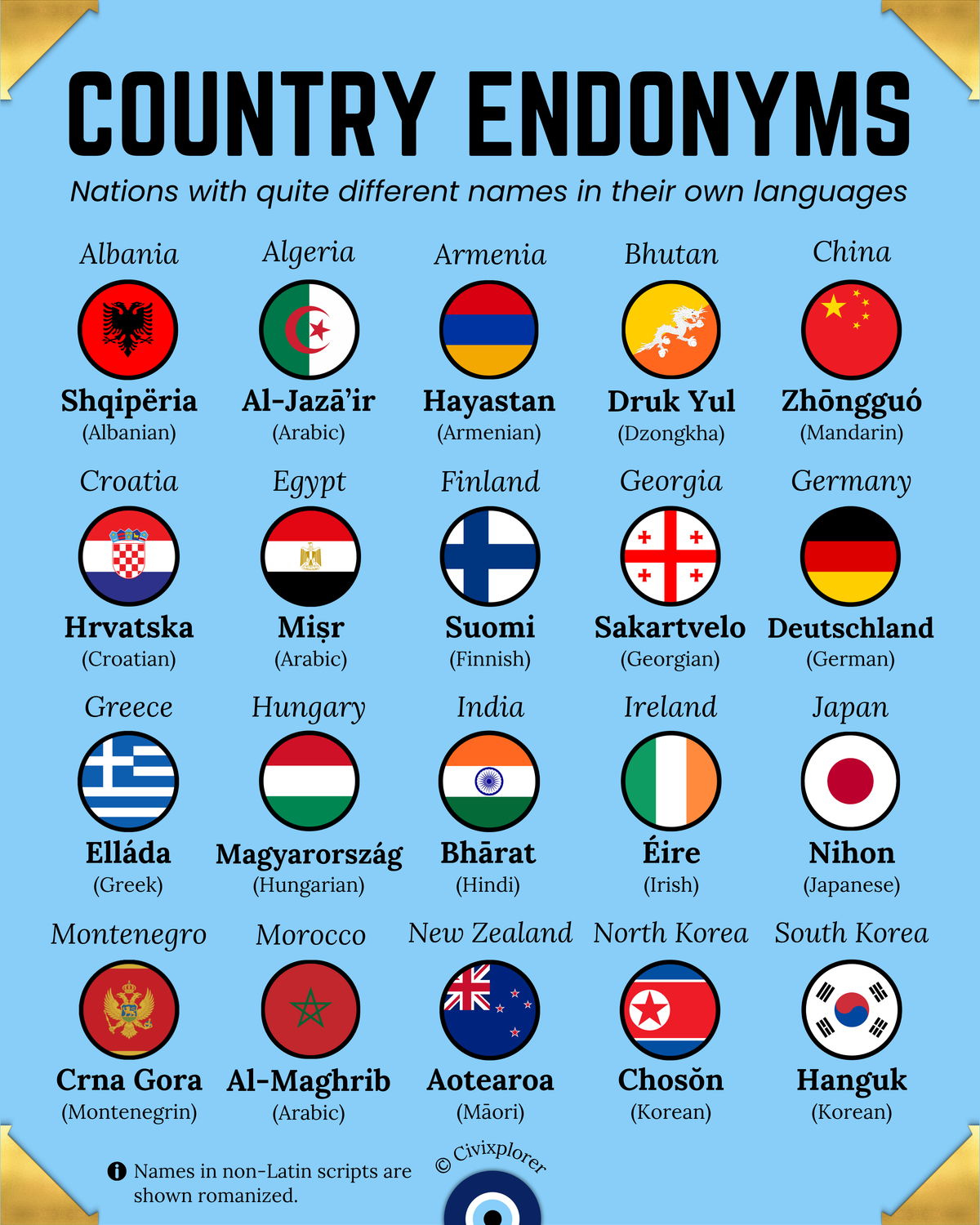
The global map is far more linguistically layered than most travelers realize. While we navigate the world using exonyms—names given to places by outsiders—the people living within those borders often use endonyms, names that carry deep-seated historical, mythological, and cultural significance. These native names are not merely translations; they are historical documents that reveal ancient migrations, imperial influences, and how civilizations perceive their place in the world.
The Geopolitics of Naming: The Two Koreas
One of the most profound examples of endonym divergence is found on the Korean Peninsula. While the world uses the name "Korea"—derived from the medieval Goryeo dynasty—the two nations identify themselves through completely different historical lenses. North Korea uses Chosŏn, a name that evokes the ancient Gojoseon civilization and the long-reigning Joseon Dynasty, signaling a connection to traditional heritage. In contrast, South Korea identifies as Hanguk, referring to the "country of the Han people" and the ancient Samhan confederacies. This linguistic split instantly signals different political allegiances and historical framings.
Poetic Metaphors and Spiritual Identities
Some endonyms preserve beautiful, descriptive narratives that are often lost in international nomenclature. Bhutan is known to its inhabitants as Druk Yul, or the "Land of the Thunder Dragon." This identity is deeply rooted in the Drukpa lineage of Tibetan Buddhism and is so central to their national soul that the dragon is featured prominently on their national flag. Similarly, the Māori endonym for New Zealand is Aotearoa, most commonly translated as the "Land of the Long White Cloud." While the exonym honors a Dutch province, the endonym preserves the indigenous Polynesian voyaging tradition and the first sight of the islands from the sea.
Ancient Outsiders and Historical Misnomers
Many of the names we use today are actually "linguistic fossils" left behind by ancient neighbors. Germany is perhaps the most famous example. While Germans call their land Deutschland ("land of the people"), its exonyms vary wildly based on who encountered them first. The English "Germany" comes from the Latin Germania, while the French Allemagne comes from the Alemanni tribe. Most strikingly, several Slavic languages use forms of Niemcy, which literally means "the mutes"—referring to people who could not speak a Slavic tongue.
Greece faces a similar divide. Internally, the country is Elláda, and its people are Hellenes, names tied to ancient mythology. However, the international word "Greece" stems from the Latin Graecia, a name the Romans applied to the entire region after encountering a specific tribe called the Graikoi in southern Italy.
Geography as an Endonym
In some cultures, a country’s name is a literal description of its location or terrain. Morocco is known in Arabic as Al-Maghrib, which means "The West" or "The Place of the Sunset," marking the westernmost frontier of the historical Islamic world. Conversely, China identifies as Zhōngguó, the "Middle Kingdom," reflecting a millennia-old worldview that positioned Chinese civilization as the central state of the cultural world.
Rarely, an exonym and endonym will align perfectly in meaning. Montenegro is a Venetian Italian translation of the South Slavic Crna Gora, both of which mean "Black Mountain." This shared name describes the dark, forested appearance of Mount Lovćen as seen by maritime traders from the Adriatic coast.
Understanding these names allows us to see the world not just as a collection of borders, but as a rich tapestry of stories. Whether rooted in the name of a legendary king like India’s Bhārat or a mythological goddess like Ireland’s Éire, endonyms remind us that every nation has a story it tells about itself.
Comments (0)
Join the Conversation
Login to share your thoughts with the community.
Login to Comment